

The much-loved Easy Tiger by the Mach brothers is now part of The Stirling Smith’s permentant collection!
Director, Caroline Mathers said: ‘We are delighted to give Easy Tiger a permanent home at The Smith. We would like to thank the National Fund for Acquisitions as well as David and Robert Mach for their generosity, which has allowed us to add this incredible piece to our collection. We’re sure he will will bring joy to generations of visitors to come.’
Keep an eye out for a grrr-eat event coming soon
The National Fund for Acquisitions, administered with Scottish Government funding by National Museums Scotland, contributes towards the acquisition of objects for the collections of museums, galleries, libraries and archives throughout Scotland. Find out more about the work of the National Fund for Acquisitions on the National Museums Scotland website: www.nms.ac.uk/nfa
The Stirling Smith is pleased to host a series of events celebrating the diverse voices of Stirling.
For many years visitors have been enjoying our museum display, ‘The Stirling Story’, which provides visitors with a history of Stirling from prehistory to the twentieth century through The Smith’s collection. Visitors can continue that journey for further discovery through this new and exciting programme of events as part of the celebrations for Scotland’s Year of Stories 2022. #StirlingStories extends these tales from outside the museum and into the community through some of the many voices that make up Scotland’s multifaceted heritage.
The Smith is collaborating with other community partners such as Stirling Central Library, The Tolbooth, and Forth Valley Sensory Centre to host storytellers throughout the year. These event times, locations, and prices, if applicable, will be listed on the Year of Stories Website as well as our website. In addition to these events, the museum will be holding an exhibition in September celebrating the interlinked heritage of Scotland and New Zealand by artist Mitch Manuel entitled, Woven Identities: Tartan meets Koru.
Marie Christie, Head of Development at VisitScotland said: We are delighted to be supporting #StirlingStories through the Year of Stories 2022 Community Stories Fund. Events play an important role in our communities as they sustain livelihoods and help to celebrate and promote our unique places, spaces and stories. Themed Years are all about collaboration and Museums Galleries Scotland, National Lottery Heritage Fund and VisitScotland are pleased to work in partnership to create this fund to showcase community stories. By supporting events taking place within our communities, including #StirlingStories, new opportunities with be provided for locals and visitors to come together and find out more about the diverse stories, past and present, that our communities have to share.’
This event has been supported by the Year of Stories 2022 Community Stories Fund. This fund is being delivered in partnership between VisitScotland and Museums Galleries Scotland with support from National Lottery Heritage Fund thanks to National Lottery players.


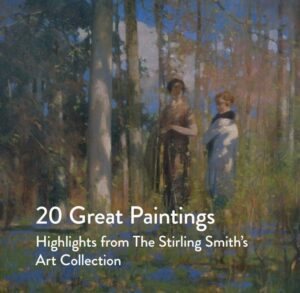
The Smith has been shortlisted for the Museums Association Museums Change Lives Awards in the category of ‘Best Small Museum Project’.
During the lockdowns of 2020 when The Smith had to close our doors, we increased our presence on social media and other online platforms. However, we were aware that many members from our local community who did not grow up with the internet, would not be able to see the content that we put out on our digital platforms. So, we created 20 Great Paintings: Highlights from The Stirling Smith’s Collection, a small book showcasing some of our favourite works of art. It was designed with accessibility in mind: with large text and images and easy-to-turn pages. After receiving generous funding from Museums Galleries Scotland to publish the books, we worked with local organisations to deliver them locally. Some of these organisations included Town Break Stirling, local care homes, Forth Valley Welcome, Strathcarron Hospice, and ‘Bags of Hope’ organisations that support isolated members of the community who live by themselves. We felt that this was a great way to bring The Smith to people who may have been missing it the most.
The Museums Change Lives Awards celebrate the achievements of museums that are making a difference to the lives of their audiences and communities across the UK. We are absolutely over the moon that our 20 Great Paintings project has been considered for this award.
This year’s awards will take place in Liverpool on Monday 8th November as part of the Museums Association’s annual conference. Wish us luck!
Hidden HerStories at The Smith by Samantha Musser
It has been a pleasure to serve as the Hidden HerStories project intern this spring at The Stirling Smith Art Gallery & Museum as a complement to my postgraduate studies in art history at The University of Edinburgh. During this time, I have seen first-hand how the Smith thoughtfully tells the stories of influential people and events that have helped to shape the character of Stirling. Even still, museums operate within a broader art historical context that for centuries has not afforded the stories of women—artists and subjects alike—the same attention or acclaim garnered by their male counterparts. To push back against this tendency, this project endeavours to mine for Hidden HerStories in the Smith’s Victorian portrait collection. Unsurprisingly, tales of resilience, accomplishment, and legacy surrounding the women whose portraits hang in the galleries have been unearthed along the way. By shining light upon these previously Hidden HerStories, the lives of Harriet Dutens, Agnes Smith Greig, and Georgina Smith are hidden no longer! Read on to see these women come to life off the canvas.
Harriet Dutens
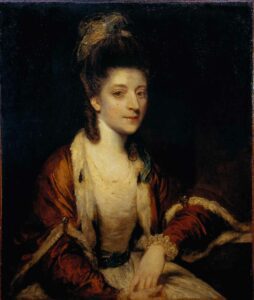 In 1772, Scottish officer of the British Army, Sir James Campbell (born James Callander) spotted Harriet Dutens at the opera in London. Just ten days later, they were wed by special licence. The pair were married for less than a year before Harriet succumbed to an illness that came on after the birth of their daughter, Elizabeth in 1773. Harriet and James made one trip to the Stirling area to visit his family before her untimely death. In his memoirs, Campbell remembers his late wife’s skills and intellect fondly: ‘she had not merely practiced music as an art but had studied it as a science, and to her, I am indebted for any little knowledge of astronomy which I afterwards possessed.’
With roots in France, Harriet’s family settled in London where they enjoyed considerable wealth while her father served as jeweller to the court of the Prince of Wales. Although the Dutens family did not initially approve of her marriage to Campbell, Harriet’s brother wound up marrying James’s sister, further solidifying the tie between families. The zany tale goes on: Campbell married twice more after Harriet’s death, was sued by his creditors to pay off his debts with Harriet’s inheritance, and changed his last name in efforts to stake claim to his relative’s fortune.
Although Harriet did not live long after sitting for her portrait in Joshua Reynolds’ studio, her legacy was carried on by her daughter, Elizabeth who began a family of her own with husband, Richard Magenis, a politician who sat in the Irish House of Commons and British House of Commons for Enniskillen.
Agnes Smith Greig
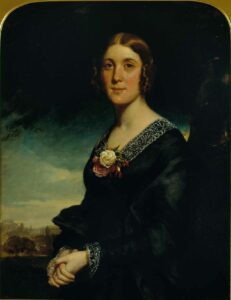 This portrait of Agnes Smith Greig (1812-1891) by Daniel Macnee dates to 1840 and shows her before a backdrop of Stirling Castle and St. Ninians where she married advocate and sheriff, Alexander Stuart Logan the very same year. The painting was bequeathed to the Smith by her daughter, Agnes Maciver Logan in 1928. Speaking of HerStories…Agnes Maciver Logan had her own stories to tell! She penned two works under the pseudonym, Katherine Steuart, By Allan Water: The True Story of an Old House and Richard Kennoway and His Friends, the former chronicling the lives of Stirling-area families.
Agnes Maciver Logan was one of seven children born to Agnes Smith Greig and her husband. In the process of ‘mining’ the Smith’s collection, we re-discovered images of her entire family that had previously been unlinked in the museum database. To be sure, Agnes’ family was no stranger to portraiture in all its forms. In 1843, just four years after the invention of photography, Agnes Smith Greig and her husband were captured via the burgeoning calotype process by prominent Edinburgh artist duo, David Octavius Hill & Robert Adamson.
Georgina Smith
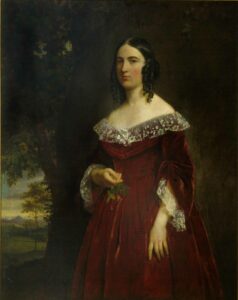 Georgina Smith (1821-1846) married Walter Paterson, a merchant of the East India Company on 8 November 1842 in Barony Parish, Glasgow. Unfortunately, Georgina passed away just a few years later in 1846, the same year that her portrait below by John Graham-Gilbert was completed. Smith was survived by generations of strong and talented women. Smith’s daughter, Grace Chalmers Paterson was the co-founder and principal of the Glasgow School of Cookery, as well as an activist in the temperance and women’s suffrage movements. Grace Chalmers Paterson’s niece, Grace Tasker led a similarly remarkable life in Stirling. Tasker earned an MBE for her tireless efforts on the home front during World War I and it was Tasker who donated Georgina’s portrait to the Smith in 1935!
Samantha has also made a curation related to her fantastic research which you can check out on ArtUK.
Thomas Stuart Smith’s Victorian Black Portraiture by Laura Baliman
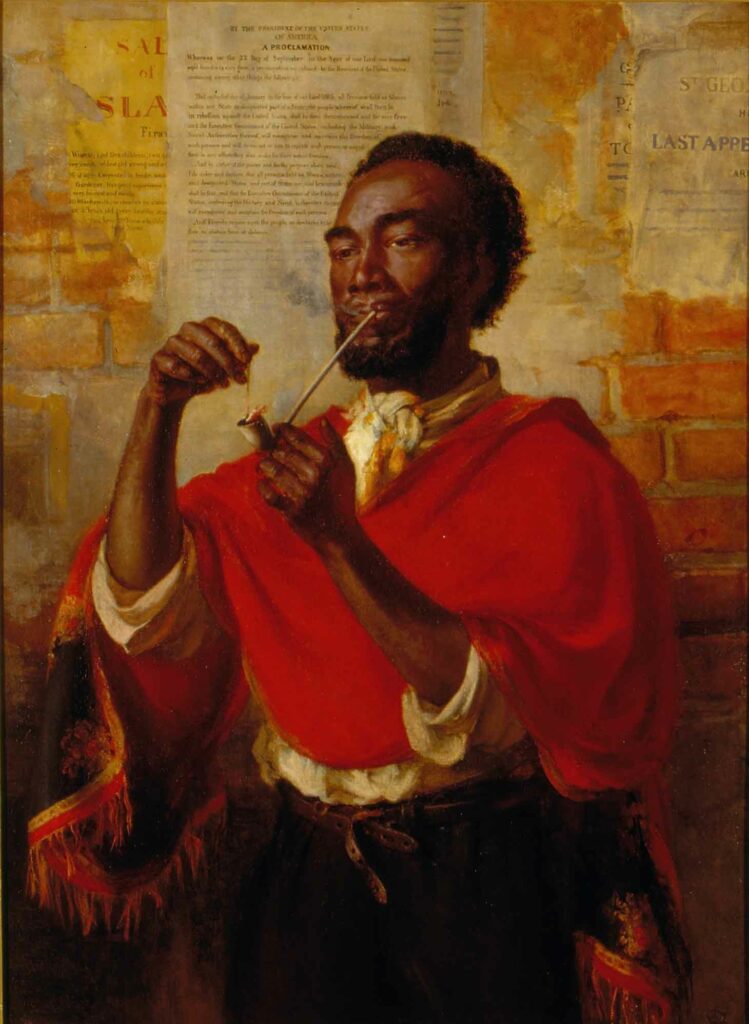
I recently undertook this internship with the Stirling Smith as a Masters student at the University of Edinburgh in Modern and Contemporary Art: History, Criticism and Curating. I focused on Thomas Stuart Smith’s three portraits of black men painted in 1869, and I sought to recognise their position within the canon of black Victorian portraiture, and within the recent upheaval of racial justice issues in the UK and Scotland.
 It is not immediately evident that Thomas Stuart Smith had any direct links to slavery, his artistic exploits being funded in the most part by his banker uncle Alexander Smith. However, his father’s (Thomas Smith) history is somewhat murkier: he worked as a secretary and accountant of the Canada Company, and was thus deeply involved in the colonisation of Canada. Furthermore, we know he was a merchant in Cuba, where slavery boomed in the years of his presence, in line with huge sugarcane exports. Although Smith the younger lost the letters from his father that could detail his exact involvement, it is important to be aware of these possible ties. It is also important to note, as Jan Marsh outlines in her exhibition catalogue Black Victorians (2005), that the expanding art world and market that Smith was greatly involved in owed a lot to British prosperity at the time, which benefitted largely from the trans-atlantic slave trade, despite slavery’s abolition in Britain in 1833.
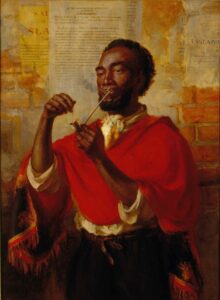
The most vital painting of this collection is The Pipe of Freedom, which was rejected by the Royal Academy for the summer exhibition in 1869 and instead hung in a Select Supplementary Exhibition in Old Bond Street. Smith claims that this rejection was based on political grounds, and although there is no evidence for this, there were indeed a growing number of alternate gallery spaces at this time. In this portrait, the model sits before the Emancipation Proclamation, lighting a pipe. There is a possible significance in this act of lighting, as other pipes in the RA collection are already lit. As a symbol of ignition, the lighting of the pipe depicts the burning of tobacco — a huge product of slavery in the U.S. In terms of the model, it is unlikely that Smith visited the U.S. or Africa, and he also noted in a letter (first transcribed in 1881) that he altered the complexion of the sitter to look partially Native American. This lack of specificity (intentionally or unintentionally) speaks to the loss of cultural history and familial connections of enslaved peoples who were torn from their lands and belongings. Smith also notes in the letter that the scarf over the shoulders of the man belongs to his wife, which brings the enslaved women of the time into light. The lack of black women in Victorian portraits as a whole echoes this hidden history. The textuality of the inclusion of the proclamation represents the greater narrative of civil rights, not only of the American Civil War, but even further into present issues of racial justice. The inclusion of narrative implicates the contemporary viewer into the Victorian painting: where do we stand in this narrative?
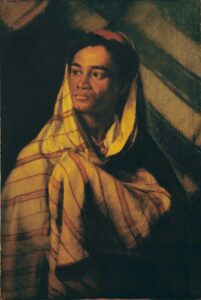
In the second painting, A Cuban Cigarette, the model seems to be sitting in a post-emancipation setting, as his pipe is already lit and his clothes are of a higher class — celebrating freedom. The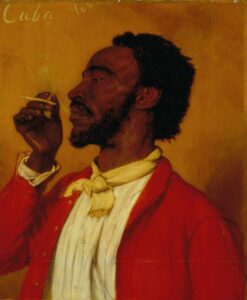 third painting, A Fellah of Kinneh, presents an ordinary man from North Africa — probably Egypt, as Jan Marsh notes that ‘Kinneh’ probably denotes the town of Qena. This work was hung in the 1869 RA Summer Exhibition, however, Smith voiced another grievance here, suggesting that the painting was hung ‘out of sight’. We have no evidence of its positioning — although Jessica Feather has noted that the 1869 Exhibition occupied a purpose-built space for the first time, with new hanging arrangements ‘intended to improve visibility’.
Although Victorian portraiture is seen often as a white discipline, Smith’s paintings are not alone and sit within a canon of black representation. Unfortunately, black figures were most often marginal and presented as servants, or at the very least as subjects of a ‘superior’ British culture. Black models were also not always available, and so dark tones were sometimes fabricated. When abolition arose as a theme in portraiture and in other paintings, white self-congratulation was a common theme, in which the white Briton was presented as a saviour, and the black subject presented as an exotic Other. Even when the black subject was given agency, as in The Pipe of Freedom, Otherness is still clear in the colonial gaze of the white viewpoint. Furthermore, progress was not linear, as the scramble for Africa in the 1880s ignited a greater level of racial intolerance in society and racist depictions in art. The Emancipation Proclamation too was not the universally emancipatory moment that we like to imagine, as the hardships of African Americans continued over the century and into our own. We must imagine Victorian racial paradigms complexly, and thoroughly appreciate but not deify positive moments.
Narrowing down to the locus of Stirling, abolition was a hugely debated and understood issue. Archives show a great number of lectures and discussions of the American situation, mostly in local churches such as the Free North Church and Erskine U.P. Church, and the School of Arts. Guest lecturers, including ex-enslaved people such as William Craft, interacted with locals in nuanced discussion. For example, an 1866 report on the United States by Stirling M.P. Laurence Oliphant notes that abolition will not solve all the problems facing African Americans, who will ‘not be allowed to buy or rent land’ and who are now ‘between the upper and the nether millstone’. Furthermore, in a lecture in the Union Hall in September 1864 by Rev. Anderson of New York, an understanding is shown of Britain’s role in American slavery: ‘by our immense and constantly increasing demand for slave-grown cotton we had been practically the parties on whom American slavery depended on for its very existence.’ It is likely that Smith was aware of these discussions, as he often attended lectures in his local area.
 As a contemporary audience to Smith’s black portraiture, we are not exempt from the progress of anti-racism and civil rights. The work and effects of the 2020 Black Lives Matter Movement are not unprecedented, as work for equality has occurred since the dawn of exploitation. Scotland too should and has taken part in recent movements, in 2020 protests but also artistic projects such as Wezi Mhura’s Scottish Black Lives Matter Mural Trail. The recently inaugurated Afro Caribbean Society of Scotland (and other more local societies) are a great resource for companies and institutions who desire to work towards ‘the elimination of inequality and discrimination’ through ‘consultation, workshops, events and anti-racist training.’ The history of slavery and colonialism still have huge ramifications in our society today, and so it is essential that we view our works through an anti-racist lens: championing black self-representation in art today whilst also examining black representations in the art of the past.
Laura has also made a curation related to her fantastic research which you can check out on ArtUK.

Further Meanderings of the Mind from Poet, Anne B Murray
In our last exhibition, Meanders, we asked people to share their memories of the lockdown with us. Local poet, Anne B Murray sent in her reminisces of the first lockdown, and now has reflected on the latest lockdown.
At Lockdown 2 [November 23rd – December 13th 2020], I started to wilt a bit. The days were becoming shorter, colder; it rained a lot. I went out walking most days but for much shorter spells of time.
Lockdown 3 [26th December 2020 to date], my spirits sink. All aspects of life seem bleak. All pastimes – jigsaws, crochet, crosswords, reading, even writing, seem utterly pointless and just as boring as doing nothing. The weather doesn’t lend itself to long walks. And anyway, I’ve lost my sense of adventure; I don’t care to try any new route. A round of Beechwood Park, stopping to say hello to Roman Maximus, the sculpted wooden bench-end; perhaps a short stretch of Kings Park or the trail along the St Ninian’s Road into town for shopping. On that last option, I stare in amazement at people buying takeaway coffees. To drink walking along the street on a cold, miserable day?
However, they were giving the local traders custom, so I joined the queue one day. First stop Cisco’s – great coffee and delicious choice of traybakes. I’m wrapped up well, have my sit-mat, and go to the Black Boy Fountain. I imagine I’m in the lounge of the Ritz Hotel in the 1930s, in Art Deco surroundings, being served by dapper waiters. Everyone else, myself included, wearing the fabulously stylish clothes, hats, shoes and jewellery of the time. Have I been watching too much Poirot on TV?
Another jaunt is a coffee and date slice from the Groundhouse at the top of King Street. From there I walk along Victoria Wood Avenue behind the Albert Hall to sit in Ailie’s Garden at the Stirling Smith Art Gallery. There I’m transported to somewhere in Africa – as a lowly assistant on a David Attenborough trip – the main event spotting (from the safety of my carved wooden bench Landrover), a crocodile rising from the mosaic pond, opening its jaws, baring its pointed teeth before settling back down again. My stillness – one has to be really still in the presence of crocodiles – encouraging the real robins, tits, goldfinch, sparrows and wagtails to come and feed close by. One can never get enough of Life on Earth.
Or am I going crazy? February 2021
How is everyone doing? Are you feeling similar to Anne? The Smith Team is busy behind the scenes but very much looking forward to the day we can open our doors again. We’re grateful that the weather has slightly improved and hope that means we’ll have more visitors to our garden again!
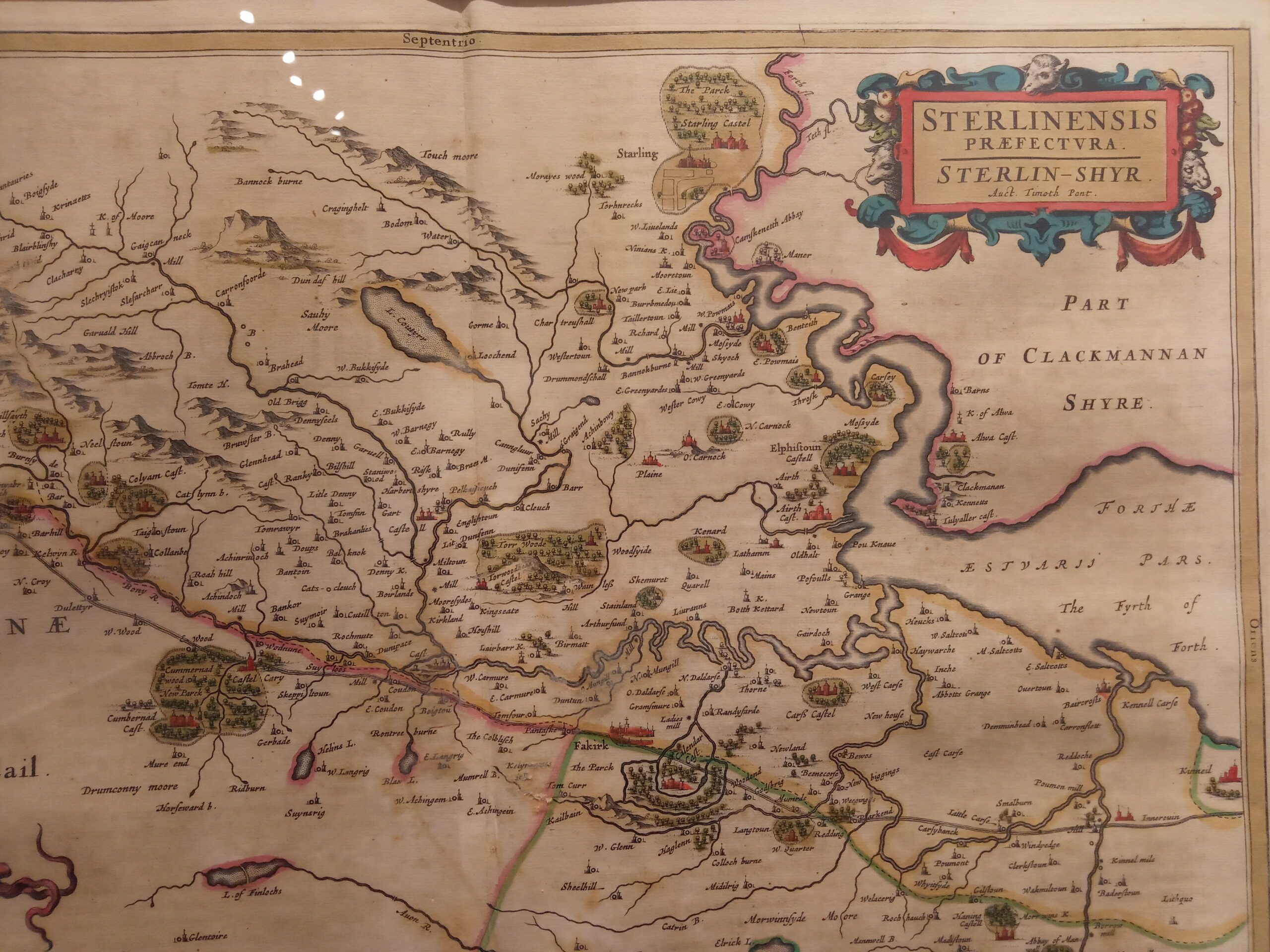 In our latest exhibition Meanderings: A Walk Through The Smith’s Collection, we asked visitors to reflect on their walks and explorations during lockdown whilst they stroll through a selection of our art collection. The artwork on display depicts nature in various forms, seasons and locations. At the end of the exhibition we have asked visitors to share their memories of the lockdown, any new discoveries, and walks they have taken in a book intended for the museum’s collection.
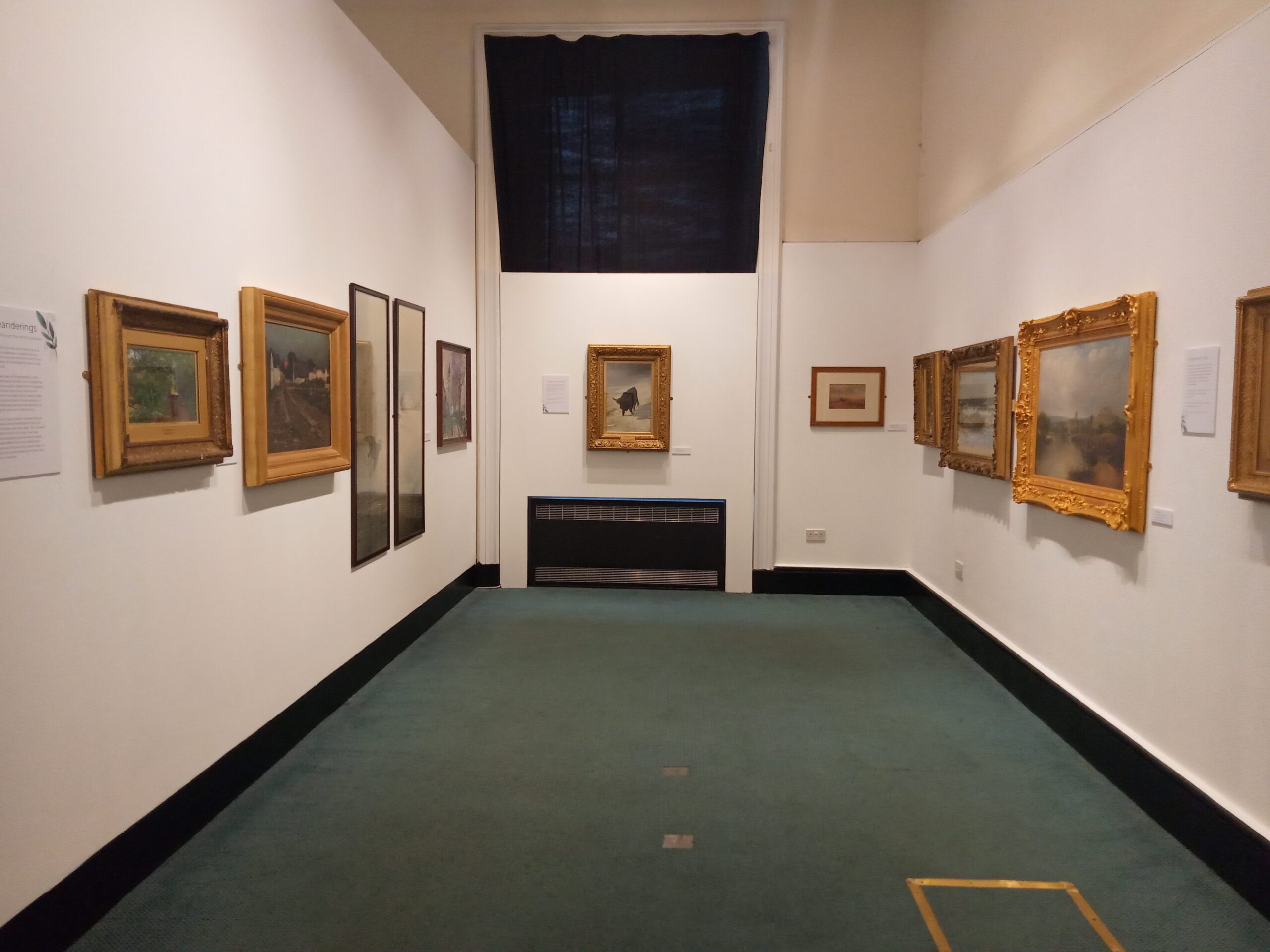
Sadly, the current lockdown restrictions mean only a few visitors were able to see the exhibition in person (however you can still experience the virtual version on ArtUK, available here). One visitor who did make it was local poet, Anne B Murray. Anne was kind enough to share her meanders with us:
Lockdown Meanderings
During the first lockdown commencing in March 2020, when we were restricted to one outing per day, and there was no public transport, like many people I went meandering very local to my home. I must have walked every pavement, lane, path and track within a five-mile radius of my front gate. And found so many places I’d never known existed.
My best discoveries were made in the woodlands around the Coxethill area, Gillies Hill Woods, and Cambusbarron. Cambusbarron village offered a small welcoming church garden to sit and rest in, and there’s a delightful walk by a stream which takes in the site of an old well and church where Robert the Bruce is reputed to have prayed before the Battle of Bannockburn. A more recent historical find was the burial site of a Murray family (no relation as far as I yet know) hidden in Gillies Hill Woods. It is marked by a magnificent Celtic Cross. Sadly, it also serves as a memorial to a very young man, A.J. Murray, killed and subsequently buried in France in 1914. I am currently researching the history of the site.
The Coxethill woodland is a small area at the top of St Ninians, where I made some more disturbing finds – old furniture and other unwanted items just dumped there. However, I decided to make amends for this human insult to Nature by reclaiming and upcycling a few finds. The rusty base of an old garden table – cleaned off and black-varnished – is now transformed into a rather classy jardinière. A slightly mangled, wheel-less wheelbarrow, after the same treatment, is now filled with flowering plants and has pride of place in my front garden.
I love the current exhibition Meanderings at the Smith. It is such a good idea to display some of the many paintings from the collection normally kept in storage. It is also such an appropriate theme – we should all try to remember something good from our lockdown experience. I’m sure many people have stories to tell of their local wanderings at that time. I would encourage others to share their stories.
Anne B. Murray, December 2020
Thank you very much for sharing your experience, Anne!
Do you have any lockdown memories?

Meanderings: A Walk Through The Smith’s Collection on ArtUK
 The Guardian‘s Great British Art Tour began today. This new series, created in partnership with ArtUK, will showcase some of the great works of art housed in collections across Britain. The series is a great way to do a little art exploration from the safety of our homes.
The work of art that launched this new series is none other than The Smith’s very own The Pipe of Freedom by Thomas Stuart Smith. As many of our visitors know, this painting commemorates the end of the American Civil War. It depicts a black man lighting a tobacco pipe in front of wall onto which the Emancipation Proclamation has been pasted. More history on the painting can be found in the Guardian article written by our Collections Manager, Nicola Wilson.
Check out the article here and join in the conversation!
The Poetry Roundabout
December 2020 on The Smith’s website
and now on Zoom!
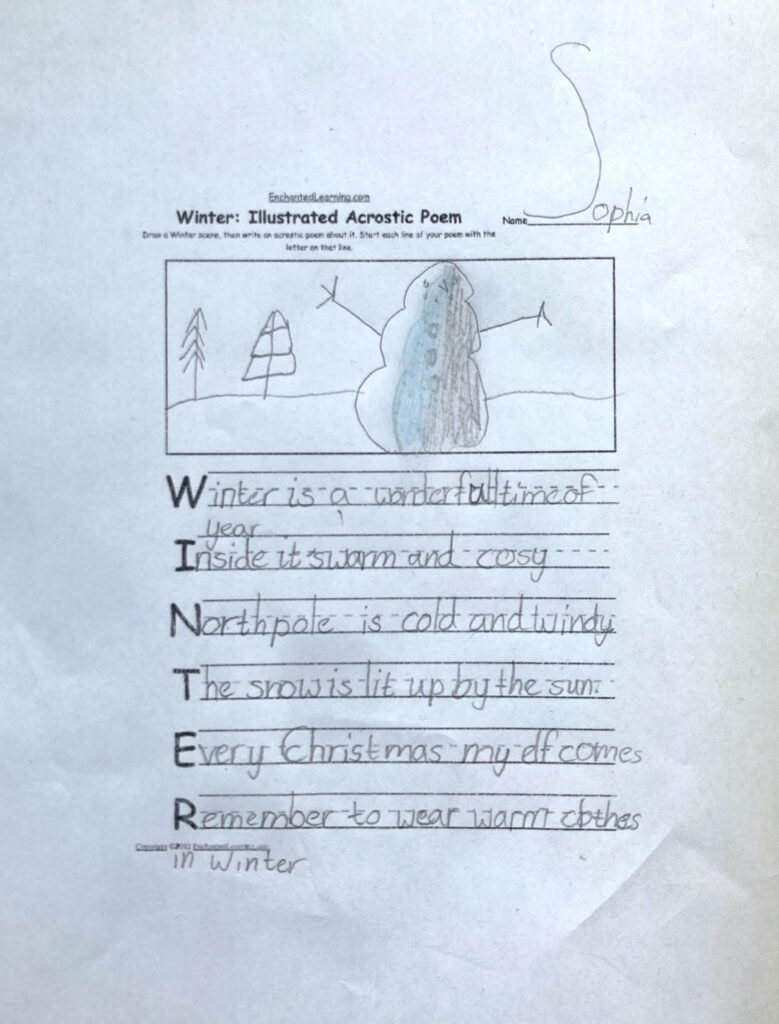
Winter is a wonderful time of year
Inside it is warm and cosy
North Pole is cold and windy
The snow is lit up by the sun
Every Christmas my elf comes
Remember to wear warm clothes in winter
Sophie McMahon, aged 8
The Zoom meeting is also planned for Friday, Jan 15th 2021 at 7.30 p.m.
How to join in? Email johnjcoutts@gmail.com.
Any queries? Email or phone 01786 470930.
Wishing everyone
Nollaig chridheil agus bliadhna mhath ùr –
a dh ’aindeoin an galar sgaoilte
[A merry Christmas and a Happy New Year –
in spite of the pandemic.]
An interesting mixed collection this time – both in themes and format.
Many thanks to everyone who has contributed.
We began – and will end – with acrostics on ‘Winter’
John Coutts Poet in Residence
Mary Gallagher sends us a topical haiku
COVID keeps us apart
I value your company
So I stay at home
And here’s a new poem by Bill Adair
Three Wise Working Men
Three wise working men came up from the glen,
Led by a shining star.
They all knew the value of hard, honest toil,
From the sunless mine to the sun-blessed soil,
Their gifts were coal and bread and oil,
And they followed a shining star.
A miner, a baker, a farmer came,
Led by a shining star,
In their working clothes to a stable door,
Wordlessly, humbly to adore,
Where they offered gifts from their harvest store,
And they followed a shining star.
First was a miner, he brought them coal,
Led by a shining star.
At times, he said, I have dug for gold,
It’s lovely to look at, exciting to hold,
But it won’t keep you warm when the night is cold,
And he followed a shining star.
Next was a baker, bringing them bread,
Led by a shining star.
He still had the smell of fresh loaves in his hair,
I bring you my work; I bring it to share,
And he bowed at the infant lying there,
And he followed a shining star.
Last was a farmer with oil and grain,
Led by a shining star.
He brought them meal, he brought them corn,
And from a cruse of an old ram’s horn
With oil he blessed the newly born,
And he followed a shining star.
Three wise working men came up from the glen,
Led by a shining star.
And they knelt by the child asleep on the hay,
Who held the universe in his sway,
Then they doffed their caps and said good day,
And they followed a shining star.
Jacqui MacCallum writes: My poem is very short and is called ‘Irony’. I wrote it one day when I was faced with a mountain of ironing and kept putting off doing it, so it just grew. Once I got started time passed quickly and I was able to smooth out a few worries in the process of ironing clothes. I felt so much better when the ironing basket was empty.
Think it’s probably metaphorical about putting off things, and that the thought of the thing is worse than the actual doing. As well as feeling better once they’re done.
Irony
Isn’t it ironic
that
Ironing smoothes
the creases
of
My mind?
Margaret Hay writes from New Zealand: How heartening to hear that the December Roundabout is surging ahead in these hard times for you Northerners, with Santa’s ‘Defy the defeaters’ resounding across the planet. Traherne’s poem is lovely. It is, as usual, ‘summer in December’ in these parts, which reminds me of Peter Cape’s poem Back Blocks Nativity.
Back Blocks Nativity by Peter Cape
They were set for home but the horse went lame
and the rain came pelting down out of the sky.
Joe saw the hut and he went to look,
and he said “She’s old, but she’ll keep you dry.
”So her boy was born in a roadman’s shack,
by the light of a lamp that would hardly burn.
She wrapped him up in her hubby’s coat,
and laid him down on a bed of fern.
Then they came riding out of the night,
and this is the thing that she’ll always swear,
as they took off their hats and came into the light,
they knew they were going to find her there.
She sat at the edge of the fernstalk bed,
and she watched, but she didn’t understand,
while they put those bundles by the baby’s head,
that river nugget into his hand.
Then she watched as they went through the open door,
weary as men who have ridden too far.
And the rain eased off and the low cloud broke,
and through the gap shone a single star .
John Coutts writes: The manuscript poems of Thomas Traherne (1636? -74) were rediscovered on a London bookstall in 1896, and handed on to Alexander Grosart (1827-1899). Grosart thought they were by the Welsh poet Henry Vaughan, and was about to publish them under that name when he died. His library was then bought by Bertram Dobell (1842-1914) who identified the real author and published his poetry in 1906. I have the good fortune to possess a copy of that first edition. Dobell writes – in a verse dedication –
‘…By happy chance there came within my ken
A hapless poet, whom – I thank kind fate – –
It was my privilege to help instate
In that proud eminence wherein he shines
Now that no more on earth he sadly pines….’
Innocence (Traherne recalls his happy childhood in Hereford)
But that which most I wonder at, which most
I did esteem my bliss, which most I boast,
And ever shall enjoy, is that within
I felt no stain, nor spot of sin.
No darkness then did overshade,
But all within was pure and bright,
No guilt did crush, nor fear invade
But all my soul was full of light.
A joyful sense and purity
Is all I can remember;
The very night to me was bright,
’Twas summer in December….
…..No inward inclination did I feel
To avarice or pride: my soul did kneel
In admiration all the day. No lust, nor strife,
Polluted then my infant life.
No fraud nor anger in me mov’d,
No malice, jealousy, or spite;
All that I saw I truly lov’d.
Contentment only and delight
Were in my soul. O Heav’n! what bliss
Did I enjoy and feel!
What powerful delight did this
Inspire! for this I daily kneel.
Whether it be that nature is so pure,
And custom only vicious; or that sure
God did by miracle the guilt remove,
And make my soul to feel his love
So early: or that ’twas one day,
Wherein this happiness I found;
Whose strength and brightness so do ray,
That still it seems me to surround;
What ere it is, it is a light
So endless unto me
That I a world of true delight
Did then and to this day do see.
That prospect was the gate of Heav’n, that day
The ancient light of Eden did convey
Into my soul: I was an Adam there
A little Adam in a sphere
Of joys! O there my ravish’d sense
Was entertain’d in Paradise,
And had a sight of innocence
Which was beyond all bound and price.
An antepast of Heaven sure!
I on the earth did reign;
Within, without me, all was pure;
I must become a child again.
‘Antepaste’ – a foretaste
Jock Stein writes: Advent is a season where we are called to stay on watch. The coming of Christ, whether as a baby or as the end of all things, takes the world by surprise. Seamus Heaney, it seems to me, is hinting at this in his poem about a sudden gust of wind.
Had I not been awake
Had I not been awake I would have missed it
A wind that rose and whirled until the roof
Pattered with quick leaves off the sycamore
And got me up, the whole of me a-patter,
Alive and ticking like an electric fence:
Had I not been awake, I would have missed it,
It came and went so unexpectedly
And almost it seemed dangerously,
Returning like an animal to the house,
A courier blast that there and then
Lapsed ordinary. But not ever
After. And not now.
Bill Adair has also written
On Christmas Eve
Everything is suspended in the perfect stillness
Of the brand new Christmas Eve morning.
Unlit trees pose behind frosty windows,
Blue spruce and Douglas fir.
Ornaments, thread fixed, lights still dull
And waiting to sparkle,
Hang on the tinselled branches.
And the day begins.
By the window at the kitchen sink,
Ready prepared, giblets removed,
The turkey thaws slowly. Part of a dead pig
Lies dressed as a gammon joint. Other parts of it,
Wrapped in blankets of its own making,
Fill the much-too-small oven tray.
Already Mother is counting out the Brussels sprouts,
Small, rock-hard green marbles,
Indispensable, so she says.
Soon there will be none left anywhere,
And nothing looks worse than a roast turkey
In its Christmas finery wanting some Brussels sprouts.
I would never hear the end of it, she says,
All through the twelve days of Christmas.
And the cake – all five pounds of it –
A living presence in the kitchen
Since Hallowe’en stands ready.
Every Sunday afternoon for weeks it has been fed
With brandy, drizzled religiously
Over its jewel-studded crown to soak into its soft belly.
Now artful hands gently stroke its body,
Full to bursting with plump, drunken fruit,
And prepare to dress it in its winter clothes;
An undervest of warm apricot jam,
A snug cardigan of almond marzipan –
Always removed from Aunt Nell’s slice,
Who hates marzipan, but likes the cake –
And finally, its winter coat
Of snow-white icing.
Nearby, waiting since Stir-Up Sunday,
Brindled black and brown with big, precious spots
Of cherries and sultanas, sits the pudding,
A sweet cannonball of tradition
That carries the private wishes of everyone
Who dipped in a wooden spoon and stirred up
The vital mix of thirteen ingredients and five charms;
A coin, a wishbone, a thimble, a ring and an anchor.
And hot from the stove, the mince pies,
Smelling like a recipe from Dickens.
Out they come and are tested under prodding fingers,
But their time is not yet.
Back into the oven they go,
To wait for their perfect moment.
Later in the afternoon, as the day darkens
And the unremitting television takes us into a Christmas
Where gold, frankincense and myrrh vie for pole position
With discounted baubles, Chanel and Hugo Boss,
A pure, young voice is heard from the kitchen radio;
Once in Royal David’s city,
Stood a lowly cattle shed,
Where a mother laid her baby
In a manger for his bed:
Mary was that mother mild,
Jesus Christ her little child.
As the music swells and fills the room,
As the fully dressed cake is proudly placed on the table,
As napkins are unfolded and the mince pies savoured,
As tea is served in kitchens piled high with plenty,
The old, old story is told again in lessons and carols,
And we are reminded, because we need reminding,
That while we celebrate our feast,
There is an abundance of need and want
In a world where mangers have been replaced
With cardboard boxes,
And families still rely on gifts
From anonymous strangers.
Holden Hall composed this in the early 1980s , ‘sitting by the Tweed on a bright winter day,’
Sitting by the Tweed
On a bright winter day
You can see –
A rich expanse of water;
Many hued white grey and black clouds
Interspersed with glimpses of
Pale blue sky;
Tall stately trees with
Finely traced branches weaving
Patterns of miniature beauty
Silhouetted against the sky;
The smooth round hump
Of a distant hill.
A boat idle at its moorings;
Fishes lazily leaping
For midday food.
You can hear –
Gurgling stream water
Surmounts smooth pebbles
To join the river.
A faint chirruping of birds
A hushed echo from the far reaches
Of the rushing river. At its lower reach.
You can sense –
Peace, refreshment, beauty otherworldliness of
Harmony of heaven on earth –
It’s real though.
I’ve seen,heard and felt it.
You can, too, if you like,
Just go and see for yourself.
David Dalziel writes: There’s a wee poem by Janet Lord – It was on the back of our wardrobe door for many years as we felt it summed up a carer’s situation very well.
I smiled and nodded brightly
To people that I knew;
How could they guess
My heart’s distress,
The sorrow in it too?
I trotted by them briskly
With footsteps firm and strong;
How could they know
My will to go–
Just barely crept along?
So as I hide my sorrows
Dear Lord, help me to see
That there are those
Who too hide woes
And need my sympathy.
Colin Gregory writes: There’s been so much uncertainty this year, including about how we’ll be able to celebrate Christmas. I’ve chosen this piece from John Masefield’s nativity play The Coming of Christ, which is sung by “The Host of Heaven” before the arrival of the three kings. As the darkest days approach it encourages us to keep singing, like the birds, and remember that hope and light will return.
O sing, as thrushes in the winter lift
Their ecstasy aloft among black boughs,
So that the doormouse stirs him in his drowse,
And by the melting drift
The newborn lamb bleats answer: sing, for swift
April the bride will enter this old house.
Awake, for in the darkness of the byre
Above the manger, clapping with his wings,
The cock of glory lifts his crest of fire:
Far, among slumbering men his trumpet rings:
Awake, the night is quick with coming things,
And hiding things that hurry into brake
Before the sun’s arising: O awake.
Awake and sing: for in the stable-cave,
Man’s heart, the sun has risen, Spring is here,
The withered bones are laughing in the grave,
Darkness and winter perish, Death and Fear;
A new Life enters Earth, who will make clear
The Beauty, within touch, of God the King;
O mortals, praise Him! O awake and sing!
Jeff Kemp, commenting on Traherne’s ‘Summer in December.’ writes: For me, during my childhood, so it was. I am attaching a poem regarding another aspect of living in Aotearoa … it is called “Followers of Soft Rock.”
Followers of Soft Rock
The roads of my childhood
were built over fault-lines;
no-one to blame
but an earthquake zone
follows nothing other than
its own pre-disposed ways.
Towns of my country
grew from European settlers’
pioneering ambition.
Forest invites the axe,
existing tracks get widened
into roads formed from rock
conveniently already shattered.
No-one wondering why.
Hard-edged suspicion
infiltrated every room
I grew to adulthood within.
To see them periodically sway
persuaded me all paths away
from childhood are irrevocably broken.
No way back, no where to shift blame.
Interpreting the spaces
we wake each day to face
is the legacy of our birth.
I’m now settled in a pleasant
land with postcard scenery
relished by tourists.
And yet I often feel shaky.
Helen McLaren offers ‘a bit of fun and nonsense’, and wishes everyone ‘a Merry Christmas.’
Bagpipe Music by Louis MacNeice
It’s no go the merry-go-round, it’s no go the rickshaw,
All we want is a limousine and a ticket for the peepshow.
Their knickers are made of crepe-de-chine, their shoes are made of python,
Their halls are lined with tiger rugs and their walls with heads of bison.
John MacDonald found a corpse, put it under the sofa,
Waited till it came to life and hit it with a poker,
Sold its eyes for souvenirs, sold its blood for whisky,
Kept its bones for dumb-bells to use when he was fifty.
It’s no go the Yogi-Man, it’s no go Blavatsky,
All we want is a bank balance and a bit of skirt in a taxi.
Annie MacDougall went to milk, caught her foot in the heather,
Woke to hear a dance record playing of Old Vienna.
It’s no go your maidenheads, it’s no go your culture,
All we want is a Dunlop tyre and the devil mend the puncture.
The Laird o’Phelps spent Hogmanay declaring he was sober,
Counted his feet to prove the fact and found he had one foot over.
Mrs Carmichael had her fifth, looked at the job with repulsion,
Said to the midwife, ‘Take it away; I’m through with over-production’.
It’s no go the gossip column, it’s no go the ceilidh,
All we want is a mother’s help and a sugar-stick for the baby.
Willie Murray cut his thumb, couldn’t count the damage.
Took the hide of an Ayrshire cow and used it for a bandage.
His brother caught three hundred cran when the seas were lavish,
Threw the bleeders back in the sea and went upon the parish.
It’s no go the Herring Board, it’s no go the Bible,
All we want is a packet of fags when our hands are idle.
It’s no go the picture palace, it’s no go the stadium,
It’s no go the country cot with a pot of pink geraniums,
It’s no go the Government grants, it’s no go the elections,
Sit on your arse for fifty years and hang your hat on a pension.
It’s no go my honey love, it’s no go my poppet;
Work your hands from day to day, the winds will blow the profit.
The glass is falling hour by hour, the glass will fall for ever,
But if you break the bloody glass you won’t hold up the weather.
William Scott writes from the Isle of Bute: What is a poem? I sense that there are no hard and fast rules, even though I feel impelled to confine the concept to: ‘A collection of words that possess structure, unity, scansion and, perhaps, music of some kind.’
Recent events across the pond raise an important question: What is the significance of the fact that 70 million people supported Trump in the election?
Truth Decay
(an expression of Obama, picked up by David Aaronovitch in The Times)
The seventy million threaten democracy.
The monster has seduced them to a new aristocracy:
The poor, the disabled, the deranged, the sick are not aided:
Left to suffer, losers. The dream is only for winners.
No medical care. No justice. Shot in the street nine times by racist police.
In Trump’s world only the rich matter; no one else.
And he would call himself a Christian, for a vote. He does not play golf,
He cheats at it all the time. The rules of centuries mean nothing to him.
His ignorance of human excellence is like an Oxford bonnet.
To this he would feel entitled. The man who understands only his own wishes.
What is to be done? To save democracy from the demagogue?
The first was Athenian, a butcher to trade, who roused the 400
to send a fleet to massacre the Melians for withholding tribute.
Overnight, they came to their senses and sent off a messenger. Too late.
8,000 died. Trumpism could triumph yet.
Can the seventy million be educated? Can the love of truth be educated?
Have they a right to be stupid, deluded by demagogues?
Can we only hope and perhaps pray and show by good example?
John Coutts adds: Cleon was the Athenian general, rabble-rouser and war hawk who incited the Athenian Assembly to order the massacre of the defeated Melians in 426 BC.
John Coutts also writes about…..
THE NIGHT MY TROMBONE FROZE
(Hawick, Scotland, in the 1980s)
Cold ears, cold toes.
King Frost will get a grip tonight.
A single snowflake whirls and blows,
Dancing in the lamppost’s light
A small brass band announces Christmastide
‘Glory to God on high,
And peace down here.’
How long, O Lord, how long?
Rather too long for me, I fear.
It’s started snowing.
O for a hot mince pie!
Something’s gone badly wrong.
Cruel King Frost has gripped my trombone slide.
I can’t keep going.
We still had proper winters then,
Though climate change was creeping up unseen.
The strength of middle age won’t come again,
And yet these notes that memory made
I wrap in rhyme for you:
Here, friend, are truths for ever true:
That night, no single horn was blown in vain.
Fun may or may not fade,
But faith and hope and steadfast love remain.
Susan Baquis writes: I love being included in this beautiful collective endeavor. I live in Sicily and my mother is in quarantine in the States.
Winter
whorls,
intricate,
nesting,
tender,
entities,
repose
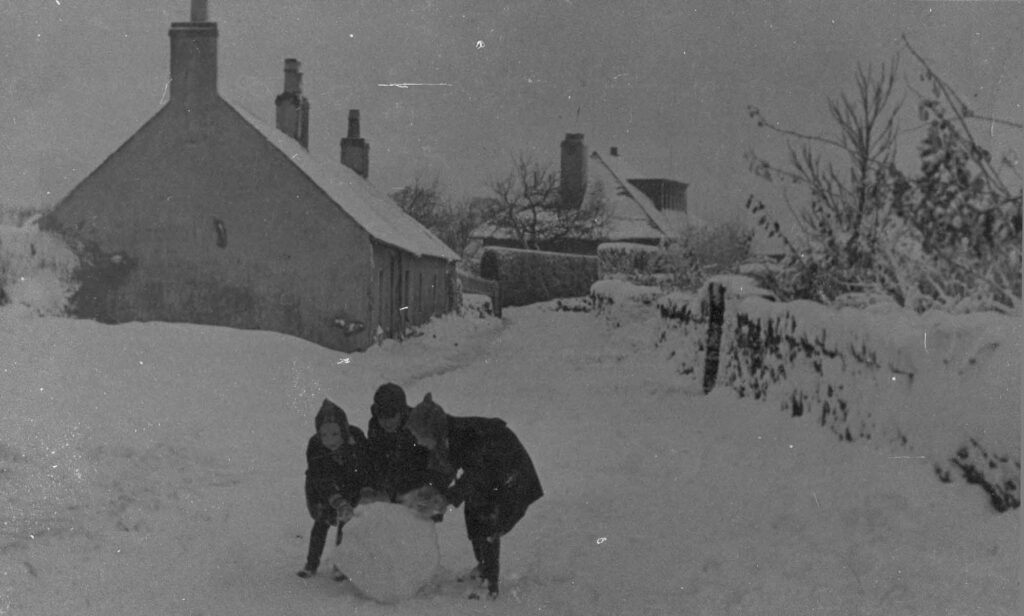
John Coutts, Poet-in-Residence at the Stirling Smith Art Gallery & Museum is collecting winter poems to share as an online poetry roundabout.
What is your favourite winter activity? What Makes winter special? What clothing, food, weather, or animals make you think of winter?
Tell us in your poem. Rhyming poems, raps, picture poems, haikus, alphabet poems, free verse, and acrostic poems are all welcome.
Send your poems along with your name, age, and school to johnjcoutts@gmail.com
Deadline for submission 14 December 2020