

Yesterday was a monumental day for the Stirling Smith, when the new bronze portrait of King Robert the Bruce is unveiled by his descendant Lord Bruce. The portrait combines the research of Andrew Nelson, Professor of Anthropology of Western University, Ontario, with the work of forensic sculptor Christian Corbet, Sculptor in Residence at the Royal Canadian Navy. Together they have concluded that King Robert was never a victim of leprosy, laying to rest a pernicious 700-year old rumour. The evidence came from the close study of a cast of Bruce’s skull.
It was from the same cast that the sculptor Pilkington Jackson created his portrait of Bruce for the statue at Bannockburn, in 1960-1964. It is a little-known fact that the Bannockburn statue was made possible through funding from Canadian lawyer and philanthropist Eric L. Harvie. The bargain struck was that an identical statue of Bruce was provided for the grounds of the Alberta College of Art and Design, Calgary, Canada.
Canadian philanthropy is in the forefront again in celebrating the memory of King Robert, as the bronze is the gift of the sculptor Christian Corbet to Scotland and to Stirling, where it will star in the collections of the Stirling Smith. Corbet has helped change the course of Scottish history with this remarkable work.
Today we look back 30 years, to the time when nurses could be immediately identified by their uniform and badges. This photograph is one of a small collection gifted to the Stirling Smith, together with nursing badges. Nurse Sloan wears the green cap band of the State Enrolled Nurse and the purple and green Stirling Wolf badge of Stirling Royal Infirmary when she qualified in 1985.
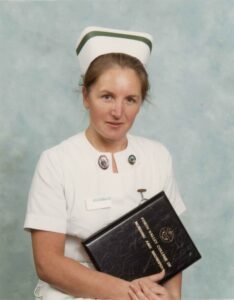
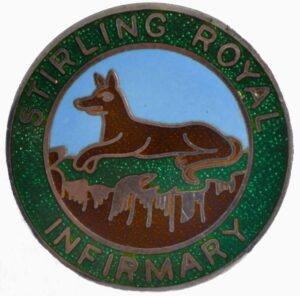
Jean Sloan joined the forces as a Royal Alexandra Nursing Student. As she did not complete her training, she later had to start from the beginning at Callander Park’s Forth Valley College. She worked in the Operating Theatre after qualifying, so rarely had the pleasure of wearing her badges at work, all of which are as new.
Nursing has changed radically in the past few decades. In the army, nurses had to stand ‘at ease’ until the consultant had done his rounds. By contrast, life in one of SRI’s gynaecology wards was so informal, that a monkey was brought in from the Safari Park in 1989 to cheer up the patients.
Nursing has always been a profession demanding strength and dedication. Nurse Sloan contributed a professional article to the Nursing Standard and was on duty when the Dunblane Tragedy struck 21 years ago.
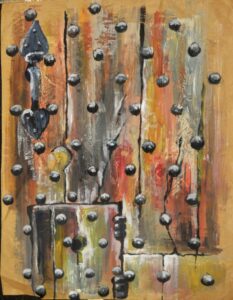 The great front door of Carnock House was donated to the Stirling Smith Art Gallery and Museum in 1938 by the Carron Iron Company, prior to the demolition of 1940. It is built of three thicknesses of wood, strengthened with big iron studs. An unusual feature is the loophole near ground level, where small cannon could be positioned to repel any attackers.
Carnock, near Airth, was one of the important country houses of Scotland, built by Sir Robert Drummond (1516 – 1592), Master of Work (royal architect engaged in building the Palace in Stirling Castle) as his own residence in 1548. It was modernised in 1827. It had fine painted ceilings of the 1540s. Part of one ceiling was rescued by the body which is now Historic Environment Scotland, and in 2007, this also was given to the Stirling Smith.
Today, using these faded fragments of buildings, we can only imagine the society which created these fashionable strongholds, but they also serve an additional purpose. This is a painting of the door by Kit Neufeld, a student in the Saturday Sketching class of the artist Peter Russell, based at the Smith. For almost 20 years, Peter Russell’s students have found inspiration in the Smith collections and their work is currently on show there.
11th September is the 716th anniversary of William Wallace’s famous victory of the Battle of Stirling Bridge and to mark it is a painting of Old Stirling Bridge, 1915 by James Bisset Crockart (1885 – 1974). This purchase was made possible with grants from the Stirling Common Good Fund and the National Fund for Acquisitions. Remarkably it was secured for the Smith in Canada by Dr Robin Campbell, was brought back to Stirling.
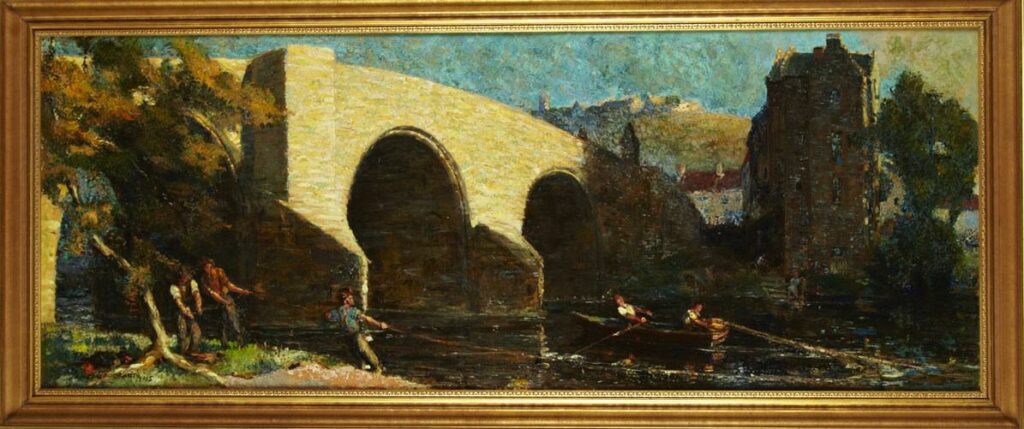
Crockart was a Stirling-born artist who emigrated to Canada in 1911. He exhibited a painting of Old Stirling Bridge in the Smith in 1910, but this picture was painted in Canada, where he obtained employment with a firm of architects. He also worked producing posters for the Canadian Pacific Railway Company, but evidently, did not forget his native town.
The salmon fishers with their nets were a common sight on the River Forth until the 1960s and they are depicted on the north bank of the river, on the left of the picture. The tall tenement building on the north side of the bridge was demolished in 1963.
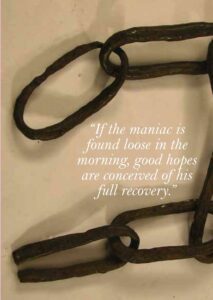 Six links of an old iron chain survive in the Stirling Smith Collections – all that is left of the chain which bound those with a mental illness at the healing pool of St.Fillan near Killin.
The Irish monk St. Fillan came to Scotland in 717AD, and gave his name to Killin, where he settled, and where the healing pool was near to the Celtic Christian church, which he built. As late as 1792, the practice of dipping ‘lunatics’ in the freezing cold holy pool and chaining them up overnight as a ‘cure’ is recorded.
The small fragment of chain caught the imagination of student Robert Weston at the University of Western Australia, and working with Professor Susan Broomhall, he designed a greetings card for the Smith, with the remarkable story of the Chain. We should take some pride in the fact that people on the other side of the world can be inspired by a single Stirling story. There are hundreds of them to be discovered in the Smith – come and see for yourself!
This watercolour by artist John Bell shows a rural Dunblane of 1887. It is a recent purchase for the Stirling Smith collections courtesy of Dr Robin Campbell and the Stirling Common Good Fund.
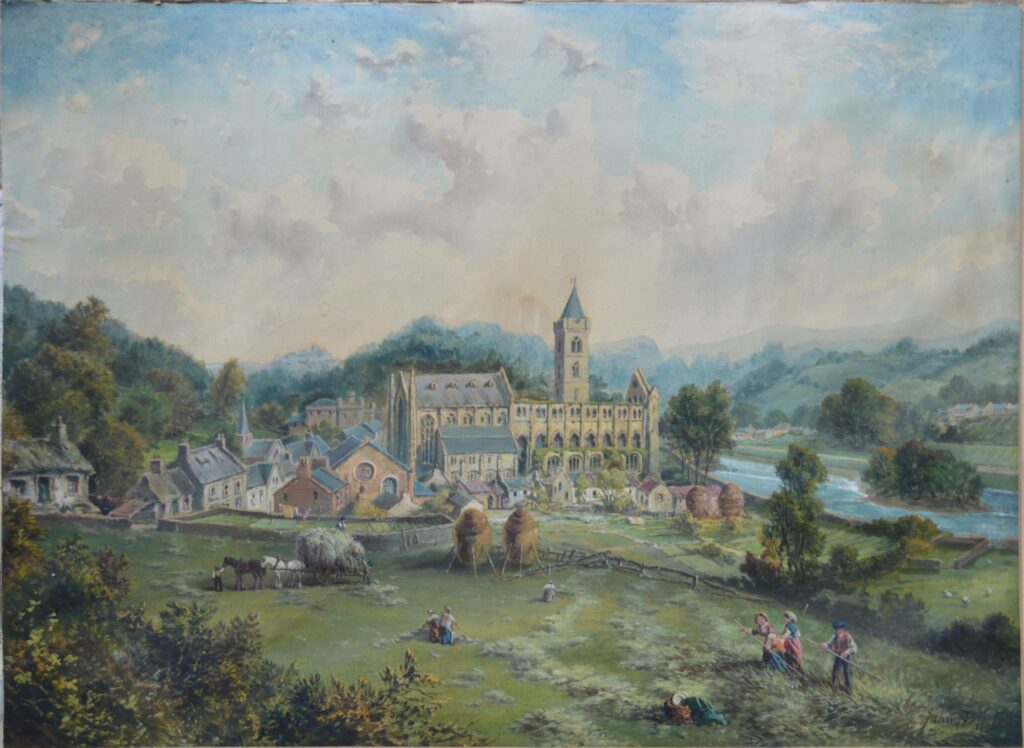
Not much is known about the artist. There are some works by him in York Museum collections and a similar oil painting in the Dunblane Museum collection.
The artist’s viewpoint is looking south. On the left is Braeport, and the castellated building to the left of the cathedral is the old jail and police office, demolished in 1963. Beyond the jail in the left middle distance is Stirling Castle. The River Allan is on the right.
Dunblane Cathedral was left ruined by the Reformation of 1560. The east end of the Cathedral was restored in 1816 – 17 by the great Scottish architect James Gillespie Graham (1776 – 1855) who was born in Dunblane. The nave, or main body of the Cathedral, was restored by another great Scottish architect, Sir Robert Rowand Anderson in 1888- 1893. This was made possible only by funding from Janet Wallace of Glassingall, who insisted on matching money being raised and gave £19,000 herself. Otherwise, the Cathedral might still be a picturesque ruin today, like St. Andrews or Elgin Cathedrals.
The Year of the Rooster 2017 is now well underway. It was brought to Stirling by a huge Chinese dragon, dancing to the delight of the crowds at the Albert Hall, followed by a night of spectacular performances of Chinese song, music, dance, gymnastics and magic. This was organised by the Central Scotland Chinese Association and Stirling Council.
Stirling’s relationship with Chinese culture is young and strong, thanks to the students at the University of Stirling and the Confucius Hub concept in Stirling High and other schools, but there are also traces of older relationships to be found in the collections of the Stirling Smith Art Gallery and Museum. The punch bowl from which Bonnie Prince Charlie drank, at Bannockburn House in 1746, is of Chinese porcelain.
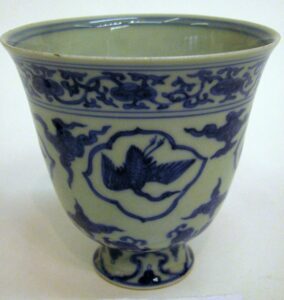
Even this is young in comparison to the lovely little porcelain cup from the Ming dynasty. It is 106 cm high but very rare, with markings confirming manufacture in the reign of the Emperor Jiajing, the eleventh emperor of the Ming dynasty who reigned 1521 – 1567. The cup is painted with four cranes which symbolise longevity, wisdom and nobility in Chinese culture. The cup, and many other artefacts and paintings were bequeathed by Stirling dentist L. J Platt in 1914.
Places change their geographical focus through time. For most of the twentieth century, Corn Exchange was the commercial, literary, ceremonial and municipal centre of Stirling. Shown here is a royal visit at the Municipal Buildings in 1929. The Municipal Buildings were opened less than 100 years ago in 1918, joining the Corn Exchange Hotel with its hiring market, the Carnegie Library (opened 1904), the Campbell Bannerman statue (1913) and the Burns statue (1914). The War Memorial completed the grouping in 1922.
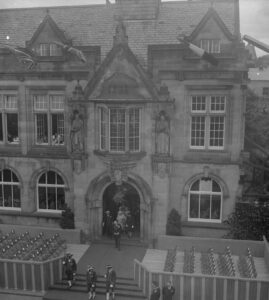
One of the most important businesses in the area was McArees who owned property facing Municipal Buildings, as well as their large store in King Street. In 1937, they built the present red sandstone building opposite Municipal Buildings and for a century had a grand stand view of the historic visits taking place. This photograph is from a collection presented to the Stirling Smith by Mrs Elizabeth Young of McArees.
The entrance to Municipal Buildings where the Duke and Duchess of York are emerging has an outdoor seating area for the ceremony. The windows of the Council Chamber above are wide open, and three Halberdiers dressed in their distinctive red uniforms are on the front steps.
Today both Stirling Council and McArees have moved on.
This column often features paintings which are part of the art history of Stirling and Scotland. The Stirling Smith Art Gallery and Museum was founded by a practising artist, Thomas Stuart Smith, with his own paintings and works of his contemporaries as the foundation collection. The Smith, therefore has a commitment to the work of living artists, and contemporary exhibitions are held throughout the year.
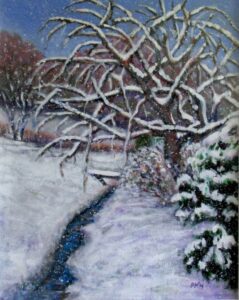 These exhibitions offer the opportunity of building up a collection, or at the very least, finding that unique and special gift for friends and family. Featured here is a seasonal painting by artist Pamela McMahon who resides at the Port of Menteith and delights in painting the local landscape. The district of Menteith was first made into a tourist attraction by the book of that name (1895) written by Robert Bontine Cunninghame Graham and illustrated by local artist Sir David Young Cameron. Literature, art, and tourism go hand in hand.
Contemporary art is always worth consideration. It becomes tomorrow’s art history, and unlike the mass-produced goods in our chain stores, it is unique. There are many artists and craftspeople that live and work in Stirlingshire, and all deserve our support.
The Smith will be closed on the four public holidays of Christmas and New Year, but is open as usual during the holiday weeks.
Featured today is a watercolour by the eminent Glasgow artist, Alexander Kellock Brown RSA RSW RI (1849 – 1922), purchased recently for the Stirling Smith collections. The artist’s viewpoint is from the Cornton area, looking across the Forth to what was Winshel Place at Laurencecroft (now Drip Road) in the late 19th century. All of the little vernacular buildings, some with red pantiled roofs, were swept away by new local authority housing at Laurencecroft and the rest of Raploch in the 20th century. The magnificent tenement at the south end of the Old Bridge was demolished in 1963. The only building which remains from that time is Campbell’s building at what is now the foot of Lower Bridge Street. There are cattle grazing on Laurencecroft.
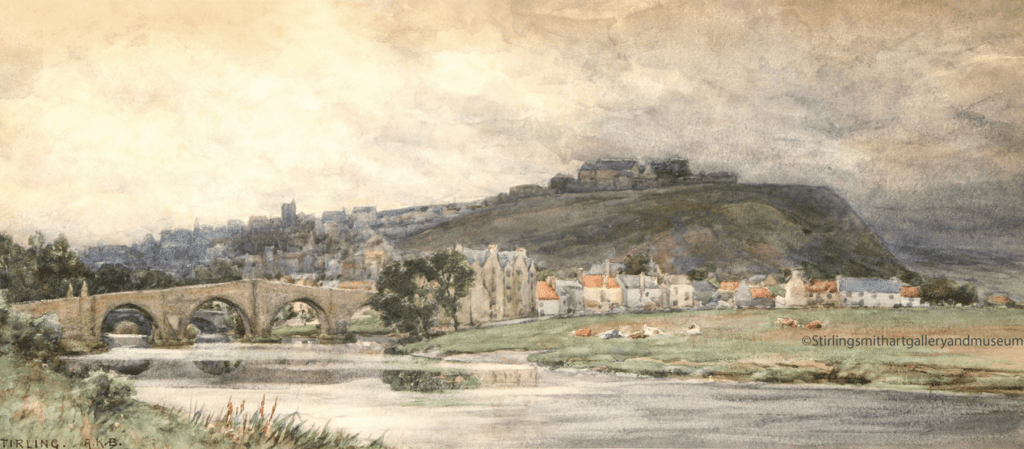
Besides its topographical importance, this work is a good example of the broad wash ‘wet’ watercolour technique developed by Kellock Brown and favoured by many of the other Glasgow painters of his generation. Brown was one of the founders of the Scottish Artist’s Benevolent Association and also President of the Glasgow Art Club. Most of his work is Scottish, and his views of Arran are particularly well – known. Like every landscape artist of his time, capturing the beauty of Stirling was on his ‘to do’ list, and the Smith is lucky to have caught this lovely work, courtesy of Dr Robin Campbell and the Common Good Fund of Stirling.