

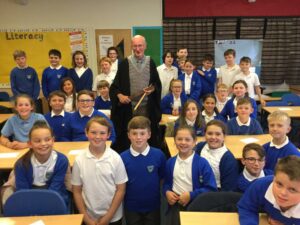
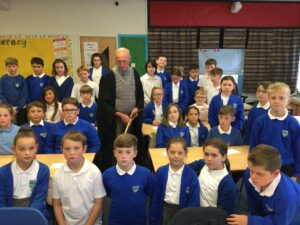
 “Is this how bad it was in school in the old days, granddad?” That’s the question in the minds of children from Strathdevon School, Dollar.
Their teacher knew how rough it would get when she invited David Smith, Learning Officer at The Stirling Smith Art Gallery and Museum to relive life in school on day one of World War 2.
The scary teacher act is always immensely popular with children. They discover that they will have come in from a separate boys’ playground and girls’ playground. Desks in their room have been re-arranged in rows facing front. Old maps and flags now adorn the walls. The fancy smart board is converted by Powerpoint to an old-fashioned Chalkboard. No one dare breathe. Hands on laps. Backs into chairs, Eyes to the front. Then it’s packed with tables drills, grammar, history and geography facts. All rounded off with writing using real pen and ink… and woe betide you if you are left-handed!
Children are so relieved when it ends and can’t stop talking about how they narrowly avoided the strap. But strangely, they always vote it the best way to learn ever!
Michael first started work at the Stirling Smith back in August 1979, at a time when Margaret Thatcher had not long been handed the keys to No.10 Downing Street. Michael had trained at Glasgow University as a geologist, graduating with a BSc in that subject, and after hanging around for a number of years with a collection of old fossils, his friends and tutors naturally advised him that he belonged in a museum. And so Michael decided to take their japery quite literally, resolving to develop his curatorial skills professionally.
After graduating, Michael worked for a year with the University of Glasgow Department of Geology, and then spent a further six months at Glasgow’s Hunterian Museum. In the summer of 1979, he applied for a vacancy at the Stirling Smith, and after successfully assuming the post he has never looked back since.
If there’s one thing that can be said about Michael, it’s that there’s no job at the Smith that he won’t try his hardest to master. As the Collections Manager, he has been maintaining the building, facilitating exhibitions and utilising computer technology and digital imagery from his earliest days in the job. Michael has many memories of his time at the Smith, and has witnessed a great number of changes to the building and its services.
In his time in the job, he has set up (and taken down) more than 400 individual exhibitions, perhaps most notably The Stirling Story, a permanent exhibition in Gallery III. Today one of the biggest attractions in the Smith, The Stirling Story took over four months to build, and is visited by thousands of guests every year. Gallery III remains Central Scotland’s biggest single exhibition space.
One of Michael’s best-known roles is that of the Official Keeper of the World’s Oldest Football. Dating back to c.1540, the ball is one of the Smith’s most popular exhibits, and Michael has showcased it both nationally and internationally. As well as appearing with it on television features, Michael was responsible for transporting the ball to Hamburg’s Museum für Volkerkünde for the 2006 FIFA World Cup celebrations. He is currently also appearing with it on a YouTube™ video on the Internet.
Additionally, Michael was one of the founding members of Operation Skylark, a children’s countryside playschool which was organised with Stirling Countryside Rangers Service, which involved one hundred children for a week each year. The project ran for around ten years until 1992.
Michael was Chair of Stirling Conservation Volunteers for over a decade, and a Trustee of Scottish Conservation Projects for five years. At the moment, he is on the Committee for the Restoration of Portmoak Bog in Scotlandwell near Kinross, and retains a keen interest in all new developments in restoration, digital photography management and museum issues.
In recent times, Michael has been searching out the treasures of the ethnographic collection with a view to a future exhibition. He is also currently looking into making the Smith more accessible to international audiences by using new technologies to bring the museum’s collections alive for visitors regardless of their location.
Exciting times at The Smith!
Work is about to start on renovating Gallery Two so we can bring you a beautifully refurbished space and a new exhibition, featuring work from our fine art collection. Getting work done is always a bit messy and disruptive but we will try our best to keep this to a minimum.
Gallery Two will be closed to the public from Friday 25 January and will re-open on Tuesday 12 March.
Gallery Three (The Stirling Story) will continue to be open to the public; please come to the main reception and our team will guide you from there. The Gallery Café and lecture theatre are open as normal, so you can still pop in for a delicious lunch and attend your regular groups.
PLEASE NOTE: During the period of renovation, wheelchair access to the museum will not always be possible. Please contact us if you have any accessibility needs.
We look forward to bringing you a new and improved gallery soon. We will keep you updated along the way. Thank you for your continued support.
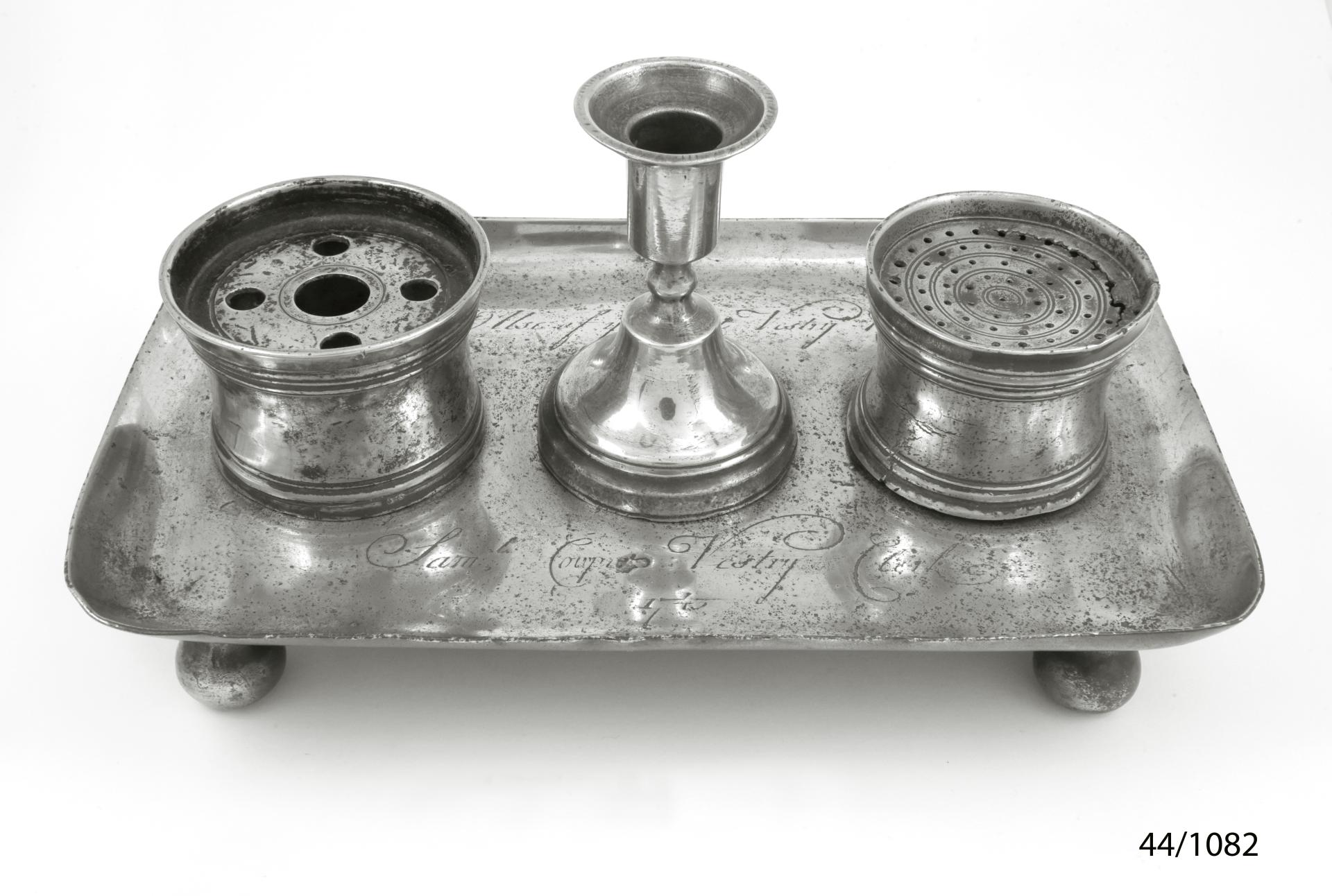 Today’s Stirling Smith object is an elegant writing stand, made for Shoreham Old Church in West Sussex. It is engraved with the words ‘For ye use of ye Great Vestry Room, Saml. Coupers Vestry Clerke 1745’ and is in the Neish Collection of British Pewter.
Alex Neish has spent a lifetime in rescuing old pewter, much of which was going abroad with the antique trade. He has spent an equal amount of time researching his collection and writing about it in specialist journals. Working with his wife Patricia he has now produced a magnificent colour catalogue of 232 pages, illustrating each of the pieces. Much of the photography work was done by John McPake who worked as a photographer for Central Region and Stirling Councils.
Alex Neish’s gift of his world–famous collection to the Stirling Smith Art Gallery and Museum is well known. Last year, he was awarded the Fellowship of the Smith in recognition of his contribution to the preservation and study of pewter and his gift to the Smith. We are pleased to announce that he has made an additional gift of the limited edition of this special publication to the Stirling Smith, and we are retailing it exclusively at £40 per copy in support of the collection.
It is a unique publication of which Stirling can be justly proud.
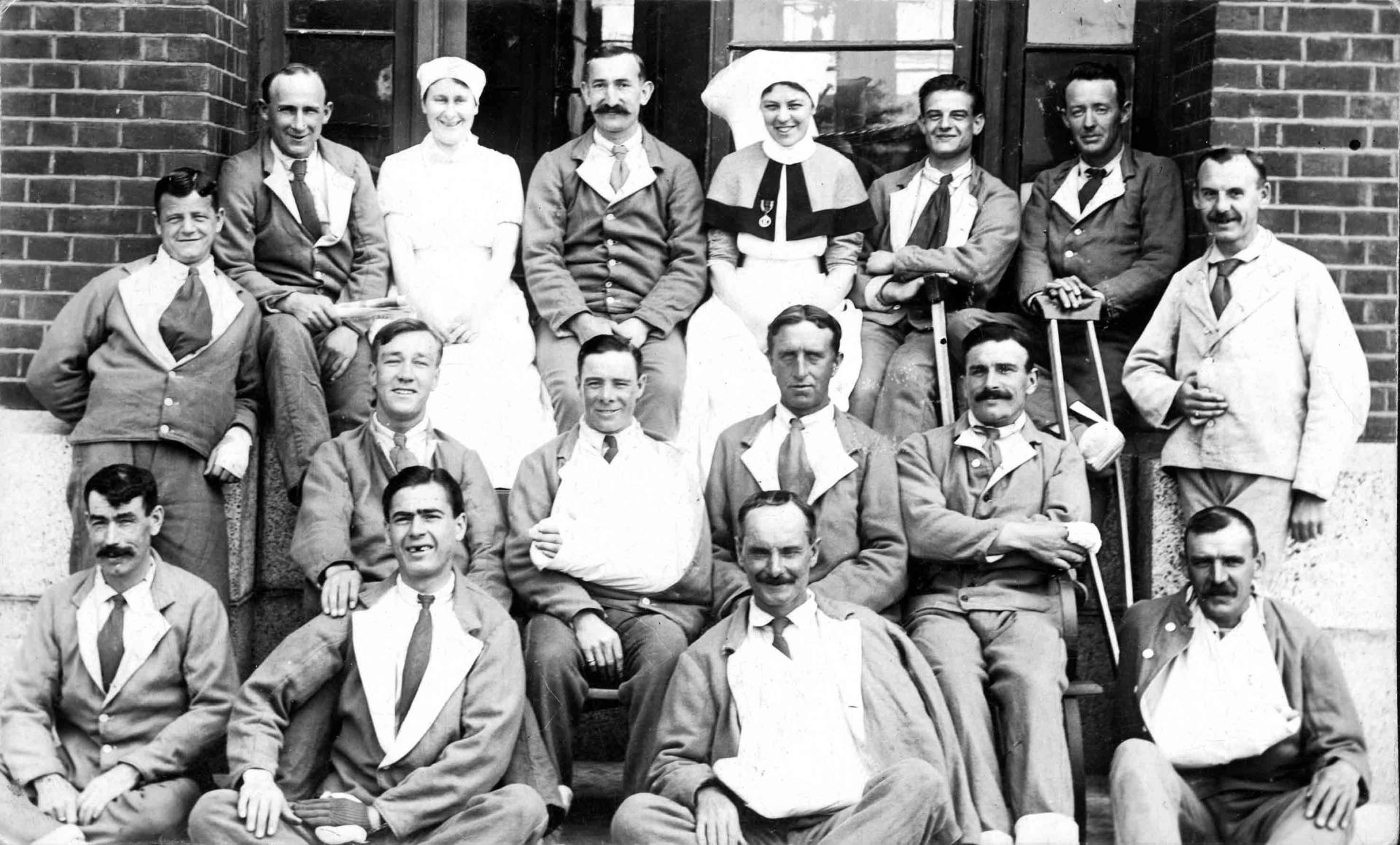 During the Great War, there was a uniform which at one time was seen everywhere but is now largely forgotten. This was the Hospital or Convalescent Blues worn by injured or recovering soldiers. The men in this photograph taken at a Stirlingshire hospital are wearing them. The uniforms were pale blue in colour, made of a flannelette material and were large and loose fitting, more like pyjamas. Hospital Blues had many purposes. The loose fit ensured that they could be worn by men of different sizes. They were clean and comfortable, taking the place of lice and flea -ridden uniforms of the men injured on the battlefield. A bright red neck tie was worn, making sure that all who saw them knew of their status as injured soldiers. There were no pockets in the Blues uniform, as no soldier was allowed money in hospital. Officers did not wear this uniform.
This photograph loaned to the Smith by Marion Jackson has a written message from her grandfather who is the man at the back between two nurses: ‘I am never far from the ladies. This is better than selling sausages’. Peter Roberts was a butcher in Allan Park before the Great War. The shop later became the Allan Park Post Office.
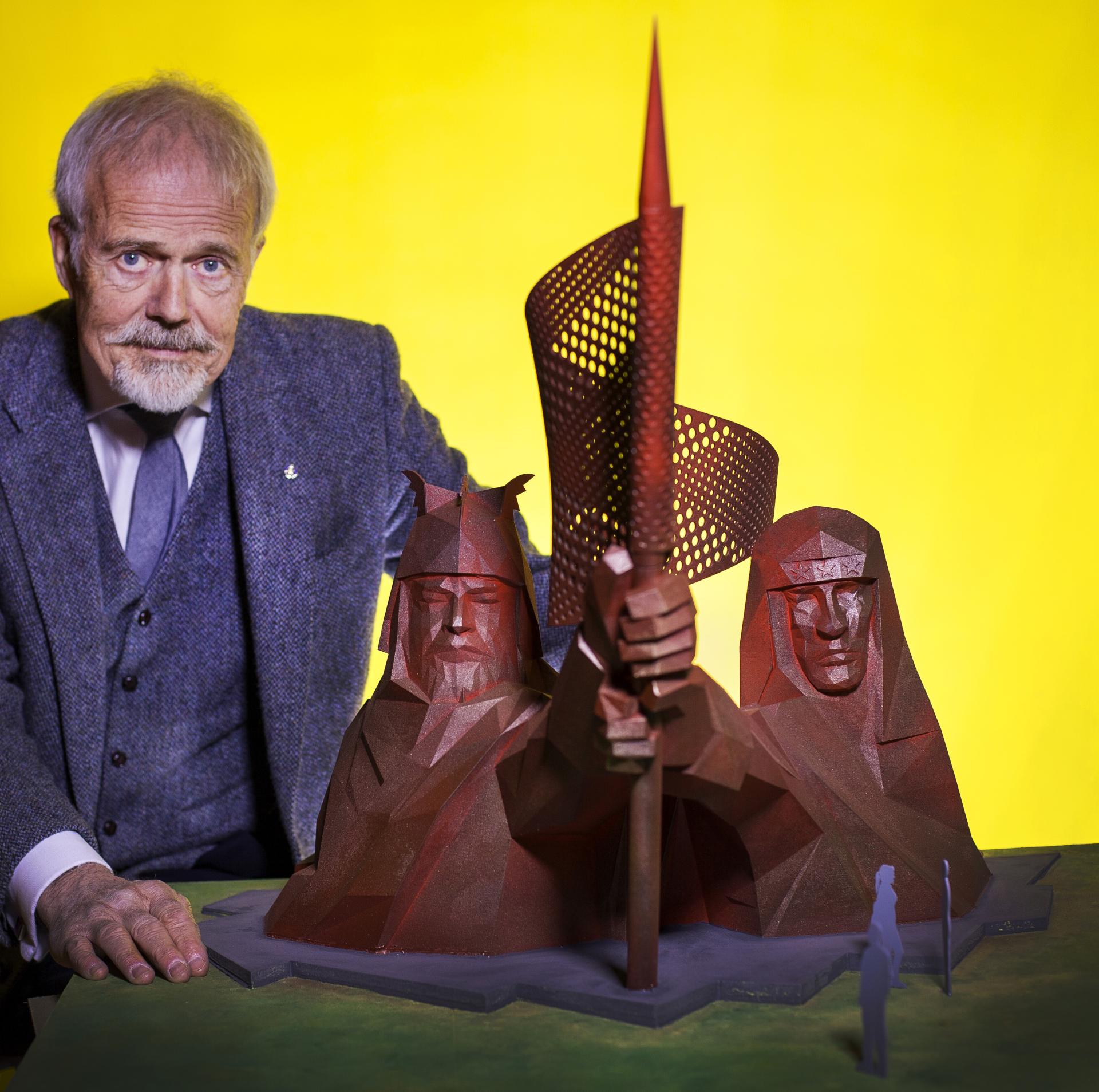 The story of William Wallace is central to the survival of Scotland as a nation and his victory at the Battle of Stirling Bridge in 1297 spread the fame of Stirling far and wide, according to contemporary reports. With 22 portraits of Wallace included in the 500 items in the Stirling Smith collections which reference the Wallace story and the presence of the Wallace Monument since 1869, Wallace is well-remembered in Stirling.
But there is more to the story. Wallace’s co-victor at Stirling Bridge was Andrew de Moray, who died of his wounds not long afterwards. The surviving letters to the towns of Lubeck and Hamburg, inviting trade with Scotland after the war, make it clear that Andrew de Moray and William Wallace were Guardians of the Realm when Scotland had no king. This concept was unique in European history.
The Guardians of Scotland Trust’s exhibition of the proposed art work for Wallace AND Moray, to be sited at Stirling Bridge is at the Smith until 2 September. Shown here is the eminent Scottish sculptor Malcolm Robertson with his model of the work, (photo credit: Drew Farrell) to be constructed in corten steel at the Old Bridge. This is a proposal which will embed Wallace and Moray in the landscape. It is the first major public artwork since the Bannockburn statue of 1964.
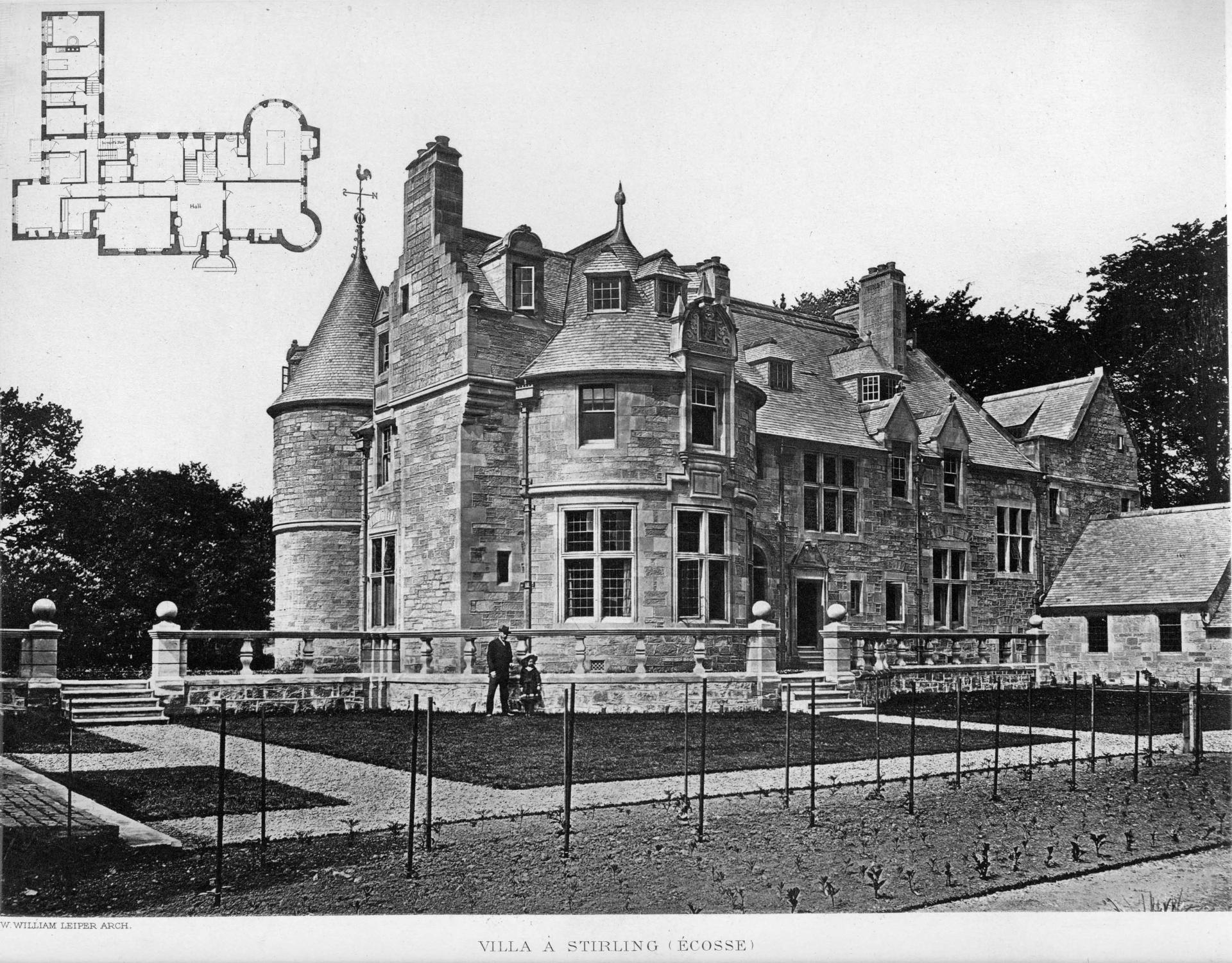 Langgarth is one of Stirling’s great villas, designed by the architect William Leiper (1839 – 1916). Built in 1897, it was originally one in a group of four on the St Ninians Road. The others were Viewforth (Stirling Council headquarters), Springbank (demolished to make way for Central Regional Council’s headquarters in 1995) and Annfield (also demolished). Langgarth was latterly used by Central Regional Council, and along with its little gatehouse, is now empty and boarded up.
This illustration is from the French magazine L’Architecte, 1907 and was purchased for the Smith from ebay. It shows Langgarth in its early years. Leiper was an architect who paid as much attention to the laying out of the gardens and grounds as he did to the building, and the garden has yet to mature.
The 1901 Census lists the owner of Langgarth as widower William Renwick, aged 61 with his son Thomas, 8, and daughter Bethea, 7. His sister-in-law and five servants made up the household, with gardener George McCall and his wife Ann in the Lodge. Renwick was proprietor of the sugar cane mills in Bengal, India.
Leiper is an architect of outstanding importance with the design of buildings such as the Templeton Carpet Factory, Dowanhill Church and the City Chambers banqueting hall, all in Glasgow and many fine villas in Helensburgh. It would be a shame if Langgarth were lost to Stirling.
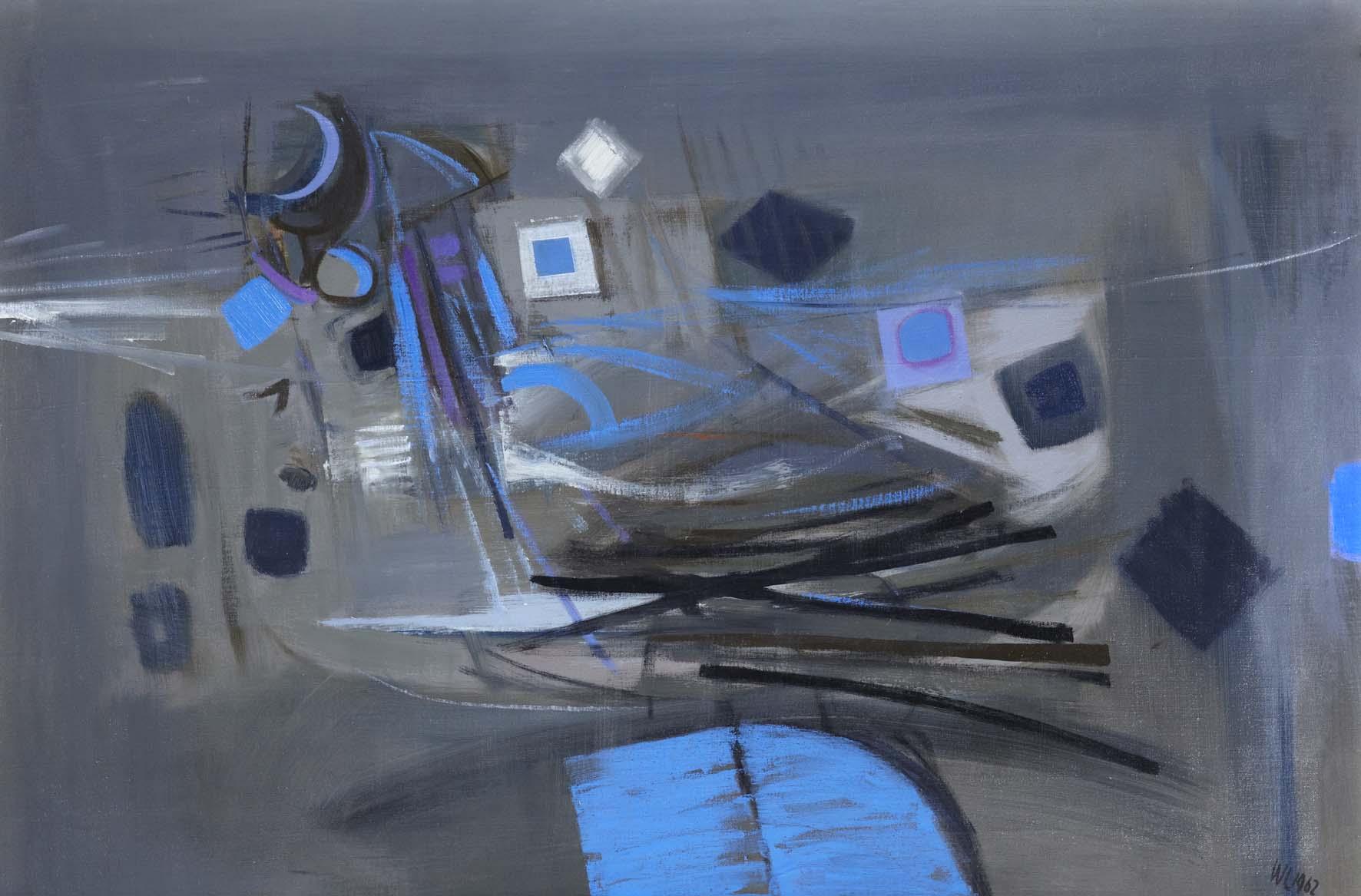 The Stirling Smith has a collection of some 850 major works of art which show different aspects of the history of Scottish, British and European art. This work by William Hunter Littlejohn (1929 – 2006) is one of two in the Smith collections, featured in a brand -new book on Education and Inspiration in Scottish Art: Students of Hospitalfield.
Littlejohn, a native of Arbroath, was an important artist who played a significant part in the history of Scottish art. He studied at Gray’s School of Art, in Aberdeen. He spent time as artist in residence at Hospitalfield, the summer school for promising young painters in Arbroath. This painting in the Smith collections, Evening Star III was painted in 1962. Taking its inspiration from Arbroath harbour, it is abstract expressionist in style.
Littlejohn held his first solo exhibition in 1963. He taught in the Angus area then joined the staff at Gray’s as a lecturer. In 1972, he was appointed their head of fine art, retiring in 1991.
His works can be found in 14 public collections and in many private ones, including that of Her Majesty the Queen. The two works in the Smith collections were gifted by the Friends of the Smith.
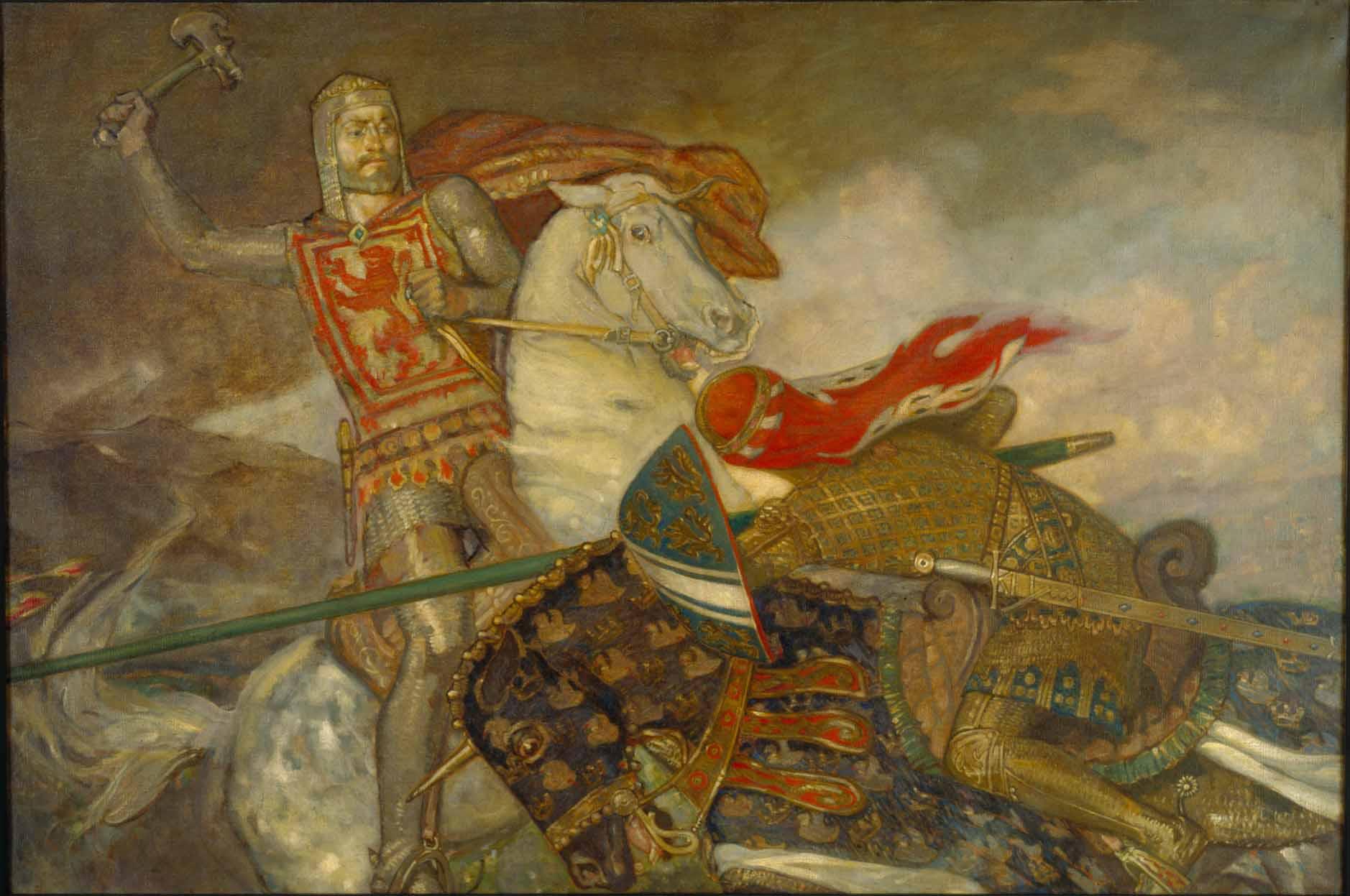 With the approach of the 704th anniversary of the Battle of Bannockburn this weekend, it is worth re-visiting one of the Smith’s more famous paintings. ‘Bruce and de Bohun’ was painted by artist John Duncan (1866 – 1945) as an entry in the national competition run by Kelvingrove Art Gallery for works to celebrate the 600th anniversary of the battle in 1914. The work of the prize-winning artist John Hassall which hangs in Kelvingrove today was highly unpopular and condemned as ‘the False Bannockburn’, the choice of scene being the prayers before the battle.
Duncan chose an episode from 23 June. Artists have tackled this subject again and again, perhaps because it is so graphically described by the poet John Barbour (1320-95) in his epic poem, The Bruce. Immediately before the Battle, the English knight Sir Henry de Bohun challenged King Robert, thinking because he looked insignificant on his small grey horse, he could kill him. Bruce killed de Bohun with one stroke of his battle axe. The artist has depicted carefully the costume and heraldic tributes of the two warriors.
John Duncan exhibited at the Smith and gave a talk on ‘Painting Today’ in 1938. Knowing how important Bannockburn is to the history of Stirling and Scotland, he bequeathed this work to the Smith.
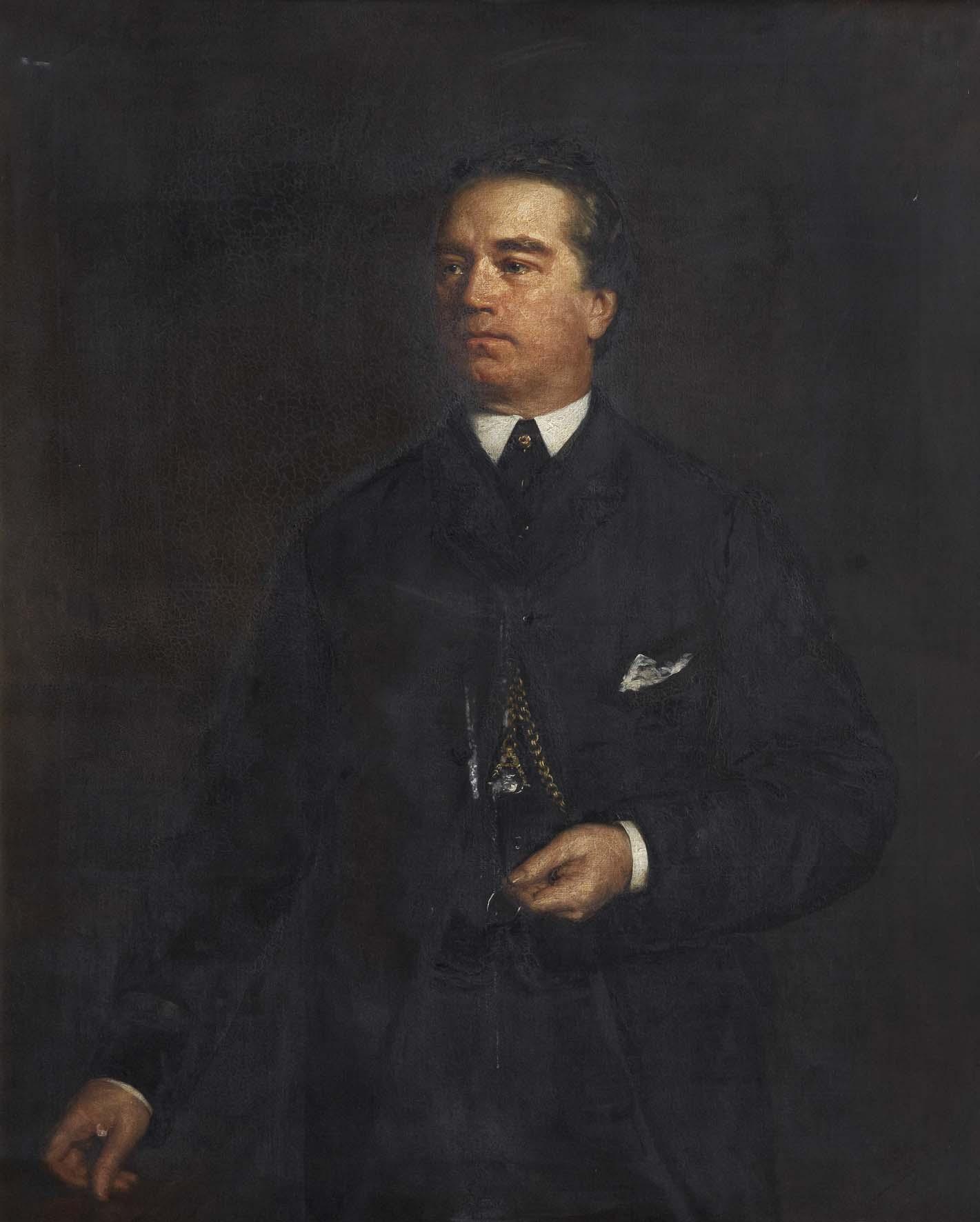 People expect the Stirling Smith to have portraits of past Provosts of Stirling. This is not the case, for unlike the other major Scottish cities, Stirling has never commissioned or curated civic portraits. There are few Stirling Provosts represented in the Smith’s collections and most, like this one, were painted as private individuals.
George Christie was a businessman of substance, engaged in his father’s brick and tile manufactory at Forthbank. It was shown as a large enterprise on Wood’s map of 1820 and by the time George inherited it, there were other operations in Perth, Aberuthven and Blackgrange.
Christie was first elected in 1867. In his time in office, Stirling went through radical changes, with the first division of the burgh into wards, and the introduction of the School Boards from 1872. The Stirling Smith was built in his time as Provost, so his name is affixed to the building. The Christie Clock Tower was built in Allan Park in his memory.
In retirement, Christie became very active in freemasonry. He was a member of Lodge Stirling Ancient no. 30 and took 32 degrees in masonry. In 2006, the late Thomas McDonald of Lodge Abercromby project-managed the complete restoration of the Christie clock.