


The great Scottish artist and writer Alasdair Gray has a dramatization of his ground – breaking novel Lanark at the Glasgow Citizens’ Theatre this month. After an accident in June, the artist is still critically ill in hospital, and as we wish him a good recovery, we feature one of his lesser known works from the Smith collections.
Alasdair Gray has always been a good friend to Stirling. His 70th birthday exhibition was shown in the Smith in 2004, and featured the preliminary work for the decoration of Oran Mor, the church which is now an arts and music centre at the top of Byres Road. The Smith exhibition was more modest than the Kelvingrove extravaganza held for his 80th birthday last year, but perhaps the Smith showed the way.
The rapidograph portrait was done during the Smith’s Leonardo exhibition in 2008, and is of Stirling fashionista, milliner, teacher, needlewoman and Smith volunteer Mary Rennie. It is not a likeness in the traditional sense, and it is not a portrait which pleased the sitter. Portraits are much more than likenesses, and this is a very skilled pen portrait, the product of a lifetimes’ practise. It is one of 30 works by Gray in the Smith. The earliest is from 1964.
Elspeth King

To mark ‘the Glorious 12th’, the traditional start of the shooting season in Scotland, today’s painting from the Smith collections is a still life by artist John Bucknell Russell (1819 – 1893). It was gifted to the Smith by Mr Watt of Stirling in 1932. At one time, such paintings were very fashionable in places associated with the hunting fraternity as Stirling was.
Born in Edinburgh and raised in Aberdeen, John Russell started his working life as a house painter. He did an altar piece painting for St Mary’s Chapel, Aberdeen and interiors for Haddow House and Kelly Castle. He settled at Fochabers where he had sporting commissions from the Duke of Richmond and Gordon and his friends who came to Castle Gordon for the hunting season. He also obtained commissions from Lord Lovatt in Inverness.
Russell specialised in paintings of fish and fishing scenes. He was a skilled wood carver, making models of Spey salmon to the exact measurements of the originals. These were carved in the old laundry workshop of Castle Gordon and painted by his daughter. Several of his children became artists, and he exhibited regularly at the Royal Scottish Academy. This work may be ‘The Morning’s Sport’ exhibited at the RSA in 1863.
Ronald A Muirhead (1930 – 1989) was an artist and gallery owner who enriched the lives of the people of Stirlingshire, and his portrait by James Robert Wallace Orr, in the Stirling Smith collections, reflects his artistic interests. The sculpture on the table is his own, and the view into the garden is from his living room in Ben View, Kippen.
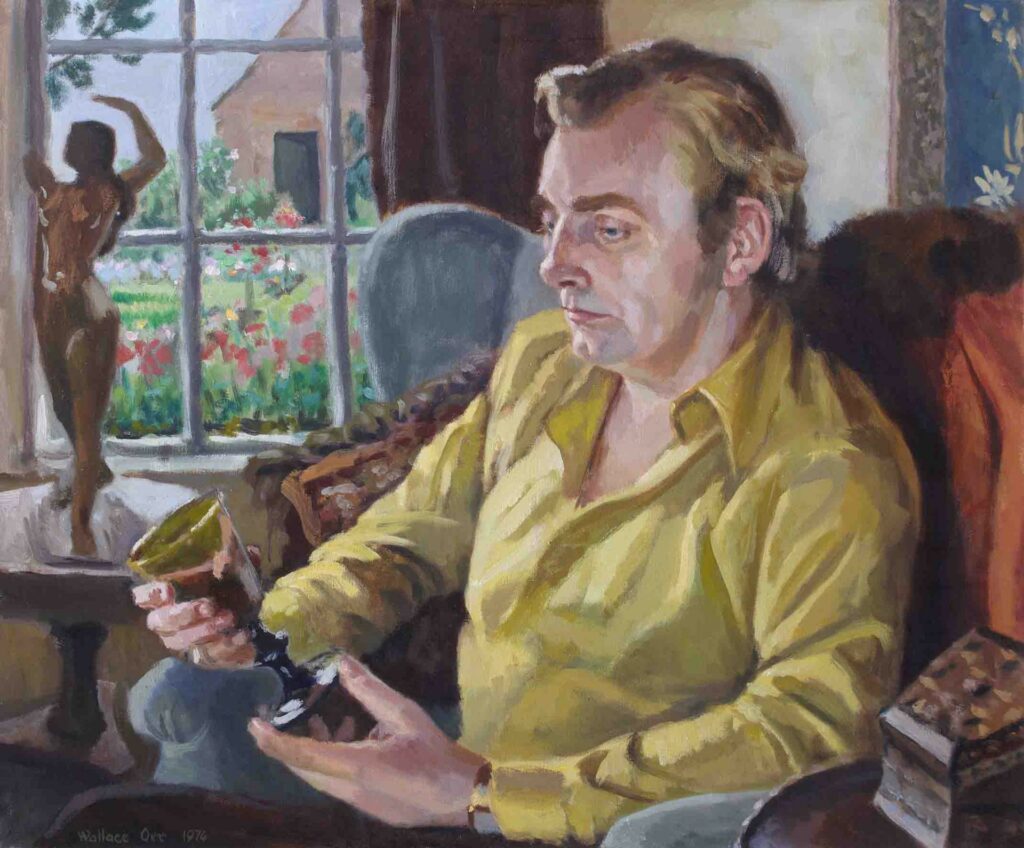
An injury during National Service restricted his capability as an artist, but he produced a series of portrait heads, including fine likenesses of the actors Moultrie Kelsall and Jeannie Carson which are also in the Smith collections.
A good singer and performer, he had many friends in the world of theatre. He acted in television and had parts in the film Kidnapped and the series Dr Finlay’s Casebook.
In 1973, he began to run art exhibitions in the Kippen Post Office. He also ran a gallery in Dumbarton Road Stirling, followed by the Kippen Gallery which opened in 1978. He initiated the annual Kippen Street Fayre in 1980, which is still going strong. Like many other good citizens and community activists, he was a Friend of the Smith.
The Treasures of the Smith exhibition, which runs until 4 October has a new acquisition of some significance. It is an embroidered fire screen by the famous suffragette activist and artist, Marion Wallace Dunlop (1864-1942). The subject is Spring and features a woman in long purple robes surrounded by blue birds, bluebells and other spring flowers.
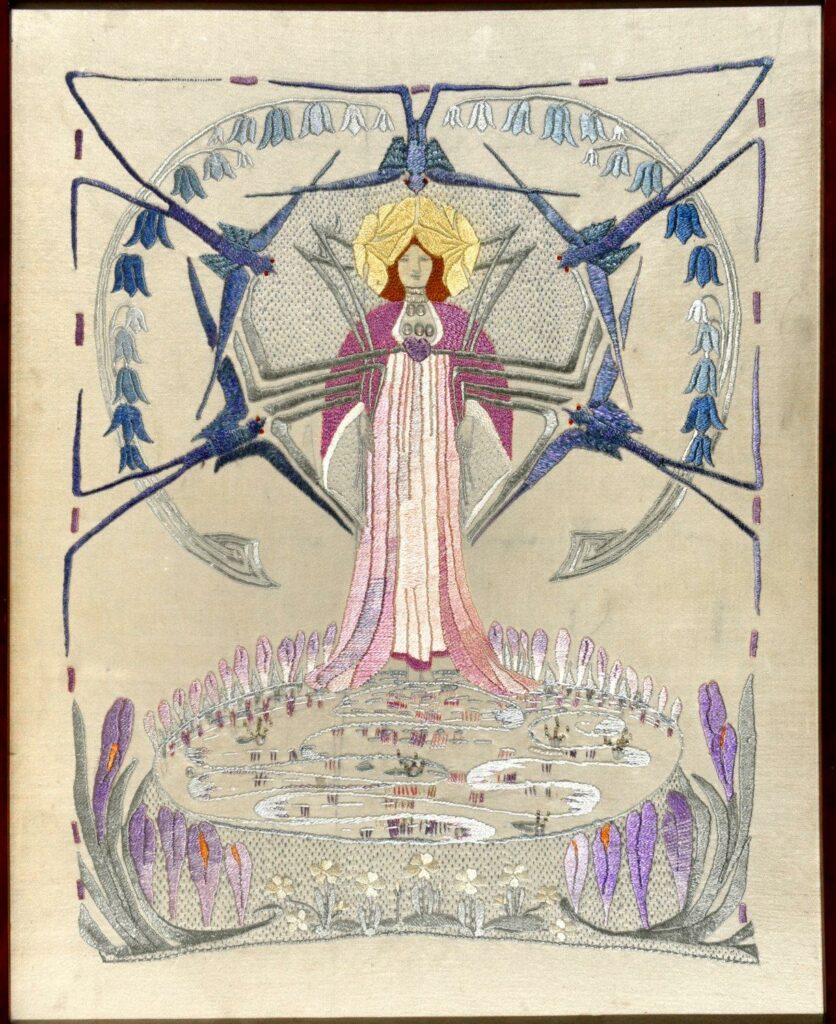
Marion Wallace Dunlop, who trained at Slade School of Art, was an artist of considerable talent but until now, none of her work has appeared in the collection of a public museum or gallery.
Although she lived most of her life in England, she was fiercely proud of her Scottish birth and heritage. She claimed descent from William Wallace’s mother (as did the entire Wallace Dunlop family), and she sought to emulate Wallace in her fight for votes for women. Jailed in July 1909, she wondered what William Wallace would do – and stopped eating, thus initiating the tactic of the hunger strike, which has since been a powerful weapon in the hands of political prisoners worldwide. George Bernard Shaw wrote that her actions ‘struck a chord which will vibrate to the end of time when we are dead and forgotten, when this great movement has spent itself and been crowned with victory’.
Marion still has relatives in Kippen, and it is good to have her art in Stirling.
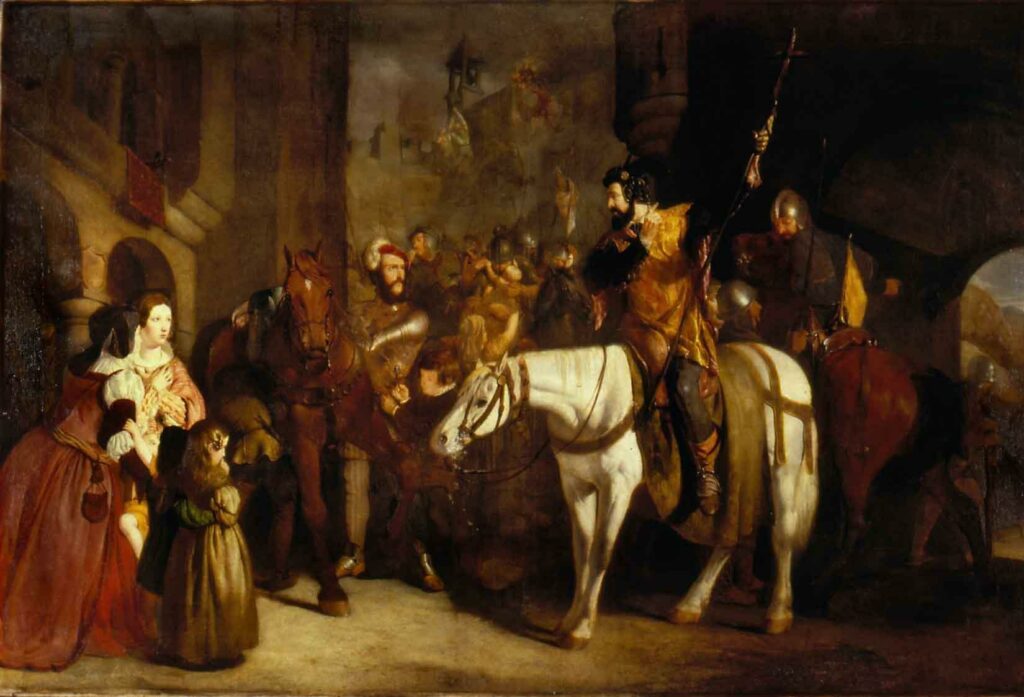
The Fiery Cross by James Drummond, is one of the great history paintings in the Smith collection, acquired through a bequest of the artist, a few years after the Smith opened, in 1877.
It shows the ‘Fiery Cross’, a Celtic signal used as a call to arms, arriving at Stirling Castle. This was carried through Scotland in 1547, by the order of the Earl of Arran, Governor of Scotland, during the time of the ‘Rough Wooing’, when Henry VIII of England was attempting to marry his son Edward to the infant Mary Queen of Scots. It was at this time that the Stirling Town wall was built and strengthened, and Mary was moved to Inchmahome for safety.
The artist James Drummond (1816 – 1877) was a member of the Society of Antiquaries of Scotland along with fellow artists Joseph Noel Paton, D.O. Hill and William Fettes Douglas. Most of Drummond’s subjects were drawn from Scottish history and allowed him to reveal his great knowledge of costume and weapons. Drummond also became curator of the National Gallery in 1868. His childhood was spent in apartments at 49 High Street, Edinburgh, formerly John Knox’s house. Later in life the artist made a series of drawings of Edinburgh’s old town during the 1840s-50s at a time when many buildings were being demolished.
The Polmaise Colliery exhibition continues at the Smith. This photograph is from Cowie Colliery, located in Bannockburn.
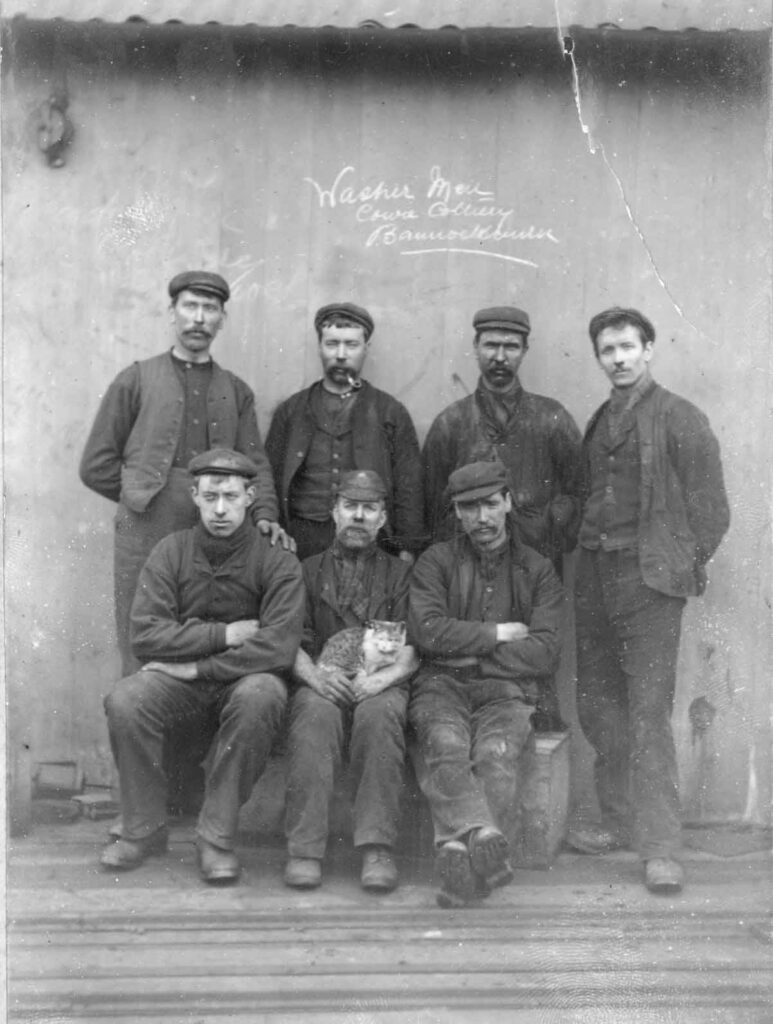
It opened in 1894, ten years earlier than Polmaise, and closed in 1953.The image dates from the 1920s and is of the men who tended the machines which washed the dust from the coal. A man in the back row is smoking a clay pipe and the man in front of him has the pit cat on his knee. Many pits were bothered with rats and mice, attracted by the animal feed spilt in the process of feeding the pit ponies, so cats had a part to play in the mining industry.
Cowie was a smaller colliery, employing on average 344 men, with 563 at its peak, when it became part of the National Coal Board in 1947. It had baths from 1931 and a canteen. It produced 400 tons of coal a day, averaging 100,000 tons a year. This was mainly coking, house and steam coal of high quality.
For generations, Stirling’s economic well- being depended on coal, and in spite of the closure and capping of Polmaise 3 & 4 Colliery in 1987, there are vast reserves of coal still underground.
An amazing amount of history can be contained in a single small piece of paper like this tram ticket, the only one of its kind in the Smith collections. The Stirling and Bridge of Allan Tramway Company operated from 1874 – May 1920, and although there was a tram with a petrol engine from 1913, the company was still operating with horses in 1920. The company had many difficulties, including the public expectation that the tram would stop anywhere along the route for passengers to get on and off.
The ticket dates from 1899, when Andrew Wardlaw became secretary, or after.
The advertisement “For dainty luncheons and teas try McLachlan and Brown, French Milliners and Outfitters 8 – 12 Murray Place Stirling” is on the back of the ticket. The shop is very much in the folk memory of Stirling as a great retail destination with its own family stores. McLachlan and Brown were taken over by the House of Fraser in 1946, but continued to operate under their own name. Writing of ‘Shopping in Stirling in the 1960s’, poet Eunice Wyles recalls that The retail reputation hung/ On McLachlan and Brown, McCulloch and Young. The tram ticket reveals that McLachlan and Brown also had a branch in Paris at one time.
The Smith collection has a 1917 wedding dress from the store, and three donations of carrier bags from citizens who want its contribution remembered.
The Stirling Smith collection contains many treasures, some of which have seen better days and are in need of major conservation work. Many are anonymous, like this ‘Portrait of a Man in Uniform’. 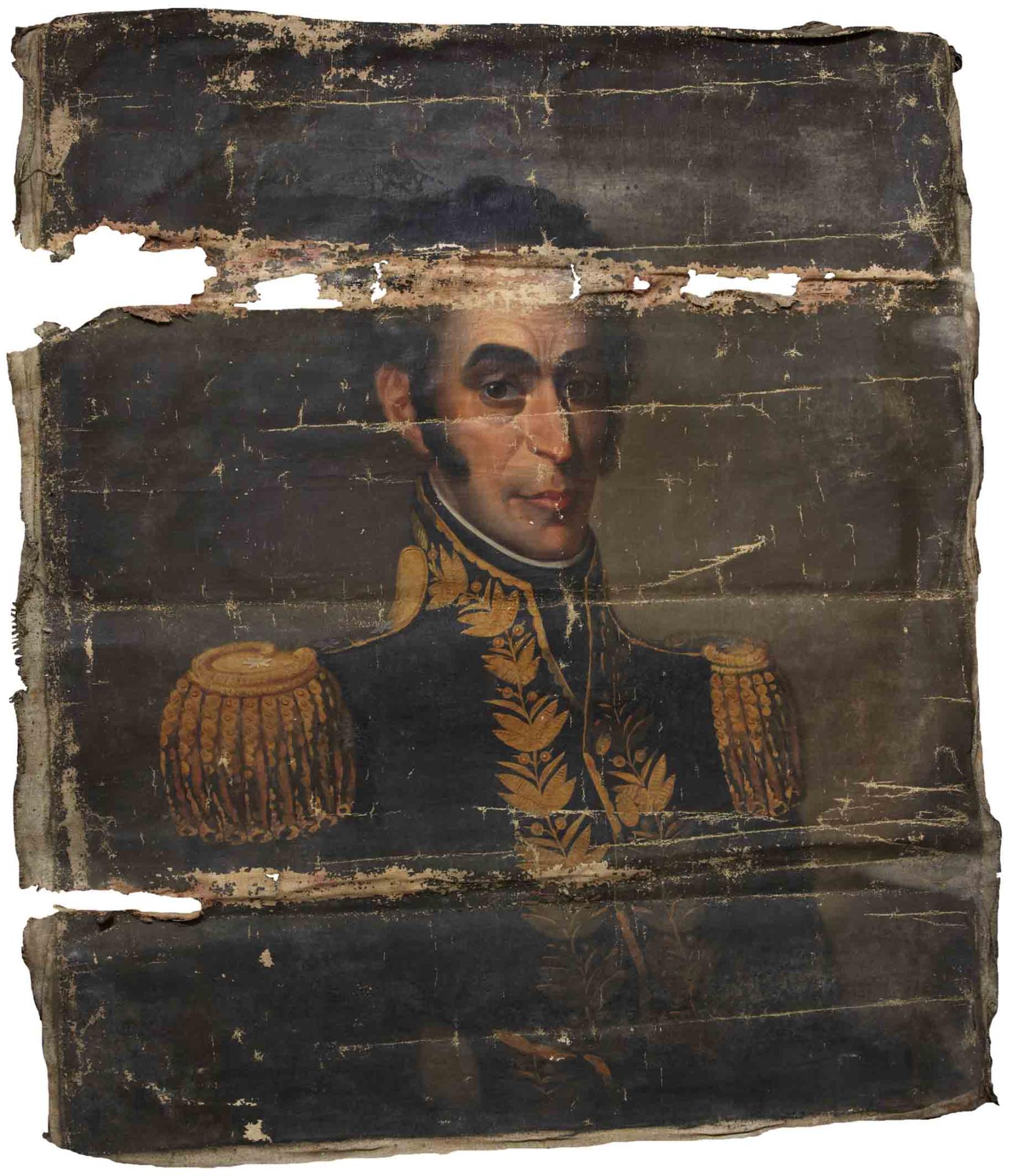 When it was published in the Public Foundation Catalogue of paintings in public collections it was recognised by Smith volunteer Michael Donnelly as a portrait of Simon Bolivar (1783 – 1830), The Liberator, known in Scotland in his lifetime as ‘The Wallace of South America’.
Bolivar was a soldier and statesman who fought and secured the freedom of Venezuela from imperial Spain, and went on to secure the liberation of Ecuador, Peru, and finally, Bolivia (which was named after him). He is the national hero of Venezuela, and when their government was working towards social change through music in areas of social deprivation, the Simon Bolivar Orchestra was born, working through ‘El Sistema’, the system of encouraging every poor child to play a musical instrument. In 2008 the principles of El Sistema came to Raploch and The Big Noise Orchestra came into being. How appropriate that the Stirling museum should have a painting of Bolivar himself!
The painting was in the possession of Thomas Stuart Smith, founder of the Smith, whose own radical paintings of black men made him unpopular. The modern equivalent would be to have a portrait of Che Guevara – and the Smith has that too, donated by the G8 protesters in 2005.
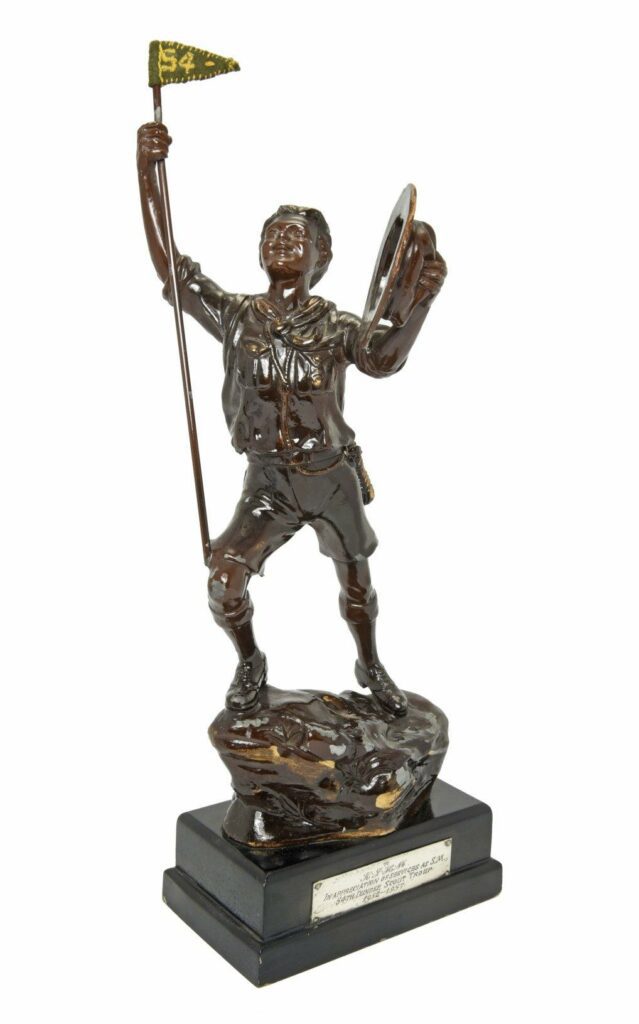 This statuette in cast aluminium alloy, varnished in brown and with gold highlights is one of several items donated to the Stirling Smith by the late Dr. Ken Mackay (1931-2014). Ken was a life-long Scout, and the trophy was presented to him for his services to the 54th Dundee Scout Troop, 1952-1957, as a Scout Leader, before his teaching career took him to Stirling.
The statue is reputedly from a design by Scout founder Robert Baden Powell himself. Baden Powell was an accomplished artist who believed in drawing every day. The figure is probably by Hungarian sculptor Julius G. Maysch (1882-1946) who produced a similar iconic statue in 1930. There are dozens of Scouting statues and figures throughout the world, but this one is special. Its fabric pennant was sewn by a member of the 54th Dundee Troop.
Ken Mackay was a much-loved teacher of science, both at the High School and the University of Stirling. He pioneered industrial archaeology, taking his pupils to record lime kilns and early industrial buildings. It is thanks to him that the Observatory Tower of the Stirling Highland Hotel (formerly the High School of Stirling) is functional, with a telescope for astronomy. It was disused for decades, before Ken and a team of his students dug out the pigeon droppings and restored the Observatory apparatus.
The Ailsa Black exhibition featuring beasts both wild and domestic finishes this week. One beast which will be remaining in the Stirling Smith’s collection is Ailsa’s whimsical portrait of cat-in-charge Oswald. The painting has been purchased by an anonymous benefactor as a tribute to all of the marketing and publicity work undertaken by Oswald in the last 10 years.
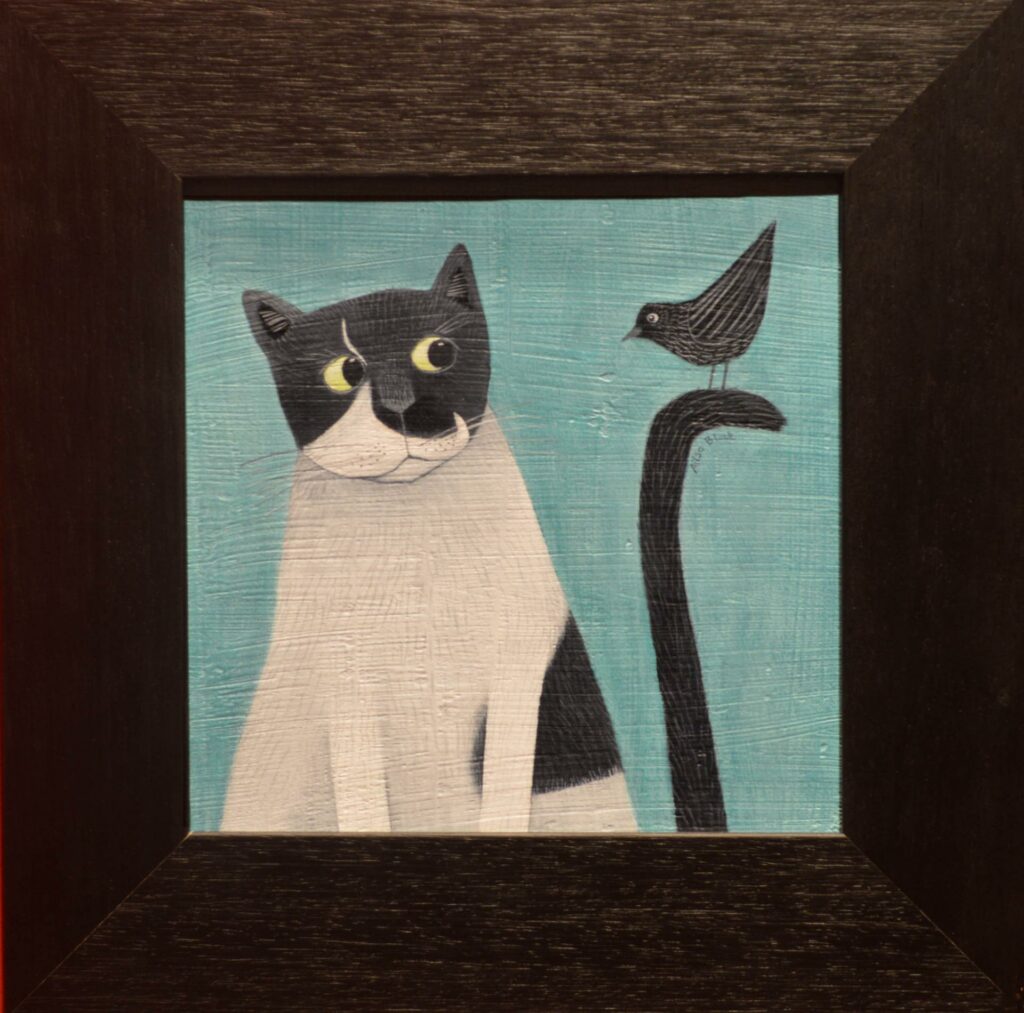
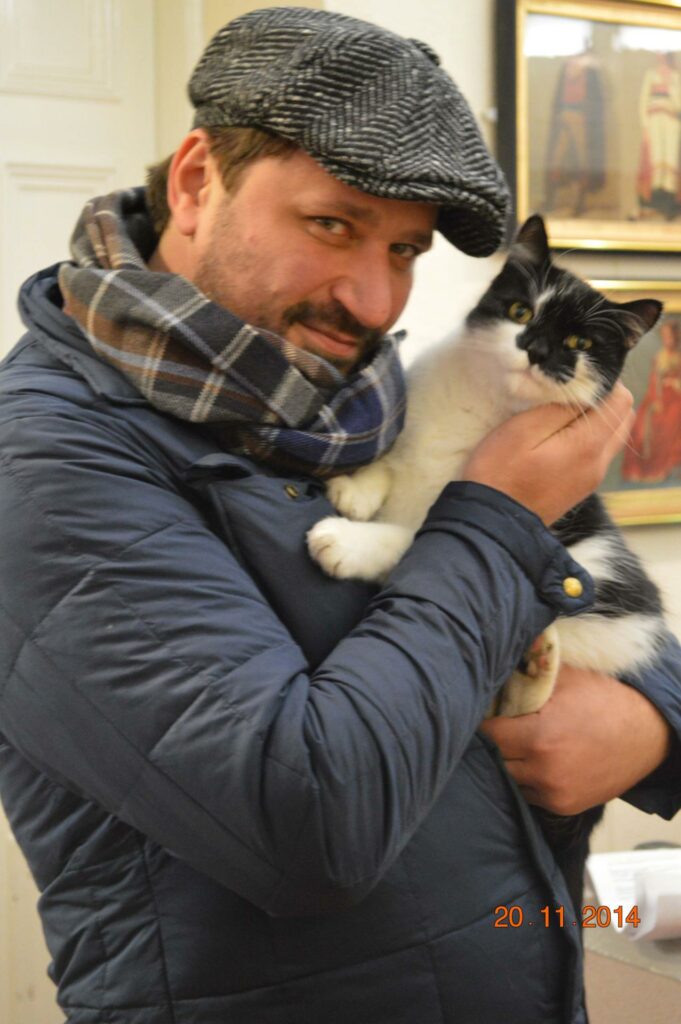
Oswald was appointed Head of PrRing in 2004, and does a meet and greet service for visitors on a daily basis. His favourite evening meetings in the Smith are those of the Stirling Literary Society, the Family History Society and the Stirling Field and Archaeological Society. He is also a supporter of Dig It! 2015, the Year of Archaeology. At night, he has security duties and is always on call. On Thursdays, he accompanies the team of volunteer gardeners who keep the Smith’s grounds smart.
Oswald has his own Twitter account, @SmithSupercat, where you can discover how many birds he has caught. Recent appearances on the Japanese TV programme, Mr. Iwago’s World of Cats, and with Russia 1 TV star Victor Loginov for the filming of an episode of Cat Planet means that both he and the Smith have an international following on social media.