

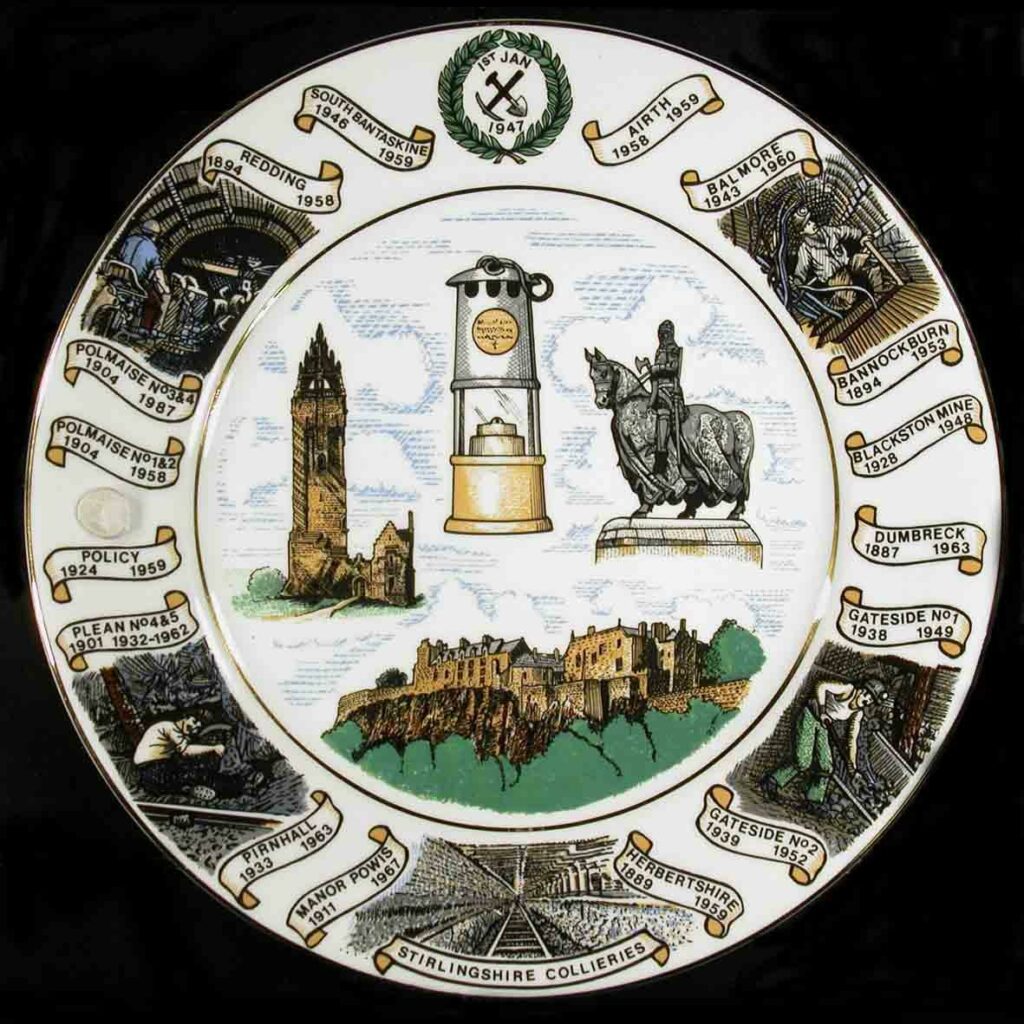
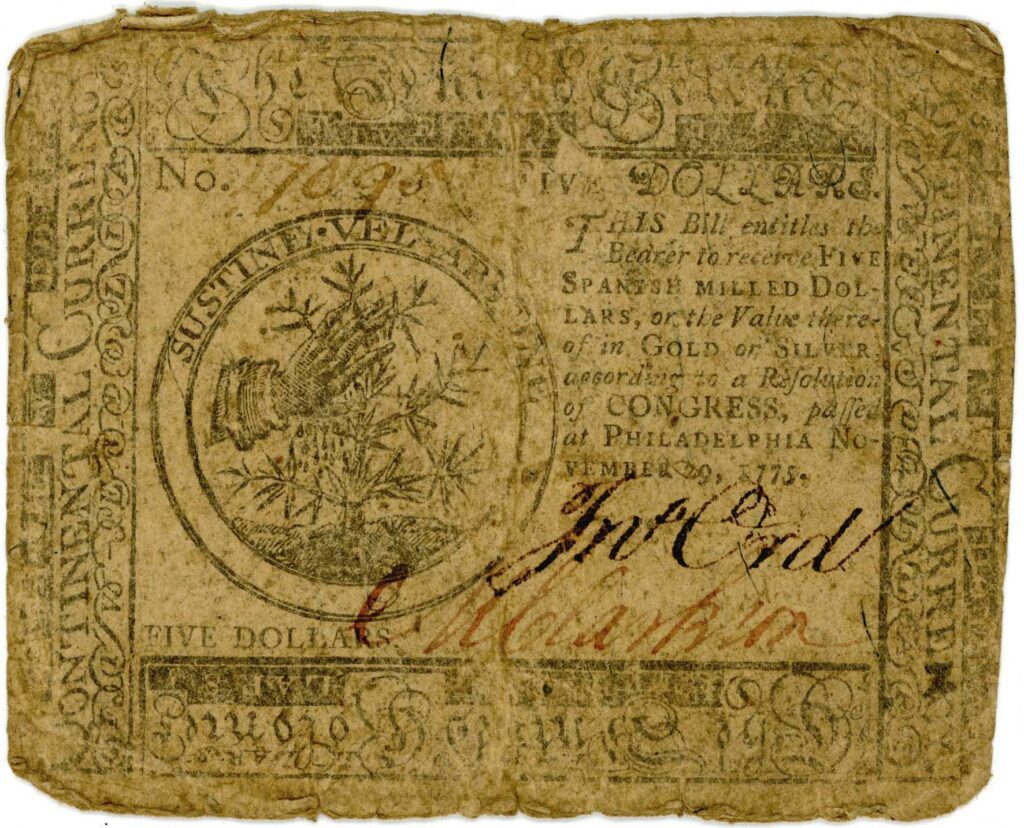
This rare plate, donated to the Smith collections by colliery workers William McKinlay and Raymond Frew, attempts, to sum up the significance of the Stirlingshire collieries. That the miners and the mining industry were as important to Stirling, as Stirling Castle, William Wallace and Robert the Bruce is undeniable. The deep mines sunk here, such as Bannockburn (1894), Plean (1901), Polmaise (1904) and Manor Powis (1911) were the wealth generators of the local economy and were worked by a community of people who regarded mining as a way of life, who worked together, lived together and played together. They changed the face of local politics, bringing in new and radical ideas.
When the Miner’s Strike started in 1984, Polmaise Colliery No 3 and 4 was one of the most efficient and productive mines in the country, had had major investment in new machinery and had an estimated coal reserve of 40 years. Three years later it was closed, flooded and destroyed.
As the 30th anniversary of the end of the Miner’s Strike approaches, it is perhaps time to look again at how mining shaped the Stirling community. There is no great visitor centre commemorating the miners, but there is the possibility of doing another exhibition. The Stirling Smith invites you to meet the Polmaise Colliery Face Book man in person to discuss this at 2pm on Friday 23 January 2015 in the Smith.
This rare print of a work by Irish artist John O’Connor (1830 – 1889) is a recent gift to the Stirling Smith collections. It was donated by Jean Archibald, who when working for the British Library, was able to pick up interesting Scottish views from the print shops in Great Russell Street, London.
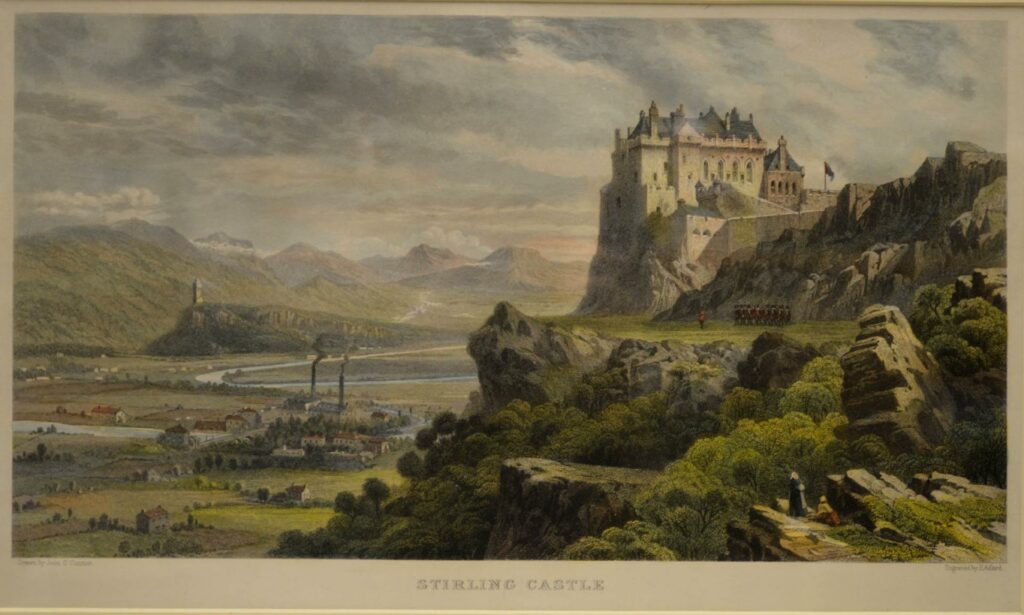
The image dates from 1869 or after, when the Wallace Monument was completed on Abbey Craig. As the work was engraved by H. Adlard for reproduction, it must have been completed in 1869, as works by him are limited to the period 1824 – 1869.
O’Connor had a very interesting career. Orphaned at the age of 12, he got work as a call boy and assistant scene painter in a Belfast theatre. He became skilled in painting and got another post in Drury Lane Theatre in 1848, moving to the Haymarket Theatre as Principal Scene Painter in 1863. He exhibited his own work from 1854 onwards, and obtained the patronage of the Royal family.
His view of Stirling incorporates all of the best features of the landscape, but as a scene painter, he has manipulated them to create a familiar, if unrealistic picture, showing features which cannot be seen from one viewpoint.
Keeping on the theme of ‘Stirling, the Artists’ Town’, here is another example of a great work in the Stirling Smith’s collections by a Scottish artist who lived locally. Ian Campbell was born in Oban in 1902 and studied at Glasgow School of Art from 1921 to 1925, where he was taught by Maurice Grieffenhagen. He became a teacher in Glasgow, before becoming Principal Teacher of Art at Dollar Academy in 1937 until his retirement in 1968.
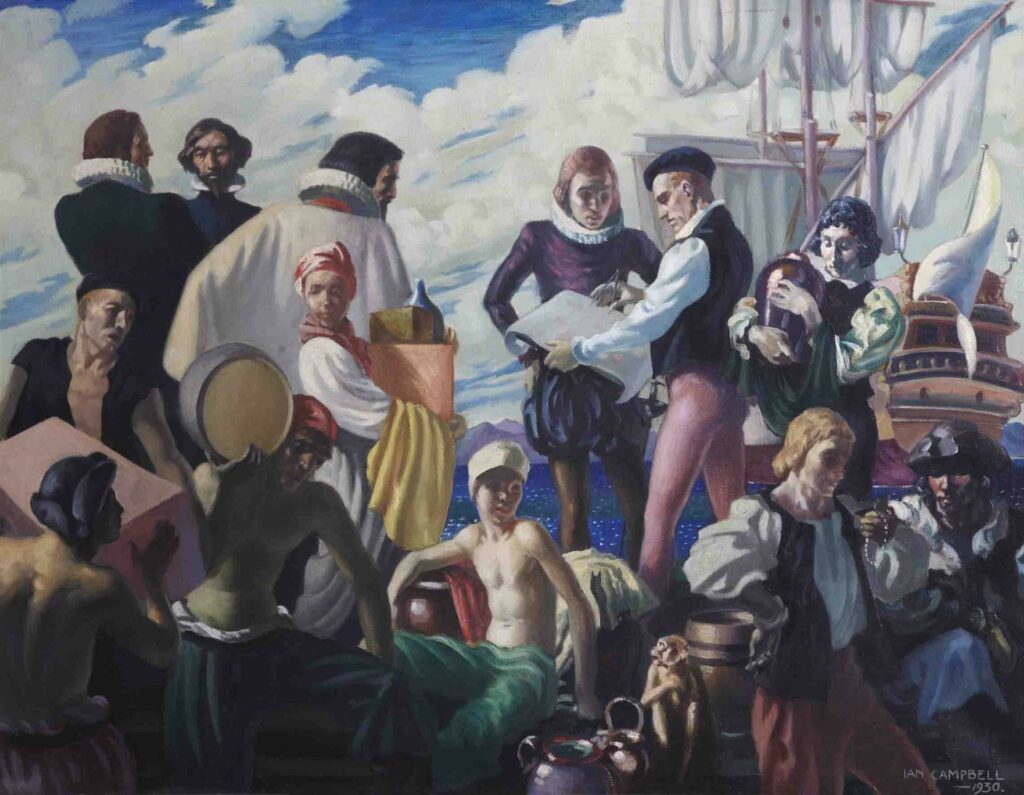
As an artist, Campbell was a force to be reckoned with. He exhibited every year at both the Royal Glasgow Institute and the Royal Scottish Academy in Edinburgh. The painting ‘Westward’ was done at the age of 28 and was shown at the Canadian National Exhibition in Toronto in 1931 as part of a small selection of contemporary art from Scotland. It was produced as a decorative composition, possibly as a proposal for a mural scheme.
Campbell was also a talented portrait painter. One of his works, in pencil and chalk, is owned by the National Portrait Gallery in London. Only two other works by him are in public collections, and a retrospective of his work would highlight another unwritten part of Scotland’s and Stirling’s art history.
The artist died in Dollar at the age of 81.
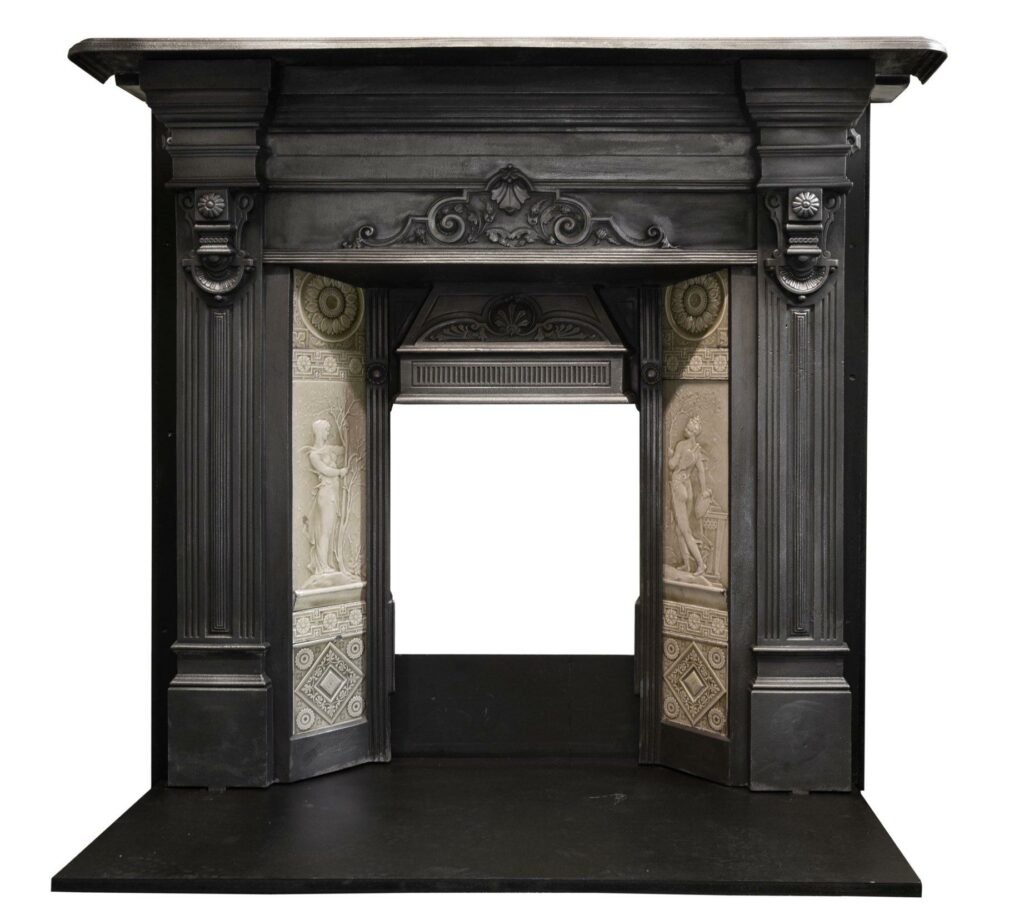
Even the mantle shelf of this fireplace, made in 1894 – 5 is of cast iron. It has been in the Stirling Smith collections for many decades, but until a few weeks ago it had thick layers of paint, in white pink and gold, obscuring the original design. Thanks to a gift in the name of the late Thomas McDonald (1949 – 2014), the fireplace has been restored to its original glory, through a visit to Possilpark Shotblasting in Glasgow, and applications of black lead by Smith staff. It has been given a set of Minton tiles by the Glasgow – born designer John Moyr Smith (1839 – 1912), with figures representing Summer and Winter, bordered with sunflowers, the symbol of the Aesthetic Movement.
Thomas McDonald was a Stirling man who loved his city, and who did much to improve it. A past master of Lodge Abercrombie No 531 and an honorary member of Lodge Stirling Ancient no. 30, he gave help with interpreting important masonic items in the Smith collections. He led the process of restoring the George Christie Memorial Clock in Allan Park, and shot blasted the decorative lamp posts at the Stirling Smith in the year 2000. He rescued the Grand Lodge of Scotland plaque from Ault Wharrie House, Dunblane, in 2007.
He would have approved of this timely restoration in his name.
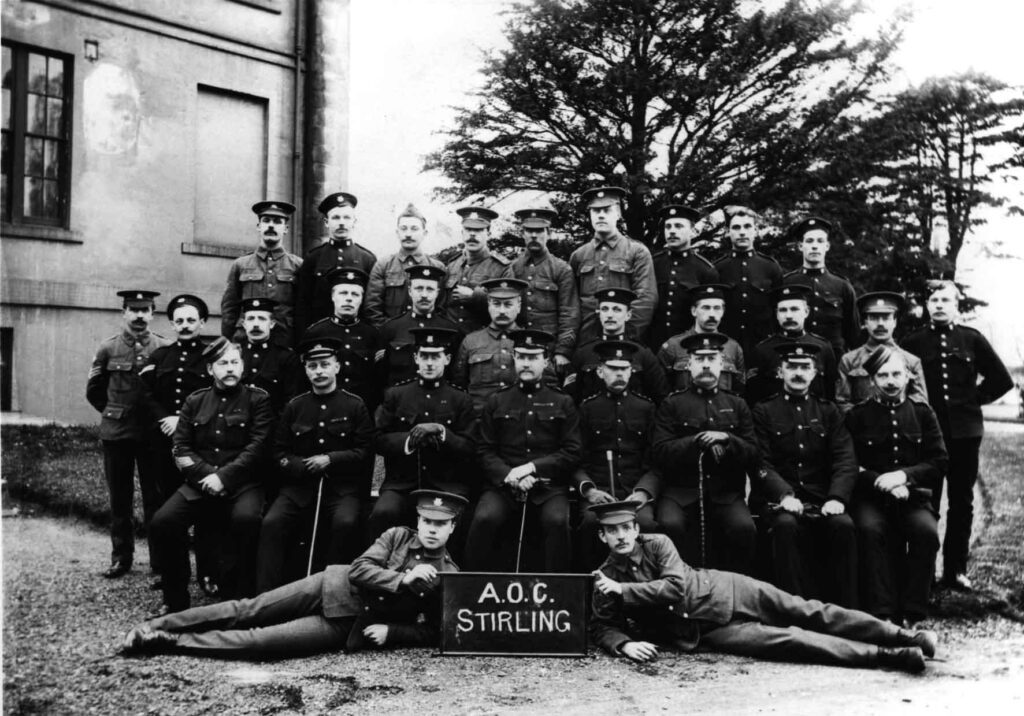 On Monday night, the Friends of the Smith are hosting a talk by Colin Tennant of Historic Scotland on the development of the Engine Shed, Forthside as Scotland’s first National Conservation Centre. This new national facility in Stirling will act as a focal point for those seeking information, advice and guidance on how to look after the built environment. Visitors will be welcomed to changing exhibitions and demonstrations of ‘conservation in action’. They will be able to chat to resident craftspeople and get information on traditional skills and building materials.
This is, therefore, a chance to look at the activity in Forthside 120 years ago, when the estate belonged to the Royal Army Ordnance Corps and the Engine Shed, built to service the railway engines which served the site, was only about 15 years old. The 11th Company RAOC are posing beside Forthside House and their occupations included an armourer, artificer, clerks, hammermen, a saddler, a blacksmith (and footballer), a painter, cook, baker, tinsmith and carpenter. The ordnance workers had to have a trade as well as army training. The photo is from Major Peter Whitehead’s collection, now in the Stirling Smith.
The Forthside estate was operated by the RAOC from 1886. One of its last major uses was to equip the army for the assault on the Falklands. The contents of the stores were lost on the container ship Atlantic Conveyor which was sunk by an exocet missile.
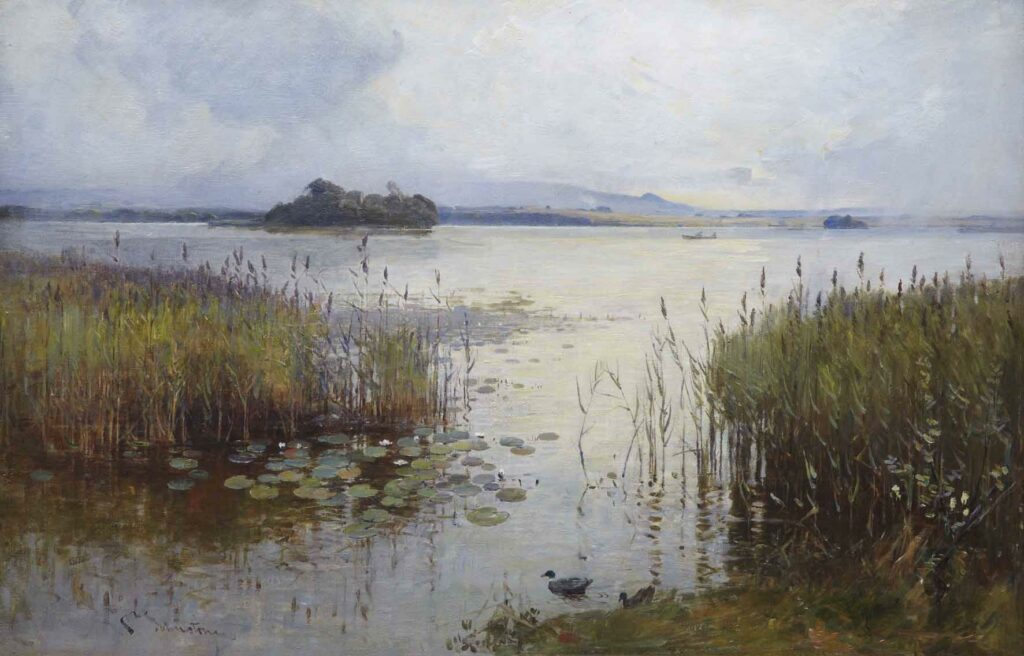
This is one of two works in the Smith collection by the Scottish artist George Whitton Johnstone RSA RSW (1849-1901) and dates to 1890.
Johnstone was born in Glamis and went to Edinburgh as a cabinet maker. He later became a pupil at the Royal Scottish Academy Life School, painting portraits and genre pictures. Later in his life, he preferred landscapes and painted many scenes around Eskdale and Annandale. He also went to France, where he painted in the Fontainebleau Forest. His composition and foliage are reminiscent of the Barbizon painter Corot.
The Lake of Menteith is one of the great romantic beauty spots within the Stirling area. The viewpoint is towards the Island of Inchmahome, the site of the Augustinian Priory to which the infant Mary Queen of Scots was taken for safety, and the burial place of the author and laird of Gartmore, Robert Bontine Cunninghame Graham.
The painting was exhibited at the Royal Scottish Academy exhibition of 1891, where it probably attracted the attention of the art collector and Stirling dentist Leon Jablonski Platt. Platt bequeathed his art collection to the Smith on his death in 1914, and this is undoubtedly one of the Smith’s treasures.
When Anne McGuire MP wrote her last column for the Stirling Observer two weeks ago, it was headed ‘Eighteen years have passed in a flash’.
Like many other politicians representing Stirling, Anne McGuire held high office in Westminster, starting off as Parliamentary Private Secretary to Secretary of State for Scotland Donald Dewar and ending with her appointment as DBE in the 2015 New Year Honours. In 1997, she made history when she unseated Stirling MP Michael Forsyth, who was Secretary of State for Scotland. She was Stirling’s first woman MP and was joined in 1999 by Dr Sylvia Jackson who served until 2007 as Stirling’s first Member of the Scottish Parliament. This double portrait by textile artist Jill McOwat was commissioned in 2003 to mark a new political era.
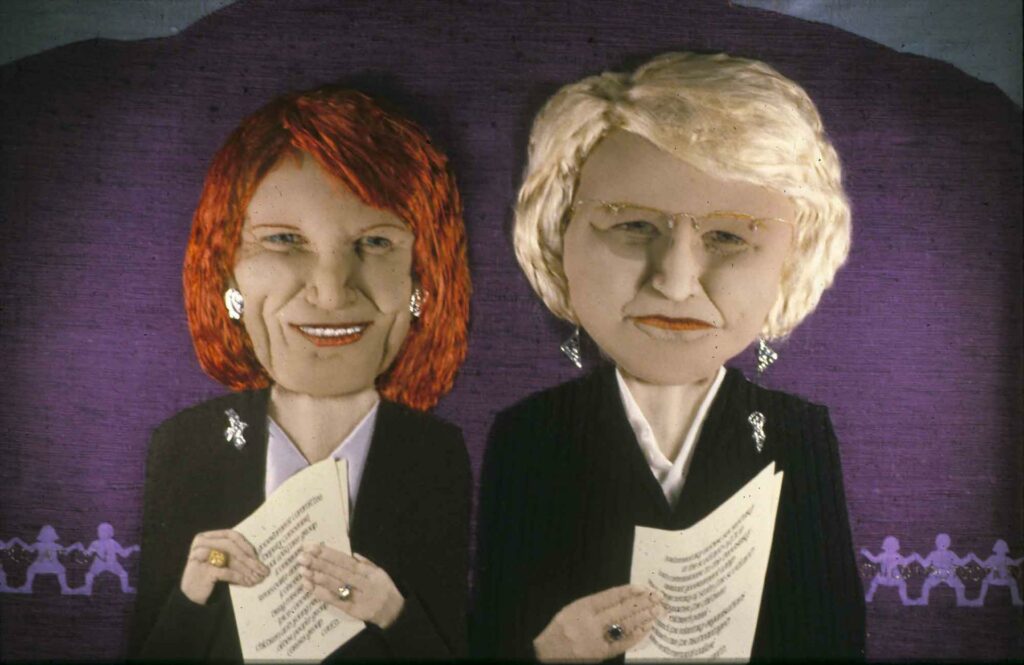
The artist paid close attention to the private as well as the political lives of her subjects. Sylvia Jackson’s brooch denotes her support of the Royal Society for the Protection of Birds. Anne McGuire was given a country dancer brooch for her interest in that subject. Both politicians wear favourite ear rings and each carries a document relating to their respective parliaments.
The Smith portrait hangs beside the bust of Sir Henry Campbell – Bannerman, MP for Stirling for 40 years and Prime Minister 1905 – 8. He was not in favour of votes for women, and visited Stirling only once a year.
Elspeth King
With the New Year comes a new face at the Smith. The Stirling Smith Girl is the creation of artist Marie Louise Wrightson, done as homage to J G Mathieson’s Stirling Girl of 1928, which in turn honoured the Gibson Girl of the 1890s.
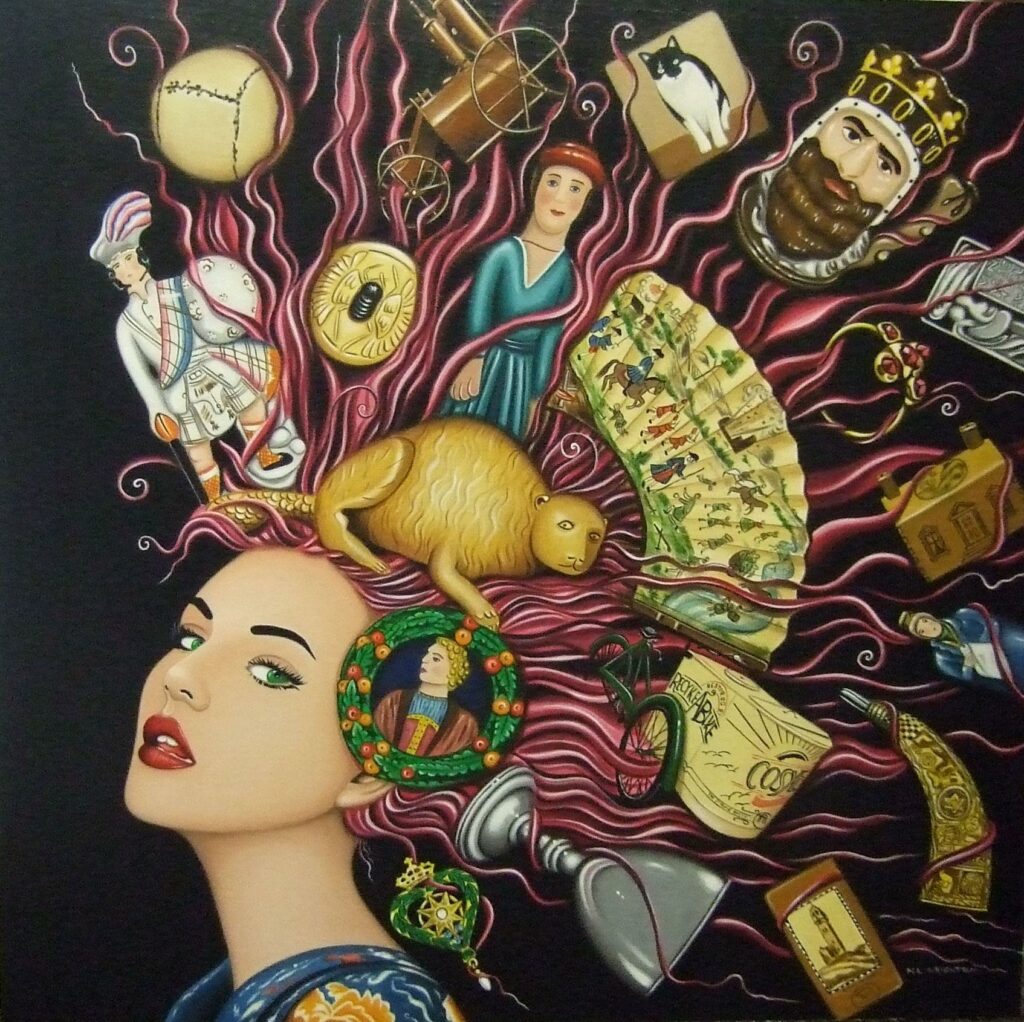
The Stirling Smith Girl is a celebration of the rich collections of the Stirling Smith Art Gallery and Museum. Every week for the last ten years we have published an object or an image from the Smith’s collections in the Observer. If we continue this column for the next 140 years, we will not cover all of the riches in the Smith collections!
The artist, a graduate of Duncan of Jordanstone School of Art, has depicted no less than 19 key objects from the Smith, all of which have featured in this column. A Stirling Head, Wallace, Bruce, the ancient figure of Justice, a cup from the Neish pewter collection, a carved cow horn of 1705, the oldest football in the world, James Guthrie’s ring, the Cosy End Ice Cream Tricycle, Hugh Green’s Glasgow School of Art medal and even Oswald the Cat all feature in her headwear. The story of both Stirling and the Smith can be told from this one work of art.
The commission was made possible with funding from the Common Good Fund of Stirling.
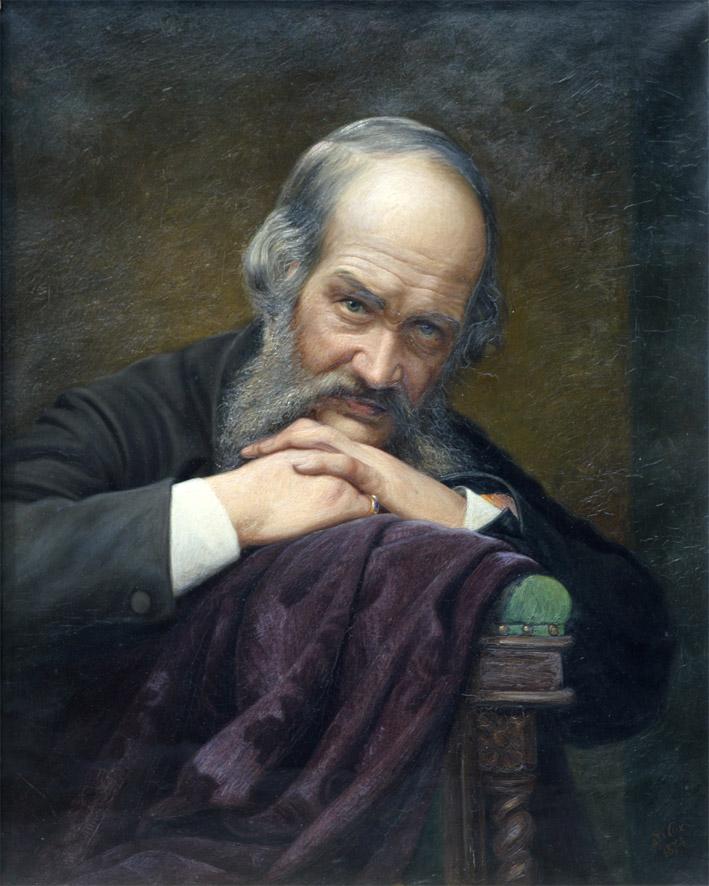
145 years ago today, the artist Thomas Stuart Smith died in a hotel in Avignon. The death was sudden and unexpected. He had planned to be in Stirling to personally superintend the building of the Smith Institute in 1870-71, but he died of ‘apoplexy’ following a cold. He was buried in common ground, but on hearing the news, the Smith Trustees had his body disinterred, and re-buried in the main cemetery in Avignon. They also commissioned this posthumous portrait from his friend and Trustee Alfred Cox. Within five years, a site was located, the architect John Lessells of Edinburgh was engaged, and the building was opened in Dumbarton Road.
2014 has been a very significant year for the Smith. Today, there are no great benefactors of the magnanimity of Smith himself, but an organisation which has supplied vital funding this year is the Clackmannan and Stirling Environment Trust, whose contribution has helped re-furbish the theatre, provide money for lighting and for essential security. CSET was also the body whose generous grant in 2004 helped create Ailie’s Garden, the biodiversity garden at the back of the Smith which continues to give pleasure to thousands of visitors. At the turn of the year, we should always give thought and thanks to our predecessors whose gifts have made things possible, and to contemporary benefactors like CSET, whose help makes the Smith such a continuing success.