

The University of Stirling is well–known as Scotland’s University for Sporting Excellence, a designation by the Scottish Government in recognition of the contribution made to Scottish sport. From the start of the University, the Gannochy Sports Centre was open to the local community. In 1981, the now-famous golfer Colin Dalgleish was the first sports scholar, and in 1991, the Scottish National Tennis Centre was developed. The mission of the University is to deliver the best for Scottish sport through the powerful and inspirational combination of sport and education.
Nearby Bridge of Allan has a distinguished sporting history which is now largely forgotten. Physical fitness was important in a spa town, and curling, skating, golfing and tennis had good provision. The Strathallan Games, founded in 1852 still take place on the first Saturday in August. In 1908, they co-incided with the Scottish Lawn Tennis Championships. The only remaining evidence of this national event are the photographs and notices shown here, rescued by Smith staff member Evelyn Cameron.
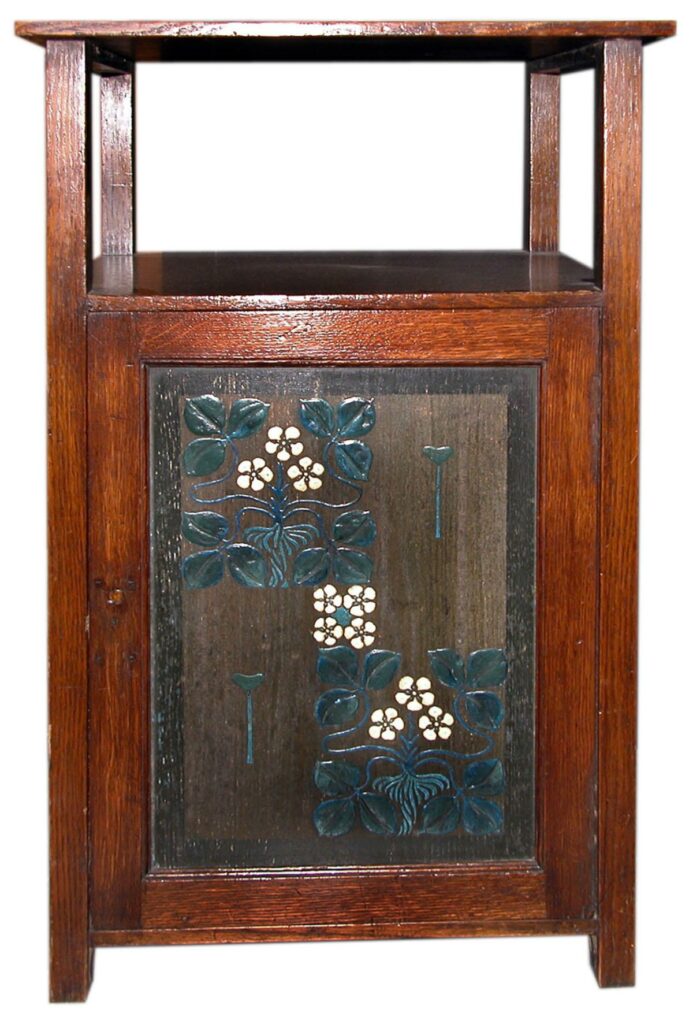 Today’s object from the Stirling Smith collections is an arts and crafts oak cabinet which has a door decorated with gesso. It was made by the furniture maker Henry T. Wyse and was part of the furnishings of No. 1 The Homesteads, Stirling. It was left to the Smith by Ailie Maclaurin (1913 – 2000), daughter of Robert Maclaurin (1871 – 1948) who established The Homesteads in 1911 as a garden city development where the householders could aim for self-sufficiency thanks to the generous amount of land surrounding each house.
Maclaurin was an inventor, scientist and businessman who developed the energy saving white flame heating system. Originally based in Glasgow, he had issues with Glasgow Corporation and published the pamphlet A Peep at the Glasgow Gas Scandal, before leaving to live in Stirling. He brought with him the Scottish Guild of Handicraft, from Glasgow to Burghmuir, Stirling in 1909. The Guild was a co-operative partnership which produced art pottery, furniture, metalwork and stained glass in the style which is known as Arts & Crafts. The partners worked in the belief that homes should have furnishings and fittings which were functional, simple and also well – designed. The cabinet by Wyse is an outstanding example of the style.
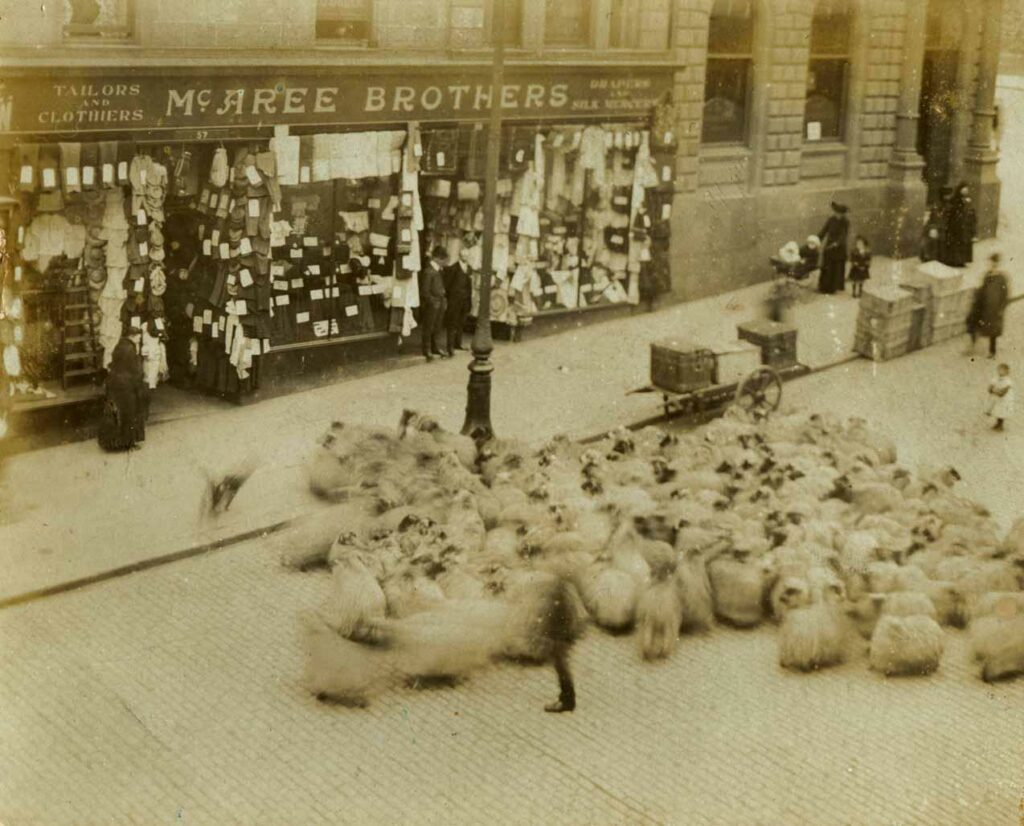 McAree Brothers, established in 1878, are described by current fans familiar with their shop in King Street as “knitting heaven in Stirling” on account of their yarn stock and knowledge of the world of knitting. As can be seen from this photograph of c1900, they have always had a close relationship with wool. The flock of sheep are on their way to the market in Wallace Street, and on market days, sheep were as common a sight in King Street as cars are today. On one occasion, a sheep broke loose and had to ousted from McAree’s front window display.
Working with the Danish Cultural Institute, McAree’s have sponsored the creation of a large woollen piece called Knitworks, now on show in the Stirling Smith until 29 August. It is made of 15 x15 centimetre squares, some of which are by knitting designers from Scandinavia and Scotland, and others by visitors to the Nordic Knitathon Workshop at the Edinburgh International Fashion Festival in the National Museum of Scotland. The Smith is the first venue for its Scottish tour; admission and parking are free.
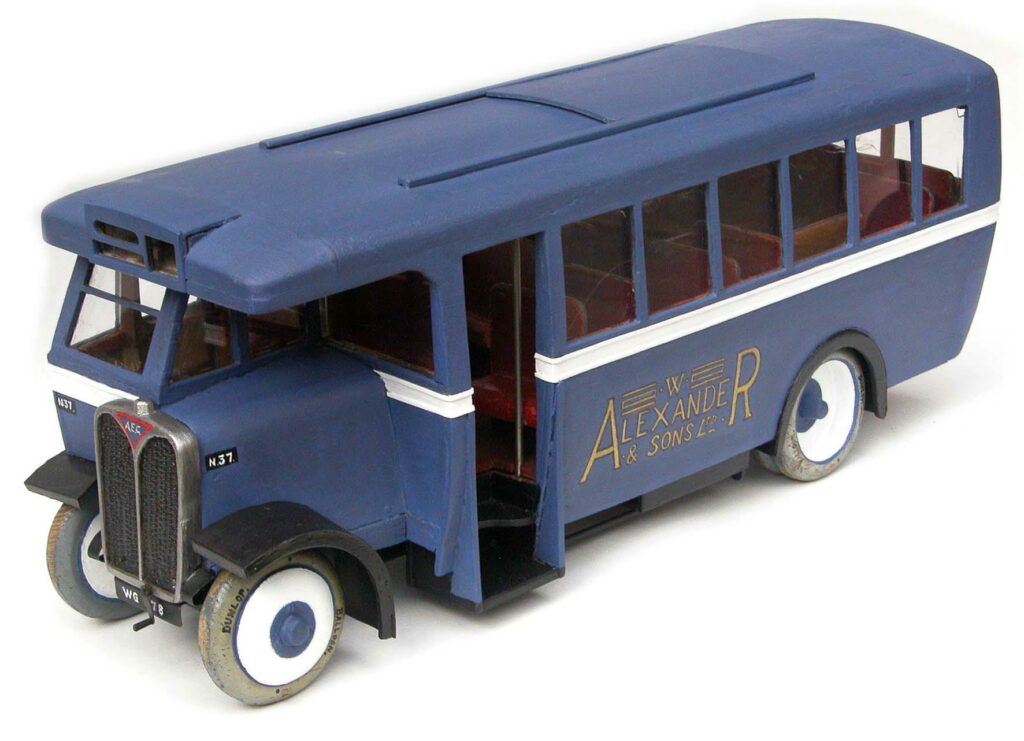 Most of us have forgotten that Stirling was at one time a centre for the coach building industry, with the main coach works sited where Marks & Spencer now is, in Murray Place. The Raploch coach building works of W. Alexander and Son was set up in Drip Road in 1931, and single decker buses were built there. Although the company is now based in Falkirk, it had strong Stirling associations. The Bluebird branding of the luxury coaches was developed by Stirling artist Sandford Morley (1910 – 1958)
This Raploch-built bus of the period 1931-1935 is a service bus, and recent purchase for the Smith’s collections. It required extensive restoration, and both purchase and restoration money came from the Friends of the Smith. Transport history is not something which can be dealt with comfortably in the present confines of the Smith, but fortunately, this bus is a toy measuring 25 by 7 inches. Most of the bus details are faithfully reproduced, and at one time it even had lights inside. It is typical of the kind of pre-war toys which skilled workmen made for their children. The bus has a Falkirk registration number, and the only thing missing is the headlights.
When the coach works outgrew the Drip Road site, they were moved to Camelon in 1958.
During the summer, this very detailed painting of the Battle of Bannockburn by Andrew Hillhouse is on display in the Stirling Smith Art Gallery’s Bannockburn exhibition. In it, the artist has attempted to include all of the action of the second day of the battle, 24 June 1314.
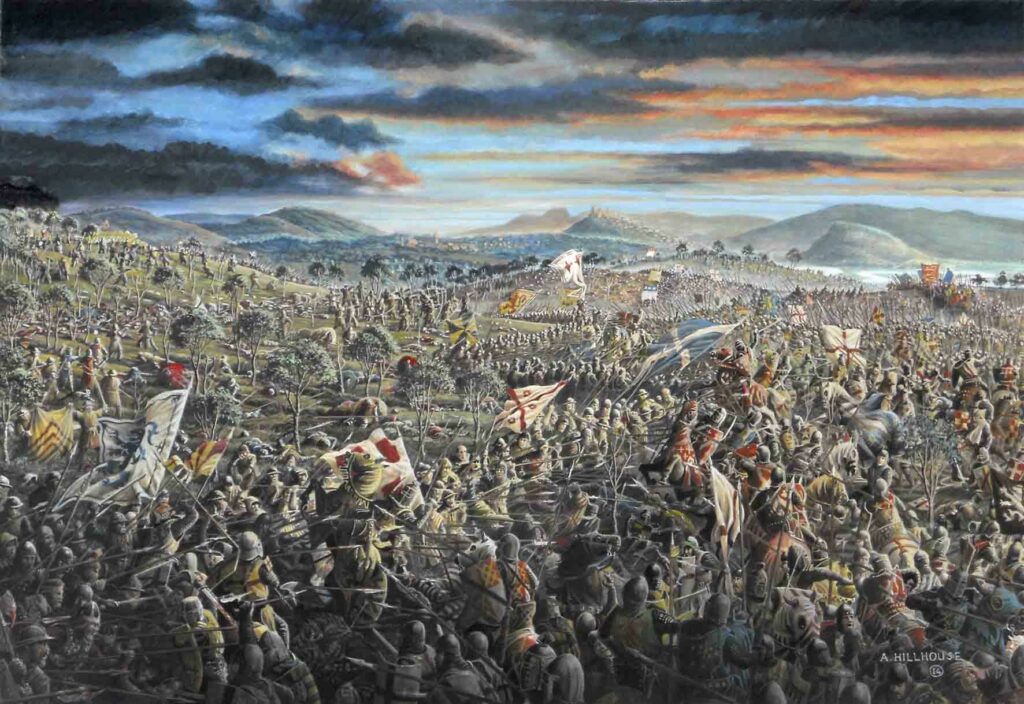 The information is taken from contemporary sources, and the artist has depicted the whole known sequence, from the Scots kneeling in prayer before the battle on the far left, to King Edward fleeing the field on the far right. The painting requires close personal study as it has a key, showing 46 different points of interest, including episodes in the battle, the landscape, and the heraldry of both the Scottish and English knights.
There are many ways of understanding the past, and we need to use all of them. Yesterday and on Monday, 700 years to the day and hour, Stirling’s bairns re-enacted many of these episodes, scripted by David Smith, Education Officer at the Smith, and guided by Stirling Council’s Archaeologists Murray Cook and Fiona Watson. On Sunday, the March of the Gillies took place in defence of Gillies Hill, preceded by the annual Bannockburn Rally organised from Glasgow on Saturday. With Bannockburn Live still to come, there are many opportunities to get involved. The Smith’s Bannockburn exhibition runs until October.
The Norman McLaren Archive
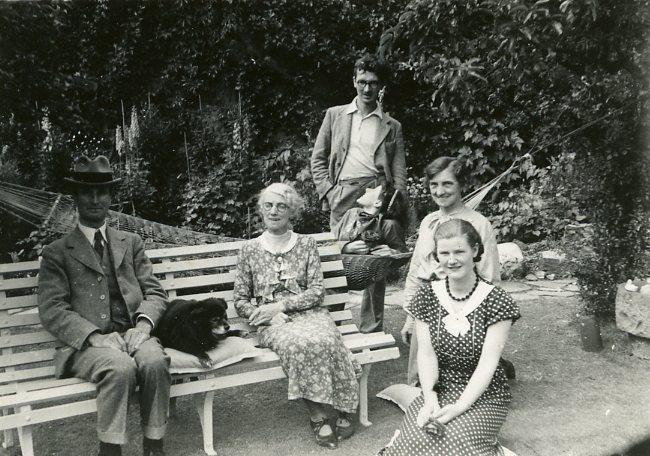
The photograph, from the University of Stirling Archives, shows a sunny day in the back garden of 21 Albert Place, Stirling. Left to right are William McLaren, his sister Jessie, his son film maker Norman McLaren, and Norman’s friends Helen Biggar and Biddy Russell.
This is one of 80 photographs in the exhibition A Dream of Stirling, which has now less than two weeks left to run at the Stirling Smith Art Gallery and Museum. Many of the photographs show the house and gardens of 21 Albert Place in the years between the Wars, and give a special insight into the social history of the Kings Park area. William McLaren was a successful interior decorator and picture frame maker who assisted with the fine art exhibitions in the Smith. His son was a genius who changed the world with his film making. The photographs show the whole social history of the family; Norman as a young child with his nanny, tea and croquet on the lawn; picking apples and sunbathing in the garden; parties mocking Hitler, the family digging their Anderson shelter on the outbreak of World War 2. There is also a treasured family film.
At 12.30pm on 19 June, archivist Karl Magee will be giving a talk on Grierson and McLaren, Tales from the Archives, in the Stirling Smith. Admission and parking are free, and this is a rare opportunity to learn more about the film treasures of the University of Stirling Archives.
The Public Catalogue Foundation now known as Art UK has, over the past ten years photographed 210,000 publicly owned oil paintings from 3,000 collections in the UK. All of which are available to see on the PCF website.
The launch of the ‘Art Detective’ programme has opened the doors for art experts to help bring together their knowledge and aid institutions to create more comprehensive records of the paintings in their collections.
Like many institutions the Stirling Smith does not always have the opportunity to investigate each painting in our large collection of oil paintings.
So when Martin Hopkinson (former Curator of Prints, Hunterian Museum, Glasgow) made a suggestion about one of our paintings we took a closer look.
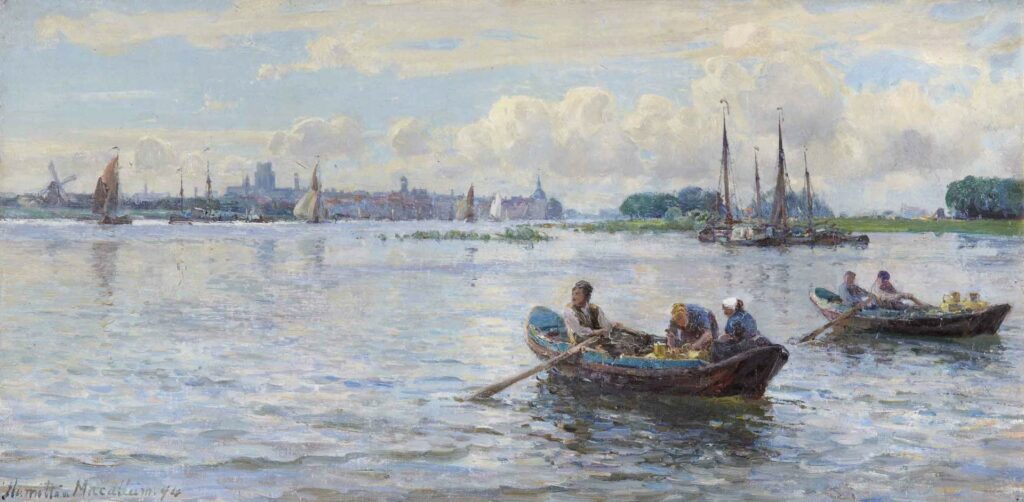
Simply named ‘Habour Scene’ this oil painting by Hamilton Macallum RI RSW, dated 1894 had no indication of its location. Following the suggestion by Martin Hopkinson that this may be Dordrecht, Holland. We began a search that would indeed confirm that this painting was of Dordrecht, from the River Maas.
The tall building is de grot Kerk (big church). We guess that the green landscaped area, is either the Sophipolder Island or the NoordPark which is the area opposite the Doredrect Banks.
Without the help of the Art Detective Project and the specialist help of Martin Hopkinson we would still just be using the term ‘location unknown’ on the collections record.
The invasion of 11 May 1938 had nothing to do with Europe. Apparently the invaders, who arrived in a canoe at Stirling Harbour, came from Montreal. They were Native American Braves, led by Chief Pokobawbees, who arrived to relieve the Stirling people of their spare cash – all in aid of Stirling Royal Infirmary.
The annual Charities Week in Stirling was always a colourful high profile event, and was reported nationwide. In 1938 the invading Braves were welcomed by John J. Munro of the Stirling Observer, chairman of the charity committee, and then went by covered wagon to the Municipal Buildings where they had tea with Provost McAllister. The rest of the day was spent collecting around the town.
Until the introduction of the National Health Service in 1948, hospitals relied on charity collections and private endowments for beds and wards. A ‘bawbee’ was the old Scots word for the half penny which disappeared after the Union of 1707. During Charities Week, the Stirling people knew that their donations were necessary, and the bawbees for the Infirmary were collected by many shops in the town, as well as on the streets.
The Bannockburn 700 exhibition at the Stirling Smith looks at how Bannockburn has been remembered and memorialised over the past 700 years. The royal victor, King Robert the Bruce, has also been portrayed by artists and sculptors in so many different ways.
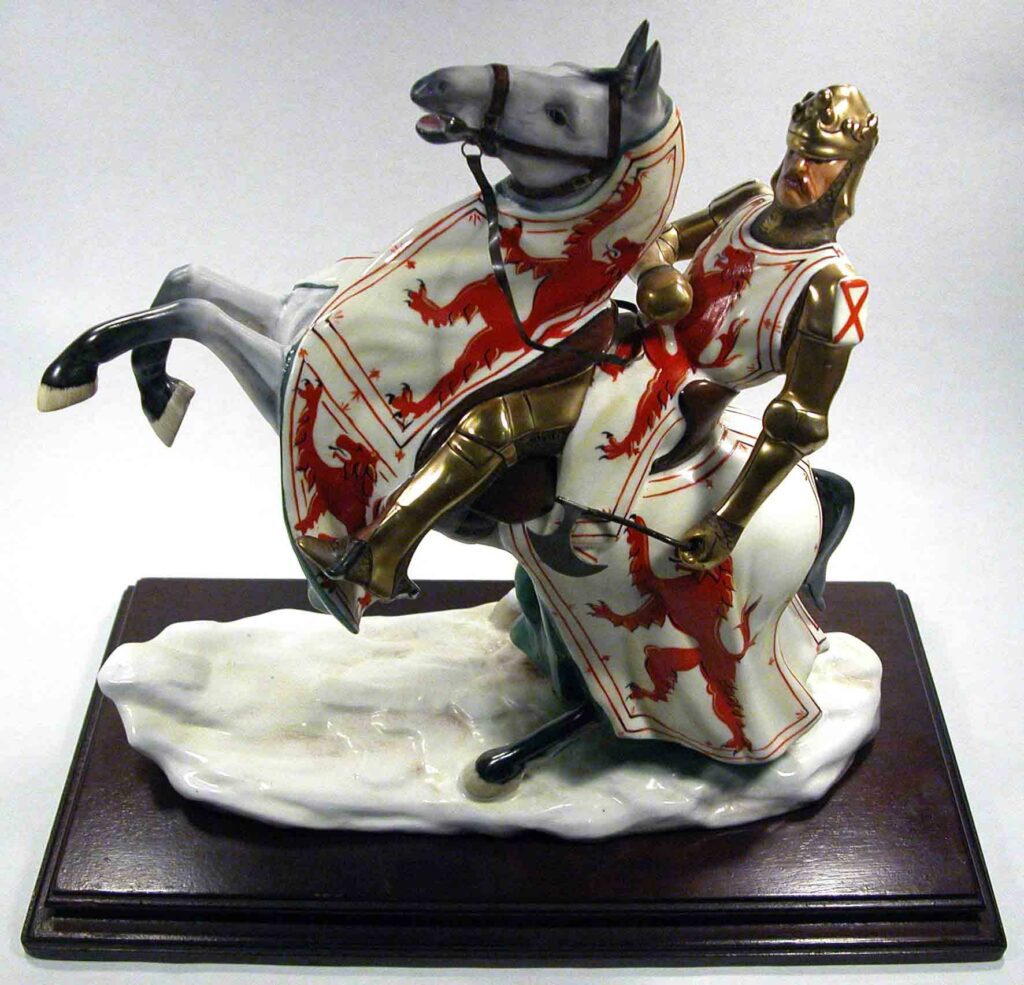
Shown here is a figurine in porcelain by Michael Sutty, made in the 1960s and purchased for the Smith collections through the Stirling Common Good Fund.
Robert the Bruce has been used for marketing purposes over the years, chiefly by whisky and shortbread companies, using his name and profile to sell their products. Chivas Regal commissioned many artistic images of Bruce and the Scottish army in different media – miniature painting, stained glass, engraved glass and manuscript illumination – for use in sophisticated magazine advertising.
One of the strangest promotions was that produced by the English pharmaceutical company, Lomotil, for their constipation medicine in the 1970s showing Bruce in a cave “try, try and trying” again.
Visit our Bannockburn Blog
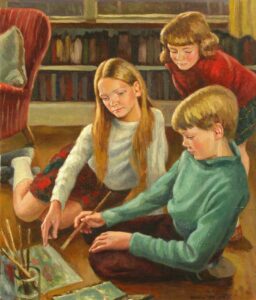 James Robert Wallace Orr (1907-1992) was a well-known Scottish artist who trained at the Glasgow School of Art, 1929-33.
Apart from war service with the RAF, he earned his living as an artist, working in Glasgow, Kirkcudbright, Helensburgh and Prestwick. He spent the last ten years of his life at Moorgait, Kippen.
‘The Young Artists’ is from this period of his life. For many years it hung in Gargunnock Primary School, and it is a recent gift to the Stirling Smith collections. Can any Observer reader identify who the young artists are, and what they are doing now?
Although the Stirling Smith has a good collection of local portraits, they are of older people. Not many commissioned portraits of children have come into the collection, and this painting is a welcome addition.
J. R.W. Orr was also a skilled engraver. His work is represented in the City of London, the Guildhall Gallery, City Hall, Aylesbury, the Hunterian, Glasgow and the University of Stirling, as well as in the Smith.