

Earlier this year, the Stirling Smith received an important bequest of a Raeburn portrait from the late Bruce Ritchie of Allan Park. Sir Henry Raeburn was the foremost Scottish portrait painter of his time, and this is the first Raeburn portrait to come in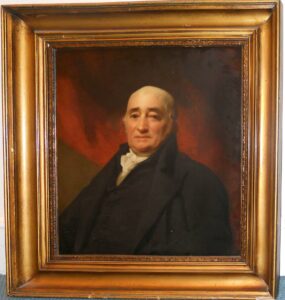 to the Smith collections.
The subject of the portrait is Alexander Bonar of Ratho (1750 – 1820), Edinburgh banker and — as Treasurer of the Edinburgh Orphan Hospital — someone who knew quite a lot about fundraising and development work. When unveiling the portrait, Sir George Reid, Patron of the Smith Development Fund, pointed out the message of this bequest. He said:
‘There are no entrance fees at the Smith. There is an ambitious outreach programme to schools and community groups. An extraordinarily diverse programme of lectures and events.
But only half the income comes from official sources. The rest has to be raised through donations, sponsorships, legacies and gifts. The Smith is great, but has ambitions and can be greater still. As Patron of the Development Fund, I urge all of you to keep the contributions coming in.
Alexander Bonar of Ratho would have understood that. He would, I think, have been happy to have his portrait hanging here.’
The portrait is on show until Sunday.
The 700th anniversary of the Battle of Bannockburn, 23-24 June 1314, is now less than a year away. Pictured here is a flower covered car from the 600th anniversary in 1914, one of a series of photos in the Smith’s collection showing the great pageant procession through Stirling, from King’s Park to the Borestone.
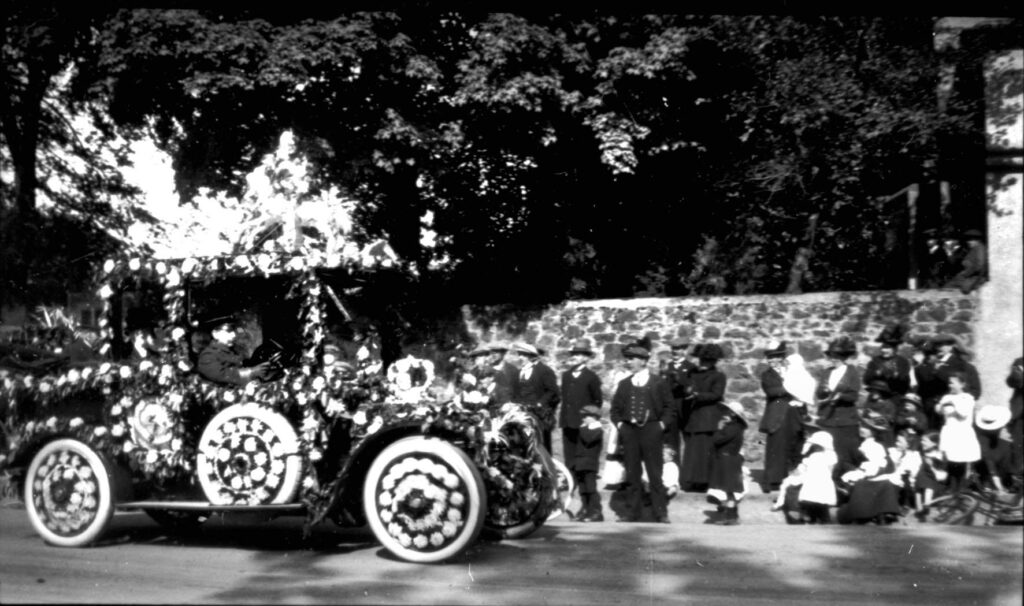
Stirling always knows how to put on a good show, and the 1914 procession was one of the largest. 22 Scottish burghs, including Aberdeen, Edinburgh, Dundee, Perth and Glasgow all sent representatives. Many of the clans sent contingents, and there was representation from many Friendly, Temperance and Masonic Societies, along with the Scouts, Guides and Boy’s Brigades. The mile long procession had an estimated 25,000 spectators.
The day was concluded by a public banquet for 200 people in the Albert Halls at night, where Sir George Douglas proposed a toast to ‘The immortal memory of Bruce and Bannockburn’.

The Smith’s first portrait by Sir Henry Raeburn, a bequest by the late Bruce Ritchie of Allan Park, was unveiled by the Right Honourable Sir George Reid. The event marked the end of the building contract to renew the roof of the Smith.
Sir George pointed out that the subject, Alexander Bonnar of Ratho, knew the difficulties of fund raising through his work for the Edinburgh Orphanage, a building which in later years became the Dean Gallery, and pointed out that Bruce Ritchie probably bequeathed the portrait for that reason.
Colin O’Brien, Chairman of the Smith Trustees said ‘We are delighted to welcome this new acquisition into the collection. Other great portrait painters, such as Sir Daniel McNee, John Graham Gilbert and Sir George Harvey are well represented in the Smith, and this work by Raeburn is now in good company.’

This drawing comes from a handful of letters, written by Dick Partridge of Forthside House, Stirling, for two little girls, Janet and Marion Wilson, who lived in King’s Park. His poem about Pat’s Hat is told and illustrated in alternate letters written in January and February 1900 and intended to amuse the children. The letters were kept by Marion Wilson, and gifted by her daughter to the Stirling Smith.
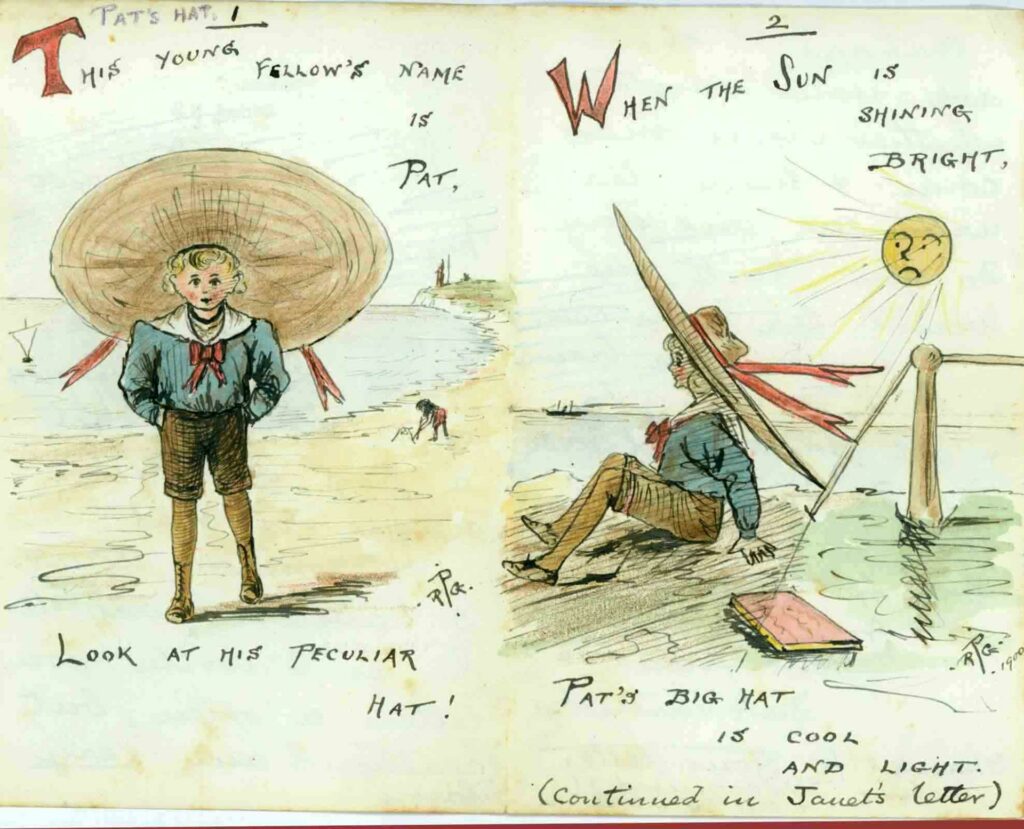
The seaside subject of the first letter was probably intended to cheer up the children during the harsh winter months. Pat also uses his hat as an umbrella, a kite, a boat, a hoop, a parachute and a bed. The illustrations give some insight into childhood in Edwardian Stirling. One verse suggests that ‘If to fight the Boers he went, it would make young Captain Pat a Tent.’ The Second Boer War (1899-1902) was raging at the time, and the author, living on the Forthside Estate, was personally familiar with it.
These story book letters are a world away from iPads and computer games and are a rare survivor from Stirling’s past.
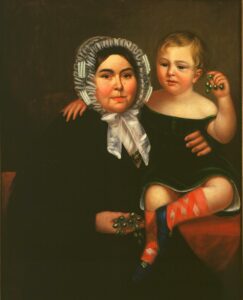 We know little of the details of this mother and child portrait, which is in the Smith collections and is currently on show in the Stirling Heads Exhibition.
Margaret Shirra (nee Low) was the wife of James Shirra (1812-1888), a Stirling draper. The portrait was painted by Stirling-born artist Sir George Harvey, President of the Royal Scottish Academy, in about 1840, when the family moved in to their new house in Albert Place.
Like many young women of her day, Margaret is in mourning dress, but the white much and ribbons indicate that the death of her loved one was not recent. Victorian women wore different degrees of mourning as a visual indication of their grief.
Her son wears a rich green velvet smock and smart tartan socks, possible from the family drapery or Drummond’s Tartan Shop. Boys were not ‘breeched’ or put into trousers before they reached the age of two.
The portrait is a charming family picture from the pre-photography era.
There are not many surviving photographs of historic office interiors in Stirling. This is the modest office of Peter Drummond (1799 – 1877), founder of the Stirling Tract Depot, in its first purpose built building (1862) which still stands at the foot of King Street. The publishing enterprise for temperance and religious tracts ran from 1848 – 1980, and started life in a seed box in Messrs Drummond & Sons seed premises in King Street. It developed into a world – wide publishing business.

On the wall is a portrait of Peter Drummond. He did much to clean up Stirling, getting rid of the race course and the gambling which went with it. His house was ‘Viewforth’, now the headquarters of Stirling Council, where his drawing room with its elaborate plaster ceiling is used for civic functions.
The Stirling Tract Depot grew so fast, that new premises were built in Dumbarton Road in 1888. When the business declined in the 20th century, it moved to 64 Murray Place. This image came from a box of lantern slides on the premises, showing the history of the Stirling Tract Depot, and was gifted to the Smith by G. W. T. Murphy, Solicitors.

Tomorrow is St. Valentine’s Day, and Stirling, branded in recent years as ‘Scotland’s Heart’, is the place to be. This mass – produced post card of the Wallace Monument, enveloped in a heart of forget – me – nots dates to the early 1900s and is in the Stirling Smith collections.
One of the best Valentine poems was written by Stirling’s George Buchanan for Mary Queen of Scots in 1561. As it was written in Latin, it is now virtually unknown, but it is one of the literary treasures which should be cherished. February 14 is traditionally the first day of Spring. Buchanan tells us that it is the day on which the birds choose their mates, and on that day every man choose a lady to revere with pure love. Some of Buchanan’s contemporaries and fellow poets – Sir David Lindsay and Patrick Hume of Polwarth – also wrote of the beauties of Stirling as a place.
We should make more of Stirling’s historic romance and beauty. Where better for a Spring break than Stirling, Scotland’s Romantic Heart?
The Stirling Smith has a number of works by the Stirling based artist Henry Morley (1870-1937), and in 2004 mounted a major exhibition on his life and work. Born in Nottingham, his art studies took him to Paris, where he studied at Julian’s Academy and fell in love with Stirling artist Isobel Hutchison, daughter of Andrew Hutchison, Rector of the High School of Stirling. He followed Isobel to Joseph Denovan Adam’s School of Animal Art at Craigmill, near Cambuskenneth. They married in 1901, and set up home in Stirling, commissioning and building ‘The Gables’ (now in Borestone Crescent) as their home and studio.
Morley’s subject matter was the landscape of the Stirling area, and the agricultural seasons of ploughing, sowing, harvesting and hay making. His studio overlooked the picturesque village of St Ninians, with Stirling Castle beyond, and he painted this scene many times.

The Stirling Ploughman is painted from the same viewpoint, but Stirling Castle is barely suggested in the top right-hand corner of this work, where all the visual emphasis is on the ploughman and his horses. The work is very different to the paintings in the 2004 exhibition, suggesting that other work and styles by him have yet to be discovered.
This painting, a recent purchase, was discovered by Dr Robin Campbell in an auction house in Germany last year and was secured with funding from the Friends of the Smith.

Kenneth Derrick, pictured here, was the last Stirling Council Officer, 1974-1996, to wear the traditional uniform, which he has donated recently to the Stirling Smith Art Gallery and Museum.
With this uniform, he was part of a long tradition, beginning in July 1607 when the Burgh of Stirling decided that their officers should be clothed in ‘rid inglische kaisar’ (red English cashmere). The red coat, waistcoat, knee breeches and tricorn hats were worn in the 1950’s, but by the 1970s the outfit had been modernised.
The earlier Council Officers or Halberdiers were employed to protect the Provost, Baillies and Councillors. As the Provost wore fur-trimmed robes and his gold chain of office when representing the Royal Burgh, a security element was necessary, and each Council Officer carried a halberd for the Provost’s protection. The Guildry Officers, who wore similar green uniforms, did this duty for the Dean of Guild. These uniforms were important in denoting and maintaining civic presence and importance.
Kenneth Derrick’s uniform was tailor-made for him in 1974 by George Shearer, 34 Barnton Street and was so well fitting that colleagues remarked that ‘it looks as if it was painted on!’
With the establishment of a new local authority structure in 1975, most of the former Scottish Royal Burghs decided to dispose with robes and uniforms, ending a colourful era in local government.
After two years in Spittal Street, the internationally important Neish Collection of British Pewter will be displayed in the Stirling Smith Art Gallery and Museum, later this year.
Shown here is a small item from it, a baby rattle dating to the 1540s. The rattle opens into a ball shape with 4 copper alloy bells attached. Under this there is a long stem which ends in a whistle. At the whistle end are the pewterer’s initials cast as part of the design – A.B. or A.I.B. The whole object is covered in cross hatching except the ball which has an Elizabethan-style design around it.

This type of rattle was common, until the end of the 18th century, but with one difference: the hard ‘teething’ piece, on which the baby could cut its first teeth was usually a piece of coral, imported from Africa or the southern Mediterranean. The ‘teething’ piece here is the canine tooth of a wolf, which the baby could press to its gums, to relieve the pain. The rattle will feature in the book The Tudor Child: Clothing and Culture 1485 to 1625, by Jane Huggett, Jane Malcolm-Davies, Ninya Mikhaila, and Perry Michael, published this month.