

Photographs by David Paterson
Stirling Smith Art Gallery and Museum 18 January – 1 March 2015
The Smith’s 2015 programme kicks off with a photography exhibition to get into the spirit of Dig It! 2015, the year-long celebration of Scottish archaeology (http://digit2015.com).
David Paterson is a former commercial photographer who retired to Killin in Stirling district in 2003 after a long career as a freelance in the advertising and publishing industries. He began his career in Edinburgh, moving to London in the early 1980s.
In both cities he worked for the leading advertising agencies, design groups and publishing houses of the day. He has published over a dozen books of landscape photography on subjects ranging from the Scottish Highlands to the Himalayas, and has held numerous exhibitions.
He enjoyed a 25-year collaboration with the internationally-renowned garden artist, Ian Hamilton Finlay, which gave rise to several more books, exhibitions and other publications.
He now devotes himself to the photography of Scottish landscapes and nature.
Colin O’Brien, Chairman of the Smith Trustees said
It is a particular pleasure to welcome this exhibition of stunningly beautiful images from an internationally-known photographer who lives locally. The Stirling Smith serves the Stirling Council area from Killin and Crianlarich in the north, to Fallin and Throsk in the south, and we like to feature the work of artists who live here.
Scotland is rich in neolithic monuments and David Paterson has been photographing them from the 1970s to the present day. He writes:
The stones tell us that humans have long been capable great feats of strength and organisation, and that they have been engaged since the beginning in a search for meaning and spirituality. These monuments speak directly to us and though we may no longer understand their language, we feel their power and mystery.
They are messages written on the landscape; memories from out of time.
All works are for sale in the price range £150 – £300.
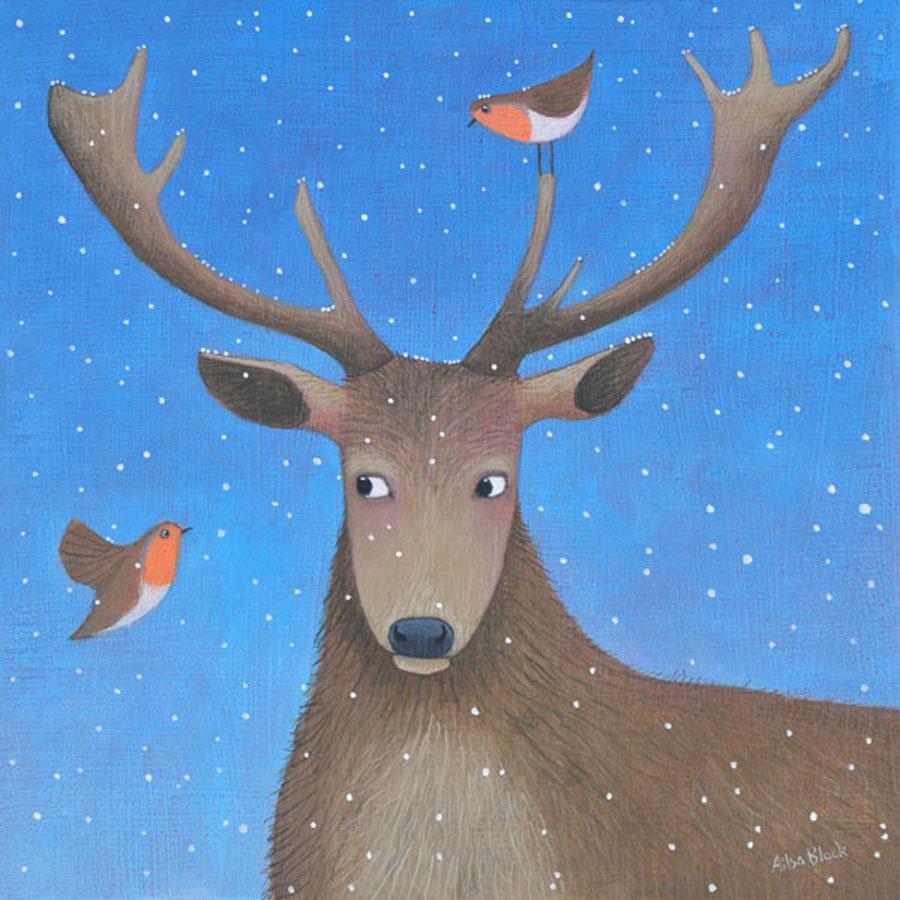
The end of a significant year for Stirling, and the historic, 140th anniversary year for the Stirling Smith Art Gallery and Museum, will be brought to a colourful conclusion by an exhibition of the work of the Scottish artist Ailsa Black.
Weather forecasters have promised a snow- free December, but Ailsa Black is the mistress of the snowy landscape. In many of her works, she captures the magic, sparkle and excitement of falling snow remembered from childhood.
She describes her work as an expression of Scottish contemporary rural life and she focuses on the interaction of landscape, animals, birds and people, producing a unique perspective on the world around her. Her work is quirky and naïve, with clean lines, sharp colours and a simplicity of form which has a decorative clarity. She works mainly in acrylics, but whether you choose an original work or a limited edition print, it will be a focal point for the wall on which it hangs.
Although her work is well-known through prints, cards and mugs sold across Britain, few people outside of the Dumfries and Galloway area where she lives and works, will have seen a solo show by her. The exhibition opens at 2pm on Saturday 6 December, and all are invited to enjoy the snow scenes at the Smith. There will be a competition for a prize hamper, to be drawn at 3pm.
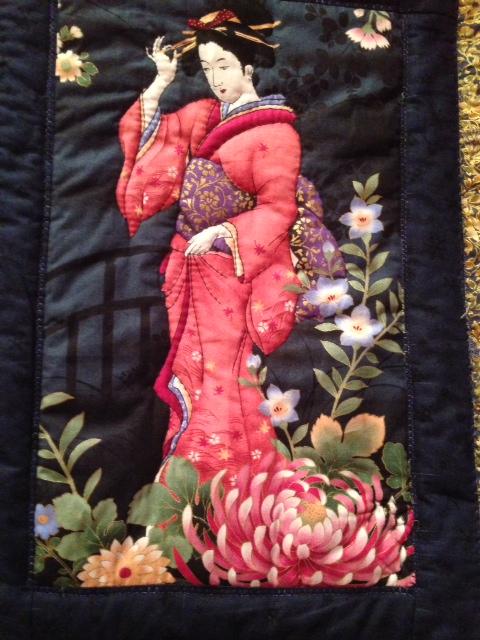 The Stirling Castle Quilters were established twenty years ago, following a major exhibition on Scottish quilting at the Stirling Smith. They are celebrating their achievements in a Smith exhibition which runs until the end of the month. There are over 60 colourful quilts, with many hangings, cushions, bags and other quilted accessories.
Shown here is a decorative quilted panel, Geisha in the Garden by Lynne Laing. It is one of seven panels with a Japanese theme.
Quilting is an international art which goes back to prehistoric times, with layers stitched together and padded for warmth both for clothing and bedding. It has often been a communal art form, with quilters helping each other on the bigger productions. The International Quilters’ Association claims to have been ‘Piecing the world together since 1979’ and there are many examples of collaborative work in the Stirling show.
In some countries, quilting is big business. The Tokyo International Great Quilt Festival, supported by Japanese Public Television, has been running every January since 2001. Other international quilt festivals are run in Chicago, Houston Texas, Santa Clara and Dubai, and some of these shows feature up to 800 quilts. However, these events last only a few days or a week at most. The Stirling show still has 11 days of its 6 week run, so come and meet the local quilters and make the most of it!
James gives us an insight into the Smith’s own Bannockburn exhibition on the Art in Scotland TV webchannel.
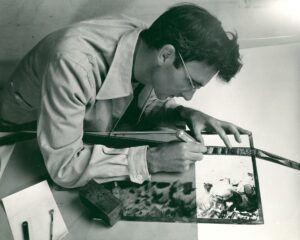 Norman McLaren, the award-winning animated filmmaker, was born at 21 Albert Place, Stirling, opposite the Stirling Smith on 11 April 1914. Using material from the University of Stirling’s extensive Norman McLaren Archive along with items loaned from the McLaren family ‘A Dream of Stirling’ is the exhibition which looks at the influence of his Scottish upbringing.
A pupil of Stirling High School McLaren’s artistic talent was recognised at an early age. In the 1930s, while a student at the Glasgow School of Art, his work was exhibited in the Stirling Smith as part of the Stirling Fine Art Society shows. Norman’s father William was an active member of the society and the exhibition catalogues include advertisements for his decorating business in Maxwell Place.
‘A Dream of Stirling’ will include examples of Norman McLaren’s artwork from the 1920s and 1930s. Much of this material has not been publicly displayed for over 70 years and has been specially conserved, mounted and framed for the exhibition which runs at the Smith until 22 June.
The year of Homecoming, 2014, started in great style with wonderful fireworks displays at the Castle and Wallace Monument. 2014 will be Stirling’s year, with so many special anniversaries – the centenary of the start of the Great War and the birth of Stirling – born film maker, Norman McLaren, and the 700th anniversary of the Battle of Bannockburn.
This column, which comes to you from the Stirling Smith, promises to bring you 52 amazing stories from the history and culture of Stirling. In 2014, the Smith will be celebrating its own anniversary of 140 years of public service. Last month, the Smith’s first crime fiction novel, The Shadow in the Gallery by Thomas Christie was published.

This month, the finishing stitches are being done on a colourful, iconic banner, for the Smith by members of the Stirling and District Embroiderers’ Guild. Shown here are the panels depicting the Smith (sewn by Frances Rankin) and the University (sewn by Kay Mackay) The banner shows the flora and fauna of Stirling, as well as many aspects of the built heritage and history of the City.

This project has been a year long labour of love for Stirling Embroiderers’ Guild, and will be presented at the opening of their exhibition, Stirling Threads, in February.
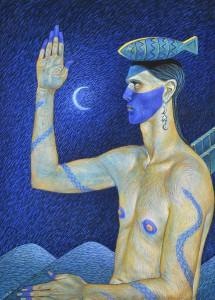 The June Carey exhibition continues at the Stirling Smith until 10 January. Born, raised and still resident in Stirling, June Carey is a Scottish artist with and international reputation. The Smith has purchased this work in pastel from the exhibition, with the support of the Stirling Common Good Fund. The deep blue colour which characterises many of her works was inspired by a residency in Mexico, and the ear rings which the subject wears in this work were purchased there.
June Carey is an artist whose work is informed and suffused by world cultures. She is a collector and interpreter of cultural symbols and icons. Pieces of significance appear in her works and symbols long before tattoos achieved their current popularity, were expressed as body decoration in her paintings. A June Carey design would be a real challenge to a contemporary tattoo artist.
Many of her paintings have a dream-like quality and feature serene angelic figures within the cosmos – the heavens, earth and seas.

At this time of year, we tend to think about our identity as Scots and citizens of Stirling. How do we differ from citizens of other Scottish cities?
One thing which has distinguished Stirling is the regiment of the Argyll and Sutherland Highlanders, now part of the Royal Regiment of Scotland, but for a century, the regiment of the city, with its headquarters in Stirling Castle. At the Smith, three different artists have looked at this history, in the Golden Thread exhibition. The Golden Thread is that which runs through Stirling’s history from the time of the formation of the Argylls in 1881, onwards.
Yvonne Taylor has painted the Scottish landscape, Frank McNab has painted the story of the Scottish soldier and literature, whilst artist and couturier Ann Tocoda has painted, written poems and created a fabulous green gown which references the history of the regiment itself.
Shown here is the painting ‘Piper’s Pride’ by Ann Tocoda. All of the clothing worn by the young girl is inspired by the historical uniform of the Argylls. The work underlines the contribution of women, who as wives and daughters, have sustained and supported the Scottish regiments. The exhibition runs until 20 January.