

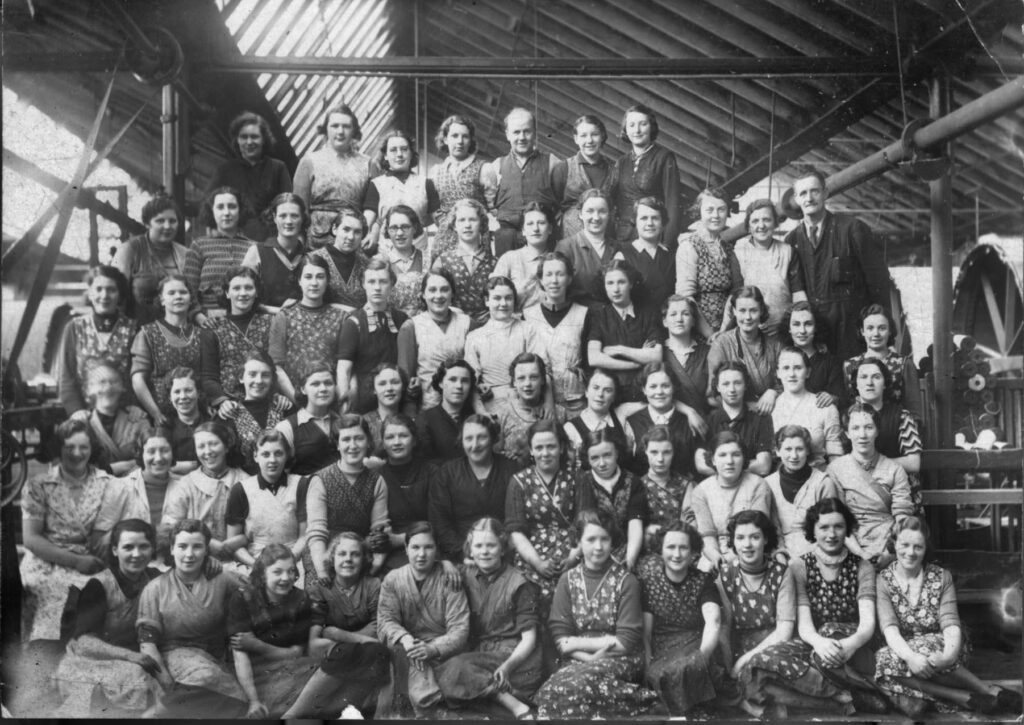
Today’s story takes a look at Stirling’s lost industrial past and the workforce of the Forthbank Carpet Works. The workers are mainly women who were weavers and bobbin winders. Most lived in Raploch and walked to work every day. Note the brightly patterned cross- over ‘peenies’ or aprons which was the common dress of factory workers and housewives alike, in the decades before and after the Second World War. The photograph was gifted to the Stirlng Smith by Dorothy Hayes.
Thanks to the survival of a company cash book and ledger of Thomas Gilfillan in the National Library of Scotland, we know that Scotch carpet weaving was a flourishing industry in Stirling in the 1760s, with many local weavers engaged in the business. In Glasgow, James Templeton took it to an industrial level, and his carpet factory on Glasgow Green was famously fronted in coloured brick work, in imitation of the Dodge’s Palace in Venice.
The Templeton disaster in Glasgow, 1889, when 29 women were crushed to death through the fall of the brick façade led to a concentration on safe building practices. This Templeton building in Stirling is so strong that it still stands as the home of Stirling Enterprise Park today, nurturing new businesses.
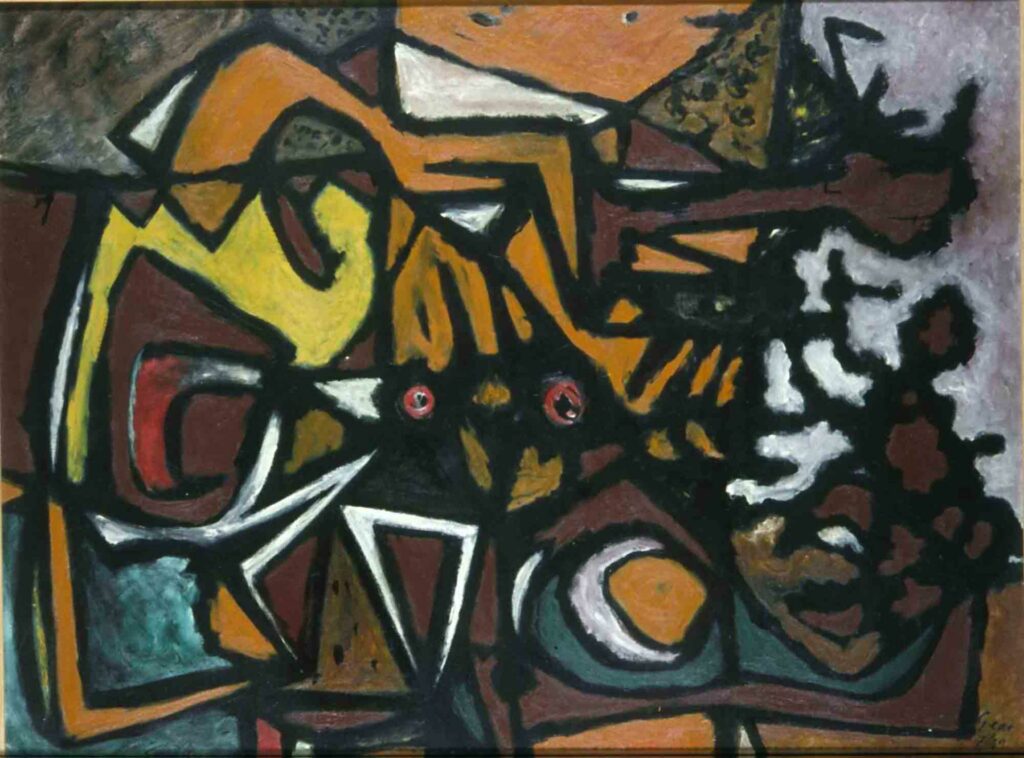
William Gear was the son of a coal miner from Methil in Fife, where he grew up. He attended Edinburgh College of Art, 1932 – 1936. A travelling scholarship took him the Paris where he studied with Ferdinand Leger. He won a Festival of Britain purchase prize in 1951 and had work in the 1954 Venice Biennale.
From 1958 – 1964 Gear worked as the Towner Gallery’s curator, and bought 311 works of art which are now the core of its collection. He became an immensely influential figure in the art world, and the Scottish artists he associated with include Robert Colquhoun, Robert MacBryde, Wilhemina Barnes – Graham and Eduardo Paolozzi. He was head of the Faculty of Fine Art at Birmingham College of Art until his retirement.
Gear has never been forgotten in his native Scotland. The Smith’s work came from the collection of the Scottish Arts Council, has been exhibited regularly in the Smith and was loaned to the Dick Institute, Kilmarnock in 2014.
Elspeth King
The painting featured here is a recent purchase made possible by the Stirling Common Good Fund and the National Fund for Acquisitions. It is by the eminent artist and Stirling resident McNeil MacLeay (1806 – 1883) and was painted in 1868. The title, in the artist’s hand, is inscribed on the back of the frame: ‘Loch Earn from the East with the hills of Balwhither (sic) in the distance’.
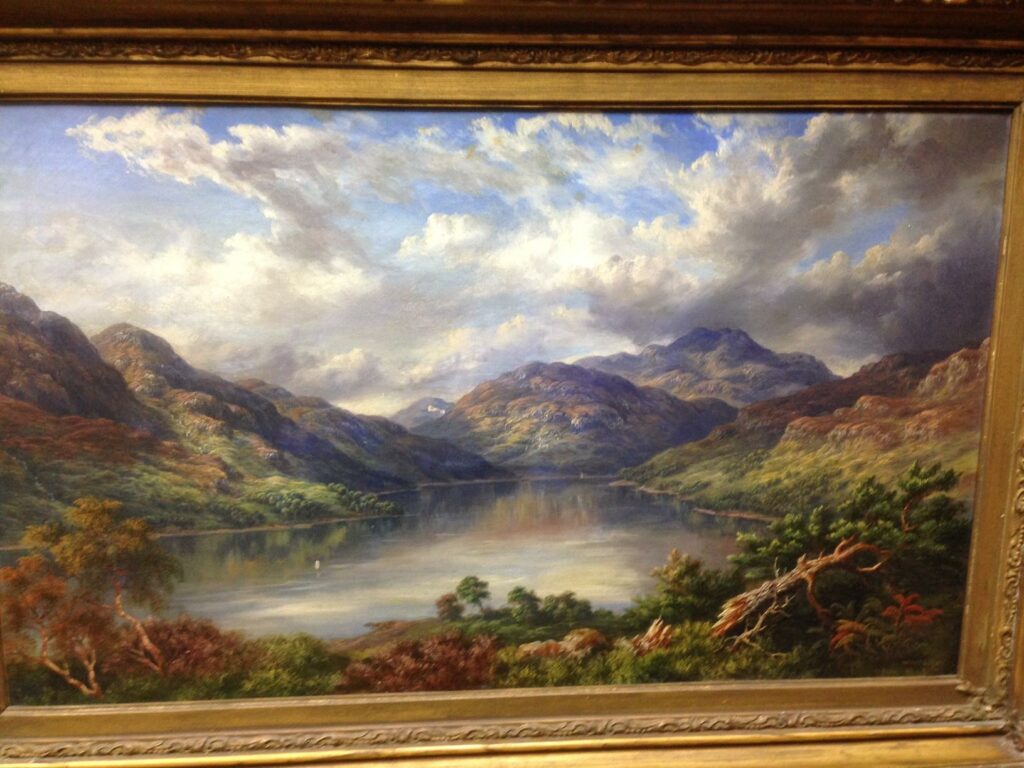
MacLeay was born in Oban, the son of writer Kenneth MacLeay. His older brother Kenneth, who was also an artist, was a founder member of the Royal Scottish Academy in 1826. Both of them loved to paint landscapes and their works are highly sought.
McNeil MacLeay painted many Highland scenes. In 1840 he travelled to the Rhine to paint similar landscapes. He settled in Stirling in 1848 in a house in Lower Bridge Street, where he lived until his death.
The Smith has a view of Stirling Castle and another of Loch Awe by him. Five of his works are in Perth Art Gallery.
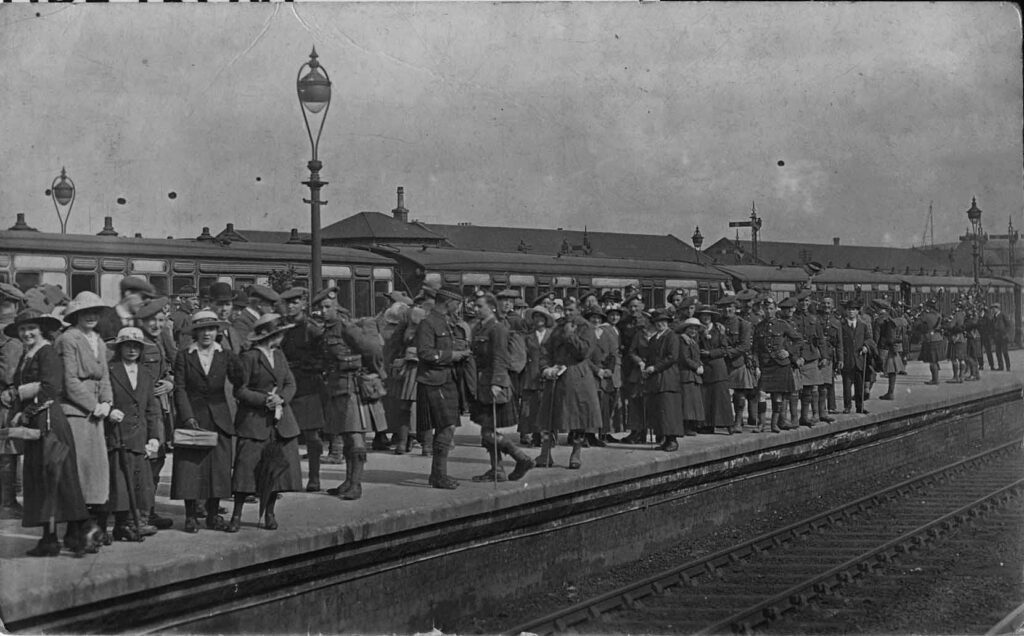
The photograph shows a scene in Stirling Station all too common a hundred years ago as battalion after battalion left Stirling, either for further training or for service in the Great War. Families gathered on the platform to say farewell, possibly for the last time. Stirling Station has never been busier.
The Stirling 100 exhibition, featuring 100 Stirling soldiers who died in the War continues at the Smith until November, and is accompanied by all of the Great War photographs in the Smith collections. Today’s photograph is from a family collection loaned by John Robertson ten years ago.
To provide an opportunity to understand different aspects of the War to end Wars, Stirling University teachers are holding a series of free talks at the Smith. The next, at 2pm on Thursday 1 October is by Dr Michael Penman will discuss how Bannockburn was commemorated in the century 1814 – 1914. At 11am on Friday 23 October Professor Rory Watson will talk about Poetry and the Great War.
The talk by Dr Jim Smyth at 2pm on Friday 6 November 2015 on ‘Music, Memory, Emotion: Unveiling the memorials of the fallen of the Great War in Scotland’ takes us in to the Remembrance season.
Elspeth King
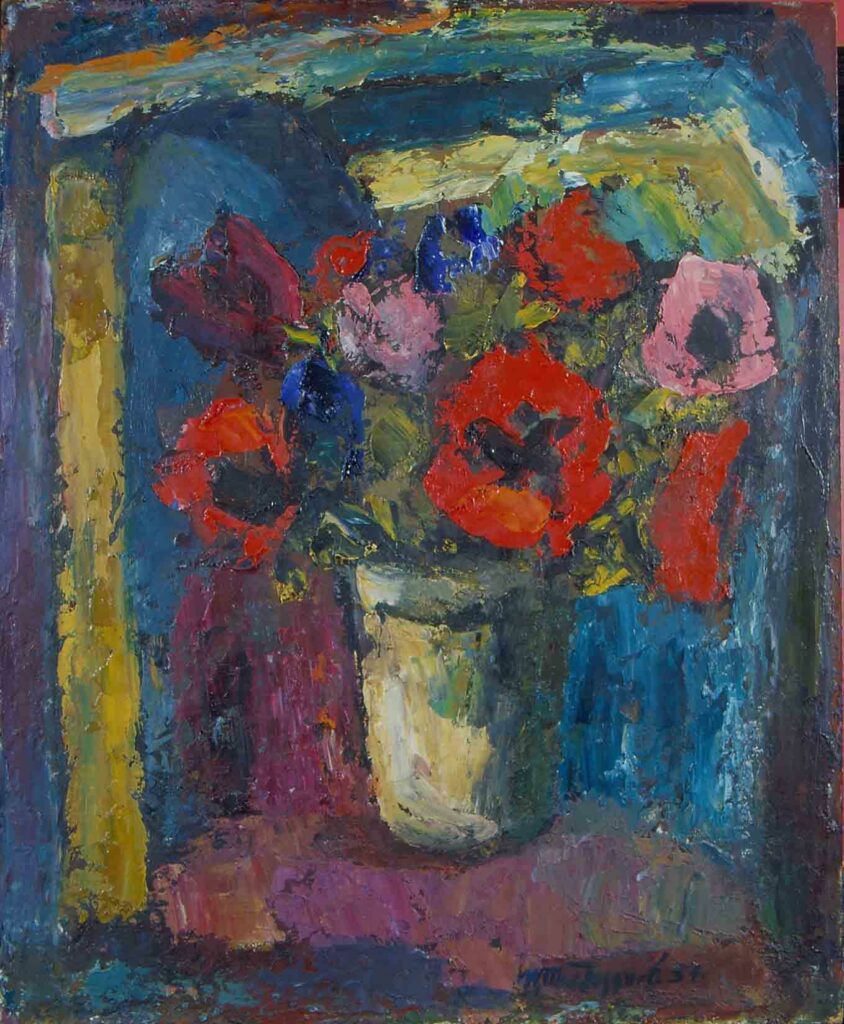 At present, the Stirling Smith mounts between 14 and 20 temporary exhibitions each year to attract return visits and maintain interest. The painting by the eminent Scottish artist Sir William MacTaggart (1903-1981) was purchased from a very brief exhibition on contemporary Scottish art in the Smith in the summer of 1959, when the artist’s reputation was at its highest.
MacTaggart was the grandson of the Scottish land and seascape painter of the same name. He studied at Edinburgh College of Art, 1918-1921, and taught there, 1933-1958, influencing a generation of artists. He himself was influenced by the French artist Rouault, whose work he saw in Paris in 1952. The rich glowing colours and soft black outlines in many of his works references those of Rouault.
MacTaggart was part of the Edinburgh school of artists, which included William Gillies, Anne Redpath, John Maxwell and William Crozier. The Smith has examples of all of their work. He served as President of the Royal Scottish Academy 1959-1964, and was knighted in 1962.
This is one of 73 paintings by MacTaggart in public collections throughout Britain. Poppies were a favourite flower of the artist.
11 September is the 718th anniversary of the Battle of Stirling Bridge, the battle which William Wallace and Andrew de Moray won, against all the odds, and an English army of invasion. This small, spirited work of 2010 was gifted to the Smith collections by Friend of the Smith Moira Lawson. It is one of several works of the Old Bridge, showing it in its autumn colours.

This was not the original bridge of the battle, but a 15th century replacement, and it has not changed much over the centuries. The Guardians of Scotland Trust have plans to erect an art work which will mark the achievement of Andrew de Moray as well as William Wallace, whose monument graces the landscape.
Artists visiting Stirling have been inspired by the Bridge for the last 200 years, but Iona Leishman is one of Stirling’s own. She has served in recent years as Artist in Residence in Stirling Castle, and has worked from a studio in Cowane’s Hospital, drawing her inspiration from Scotland’s past, painting the dreadful scenes of Flodden and Bannockburn, and inspirational figures like Marie de Guise.

The great Scottish artist and writer Alasdair Gray has a dramatization of his ground – breaking novel Lanark at the Glasgow Citizens’ Theatre this month. After an accident in June, the artist is still critically ill in hospital, and as we wish him a good recovery, we feature one of his lesser known works from the Smith collections.
Alasdair Gray has always been a good friend to Stirling. His 70th birthday exhibition was shown in the Smith in 2004, and featured the preliminary work for the decoration of Oran Mor, the church which is now an arts and music centre at the top of Byres Road. The Smith exhibition was more modest than the Kelvingrove extravaganza held for his 80th birthday last year, but perhaps the Smith showed the way.
The rapidograph portrait was done during the Smith’s Leonardo exhibition in 2008, and is of Stirling fashionista, milliner, teacher, needlewoman and Smith volunteer Mary Rennie. It is not a likeness in the traditional sense, and it is not a portrait which pleased the sitter. Portraits are much more than likenesses, and this is a very skilled pen portrait, the product of a lifetimes’ practise. It is one of 30 works by Gray in the Smith. The earliest is from 1964.
Elspeth King

To mark ‘the Glorious 12th’, the traditional start of the shooting season in Scotland, today’s painting from the Smith collections is a still life by artist John Bucknell Russell (1819 – 1893). It was gifted to the Smith by Mr Watt of Stirling in 1932. At one time, such paintings were very fashionable in places associated with the hunting fraternity as Stirling was.
Born in Edinburgh and raised in Aberdeen, John Russell started his working life as a house painter. He did an altar piece painting for St Mary’s Chapel, Aberdeen and interiors for Haddow House and Kelly Castle. He settled at Fochabers where he had sporting commissions from the Duke of Richmond and Gordon and his friends who came to Castle Gordon for the hunting season. He also obtained commissions from Lord Lovatt in Inverness.
Russell specialised in paintings of fish and fishing scenes. He was a skilled wood carver, making models of Spey salmon to the exact measurements of the originals. These were carved in the old laundry workshop of Castle Gordon and painted by his daughter. Several of his children became artists, and he exhibited regularly at the Royal Scottish Academy. This work may be ‘The Morning’s Sport’ exhibited at the RSA in 1863.
Ronald A Muirhead (1930 – 1989) was an artist and gallery owner who enriched the lives of the people of Stirlingshire, and his portrait by James Robert Wallace Orr, in the Stirling Smith collections, reflects his artistic interests. The sculpture on the table is his own, and the view into the garden is from his living room in Ben View, Kippen.
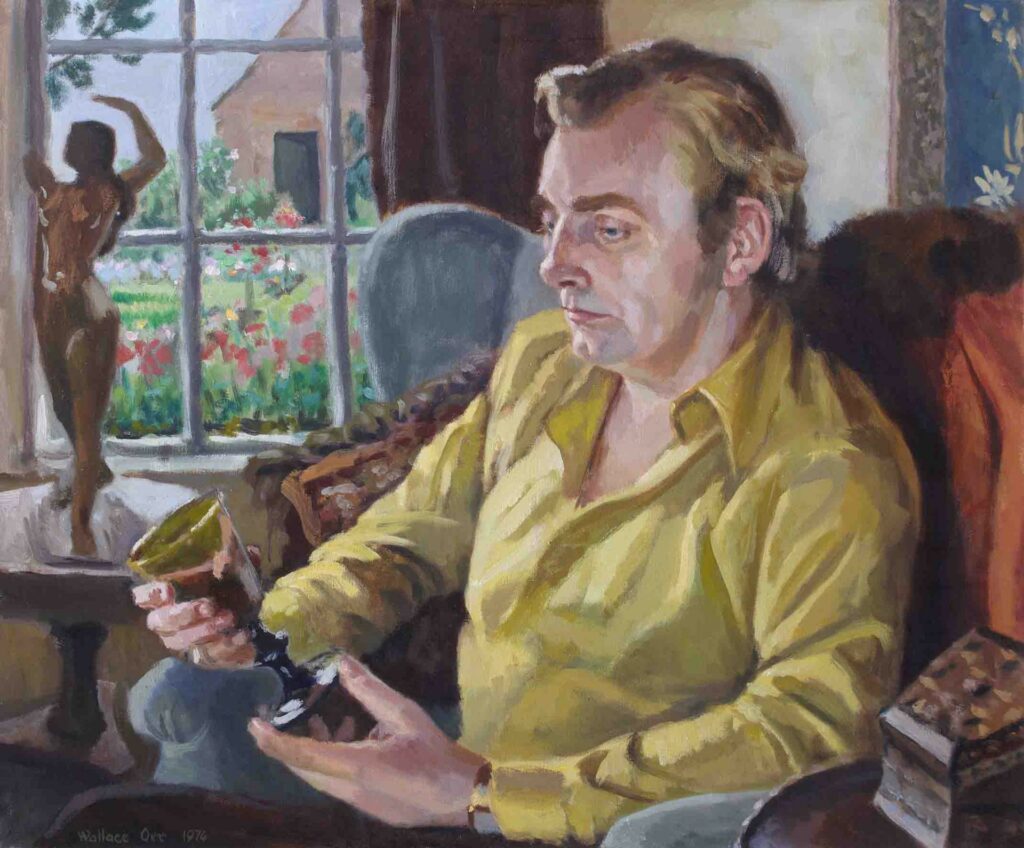
An injury during National Service restricted his capability as an artist, but he produced a series of portrait heads, including fine likenesses of the actors Moultrie Kelsall and Jeannie Carson which are also in the Smith collections.
A good singer and performer, he had many friends in the world of theatre. He acted in television and had parts in the film Kidnapped and the series Dr Finlay’s Casebook.
In 1973, he began to run art exhibitions in the Kippen Post Office. He also ran a gallery in Dumbarton Road Stirling, followed by the Kippen Gallery which opened in 1978. He initiated the annual Kippen Street Fayre in 1980, which is still going strong. Like many other good citizens and community activists, he was a Friend of the Smith.
The Treasures of the Smith exhibition, which runs until 4 October has a new acquisition of some significance. It is an embroidered fire screen by the famous suffragette activist and artist, Marion Wallace Dunlop (1864-1942). The subject is Spring and features a woman in long purple robes surrounded by blue birds, bluebells and other spring flowers.
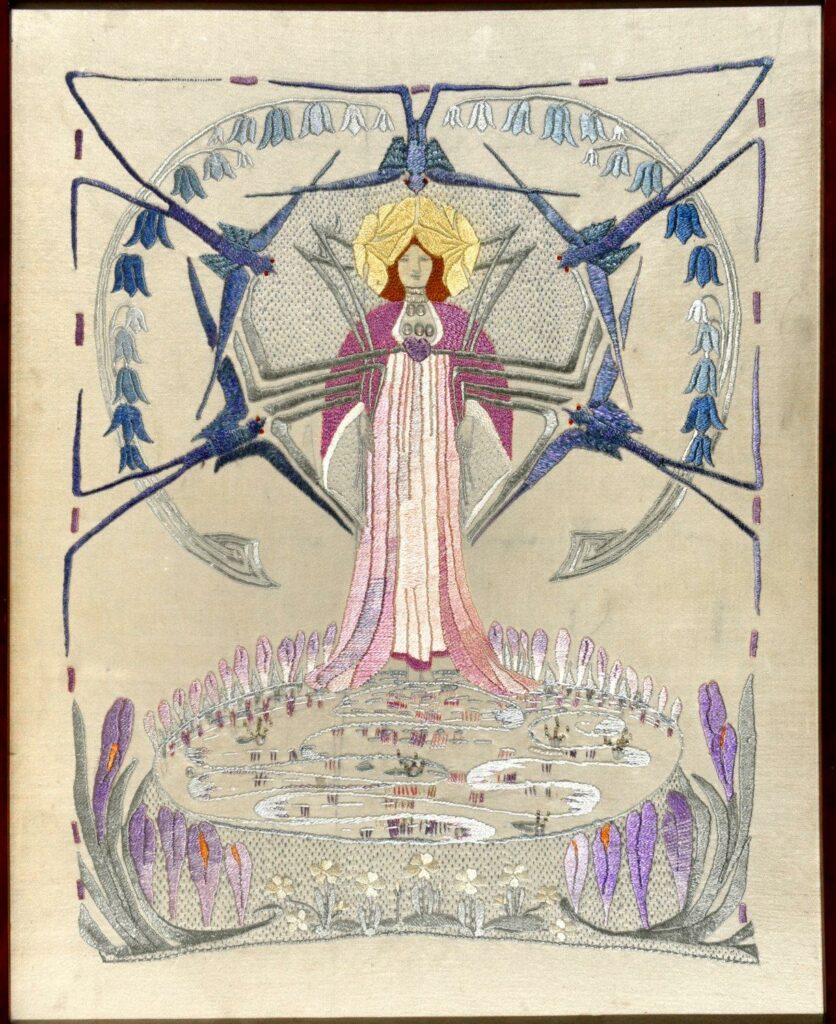
Marion Wallace Dunlop, who trained at Slade School of Art, was an artist of considerable talent but until now, none of her work has appeared in the collection of a public museum or gallery.
Although she lived most of her life in England, she was fiercely proud of her Scottish birth and heritage. She claimed descent from William Wallace’s mother (as did the entire Wallace Dunlop family), and she sought to emulate Wallace in her fight for votes for women. Jailed in July 1909, she wondered what William Wallace would do – and stopped eating, thus initiating the tactic of the hunger strike, which has since been a powerful weapon in the hands of political prisoners worldwide. George Bernard Shaw wrote that her actions ‘struck a chord which will vibrate to the end of time when we are dead and forgotten, when this great movement has spent itself and been crowned with victory’.
Marion still has relatives in Kippen, and it is good to have her art in Stirling.