

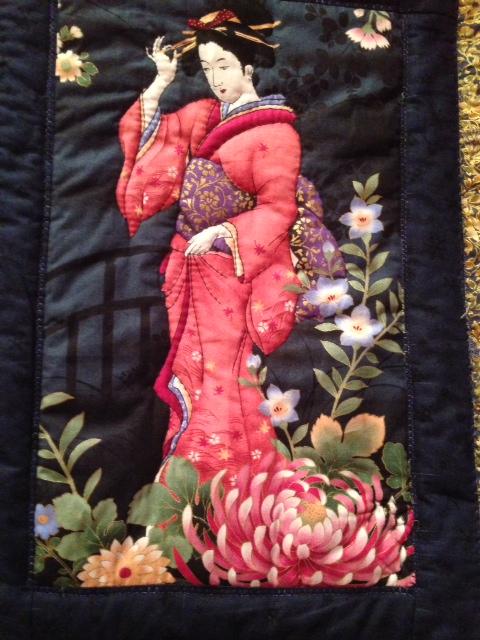
 The Stirling Castle Quilters were established twenty years ago, following a major exhibition on Scottish quilting at the Stirling Smith. They are celebrating their achievements in a Smith exhibition which runs until the end of the month. There are over 60 colourful quilts, with many hangings, cushions, bags and other quilted accessories.
Shown here is a decorative quilted panel, Geisha in the Garden by Lynne Laing. It is one of seven panels with a Japanese theme.
Quilting is an international art which goes back to prehistoric times, with layers stitched together and padded for warmth both for clothing and bedding. It has often been a communal art form, with quilters helping each other on the bigger productions. The International Quilters’ Association claims to have been ‘Piecing the world together since 1979’ and there are many examples of collaborative work in the Stirling show.
In some countries, quilting is big business. The Tokyo International Great Quilt Festival, supported by Japanese Public Television, has been running every January since 2001. Other international quilt festivals are run in Chicago, Houston Texas, Santa Clara and Dubai, and some of these shows feature up to 800 quilts. However, these events last only a few days or a week at most. The Stirling show still has 11 days of its 6 week run, so come and meet the local quilters and make the most of it!
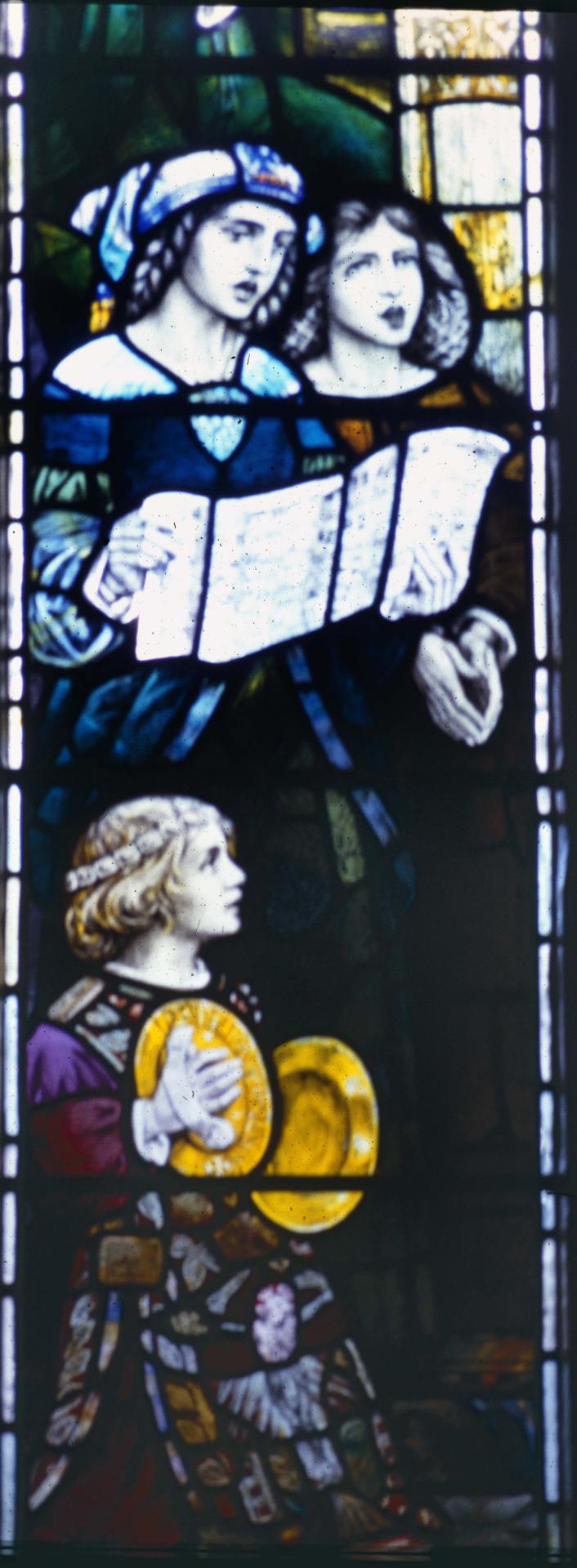 Most stained glass windows are about remembrance. Today’s story concerns a detail of the magnificent four light chancel window, the gift of Lawrence Pullar in 1911, in the historic Lecropt Kirk, Bridge of Allan.
The subject is taken from Psalm 150, ‘Praise God in his sanctuary…..Praise Him with the sound of the trumpet…the psaltery and harp…..upon the high sounding cymbals’. The stained glass artist, Alf Webster, was an outstanding designer, an exceptional portrait artist and had mastery of the control of colour, texture and transparency in his medium which made him the leading practitioner of his generation. He took over the older stained glass studio of Stephen Adam in Glasgow, and brought to it new techniques of abrading, plating and faceting the glass. The Lecropt Chancel window is one of his masterpieces. The child depicted with the cymbals is his baby son, Gordon Webster (1908-1987) who himself later became a prolific stained glass artist.
Alf Webster’s success in stained glass was short lived. He died from his wounds at Ypres in 1915, at the age of thirty, when his son was seven years old. His loss to European culture is one of the tragedies of the Great War. The Lecropt window should remind us of the loss sustained by the untimely death of so many of Europe’s great artists.
 It is 50 years since a partnership agreement was signed between Stirling and Dunedin, Florida. Twin towns or sister cities are a form of legal agreement made between towns and cities, to foster friendship and commercial links. The movement was started after the Second World War in 1947 to promote peace and understanding between different cultures.
Dunedin was founded by Scotsmen John Douglas and James Somerville in 1878. It became very important for orange growing, and machinery developed there for processing made the citrus industry a major concern. Emigrants from Scotland, and Stirling in particular went into farming there. The New World Celts maintain Scottish cultural traditions, and this week, 200 people from Dunedin, including the Tale of Two Sister Cities tour group, are here in Stirling.
Shown here is the house of John Douglas in Scotland Street, Dunedin, one of a series of artworks which are commissioned annually by the City of Dunedin to celebrate their city. The full Sister City story can be seen in the exhibition at the Smith which runs until 17 August. The Dunedin Historical Museum staff have created a time capsule gift for Stirling, and an invitation to receive one in return, both to be opened in 2064. Suggestions and contributions for the Stirling time capsule are welcome.

The Bannockburn exhibition at the Smith has some interesting new works of art. This painting, oil on panel, of Bruce slaying de Bohun is by the highly acclaimed London artist, Liz Knutt, who belongs to the Teddington Group.
Liz Knutt trained at Edinburgh College of Art and spent many years in the West Indies, which ignited her love of colour. She is well known for her paintings of views and events in Richmond upon Thames. Under the title ‘Theatreland Richmond’ she produced paintings featuring ‘Leap into Dance’ productions and studies of Richmond Theatre. Two of her paintings have been hung in the theatre itself. The Royal Botanic Gardens purchased the painting of Jools Holland’s Concert. This painting was considered an essential addition to the Kew collection of Art. Having also purchased the copyright of this stunning piece, Kew used this vibrant image to market the Summer Swing Festival.
Her reputation as an artist meant that she was granted unrestricted access to Hampton Court Palace to produce a series of paintings. The Peugeot Car Company bought a view of the Palace painted from the river. The original was presented to the director of the company and sixty prints to guests who attended the gala dinner at the Palace.
Liz’s latest paintings depict scenes from London and of the ice skating rink at Hampton Court. She has also just finished a gorgeous series of paintings of the refurbished Strawberry Hill House. Her picture of Bannockburn is an important contribution to a 150 year artistic heritage of depicting the Battle, and prints can be bought at the Smith.

At the height of the summer, it’s worth taking a look at how Stirling provided souvenirs for tourists in generations past.
It is often said that modern tourism in the Stirling area began with the publication of Walter Scott’s Lady of the Lake in 1810. By 1814, when his novel Waverley was published, the Stirling and Trossachs tourist trail was well established. The production of souvenir wood ware for the tourist market began in the 1790s with the snuff box industry in Ayrshire. By 1820, Mauchline ware was well established, supplying souvenirs from wood grown ‘on the Field of Bannockburn’, ‘on the Abbey Craig’, ‘on the slopes of Stirling Castle’ and made into sewing requisites, egg cups, trinket boxes and many other kinds of souvenirs, transfer printed with a line drawing of the place.
The industry was based in the town of Mauchline and lasted until about 1930. At its height in the 1850s, four of the major manufacturers maintained showrooms and offices in Birmingham, and supplied visitor sites world-wide.
Stirling made its own contribution to the industry. The mechanism for printing tartan on to wooden surfaces was developed with the help of Wilson’s Mills, Bannockburn.
Collecting Mauchline ware is a global activity. This collection was bequeathed to the Stirling Smith Art Gallery and Museum by retired pharmacist, Betty Meikle OBE (1928 – 2013) of Stirling, and is on display.
Not much is known about John Ferguson. The photograph is from the Christmas Observer of 1928. He was born and raised in Stirling, and attended the High School, where the commemorative plaque, a recent gift to the Stirling Smith collections by Archie MacCallum, was put up after his death.
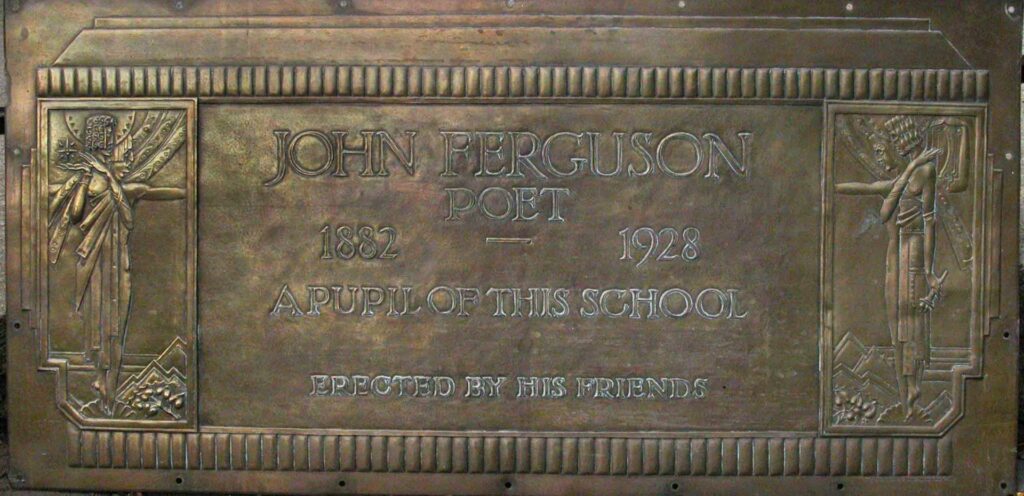
Such pieces are out of place in a modern school, but the art deco beaten brass plaque is the work of the renowned metalworker, silversmith and sculptor, Peter Wyllie Davidson (1870 – 1963). Davidson was born in Bridge of Allan, and for a period of 38 years, until he retired in 1935, was the chief instructor in metalwork at the Glasgow School of Art. He wrote books on decorative metalwork and leatherwork for his students and his work is highly prized.

Ferguson published a book of sonnets, Thyrea in 1912 which went through at least 14 editions in his life time and is still available as a free publication on the internet. The sub title, Sonnet Sequence from a Sanatorium, gives clues to his illness. Many of the other works concern circus performers and disadvantaged people, and are both compassionate and moving. The last sonnet, An Out of Work Waitress of Fifty on her Beauty Cabinet condemns the ageism of the era when job adverts stated “No one over thirty need apply” /Or “Must be under forty years of age”.
John Ferguson’s work is powerful, even today.
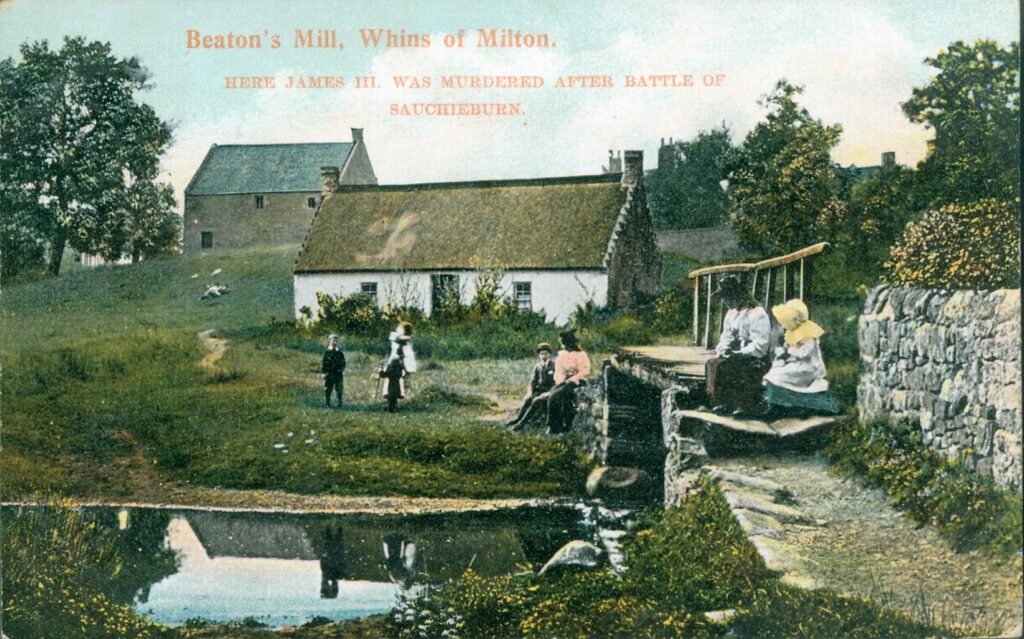
With the rise of the internet, the sale of traditional holiday postcards is in decline. This lovely card was published by the Borestone Committee in 1907 and would have been sold at the Borestone Hut on the field of Bannockburn. Visitors often explored both Bannockburn and nearby Beaton’s Mill, the place where James III was assassinated, after the Battle of Sauchieburn in 1488. This rising against the monarch, by nobles dissatisfied with his performance and associates, was headed by his 17 year old son, who became James IV after his father’s murder. The injured James III had sought refuge at the mill after the battle, and asked for a priest. One of his opponents, posing as a priest, stabbed him. He was buried with great ceremony at the Abbey of Cambuskenneth, and his son was so full of remorse, that he wore an iron belt for the rest of his life, adding weights to it in penance, each year.
In the 1850s, the cottage beside the mill was occupied by a nail-making family, who showed visitors the various parts of the mill machinery, allegedly from the time of James III, on request.
The mill was burned down by vandals in the 1950s, and the picturesque spot has gone. The card is from a collection made by the late John Wilson, President of the Stirling Philatelic Society, and loaned by Mrs C. A.Wilson.
The University of Stirling is well–known as Scotland’s University for Sporting Excellence, a designation by the Scottish Government in recognition of the contribution made to Scottish sport. From the start of the University, the Gannochy Sports Centre was open to the local community. In 1981, the now-famous golfer Colin Dalgleish was the first sports scholar, and in 1991, the Scottish National Tennis Centre was developed. The mission of the University is to deliver the best for Scottish sport through the powerful and inspirational combination of sport and education.
Nearby Bridge of Allan has a distinguished sporting history which is now largely forgotten. Physical fitness was important in a spa town, and curling, skating, golfing and tennis had good provision. The Strathallan Games, founded in 1852 still take place on the first Saturday in August. In 1908, they co-incided with the Scottish Lawn Tennis Championships. The only remaining evidence of this national event are the photographs and notices shown here, rescued by Smith staff member Evelyn Cameron.
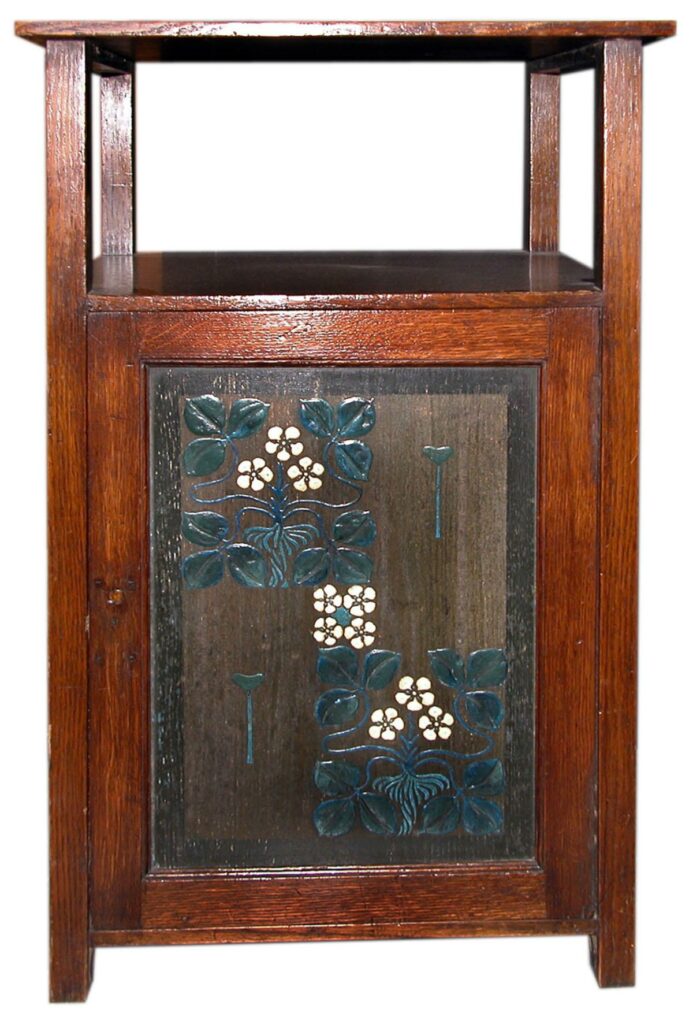 Today’s object from the Stirling Smith collections is an arts and crafts oak cabinet which has a door decorated with gesso. It was made by the furniture maker Henry T. Wyse and was part of the furnishings of No. 1 The Homesteads, Stirling. It was left to the Smith by Ailie Maclaurin (1913 – 2000), daughter of Robert Maclaurin (1871 – 1948) who established The Homesteads in 1911 as a garden city development where the householders could aim for self-sufficiency thanks to the generous amount of land surrounding each house.
Maclaurin was an inventor, scientist and businessman who developed the energy saving white flame heating system. Originally based in Glasgow, he had issues with Glasgow Corporation and published the pamphlet A Peep at the Glasgow Gas Scandal, before leaving to live in Stirling. He brought with him the Scottish Guild of Handicraft, from Glasgow to Burghmuir, Stirling in 1909. The Guild was a co-operative partnership which produced art pottery, furniture, metalwork and stained glass in the style which is known as Arts & Crafts. The partners worked in the belief that homes should have furnishings and fittings which were functional, simple and also well – designed. The cabinet by Wyse is an outstanding example of the style.
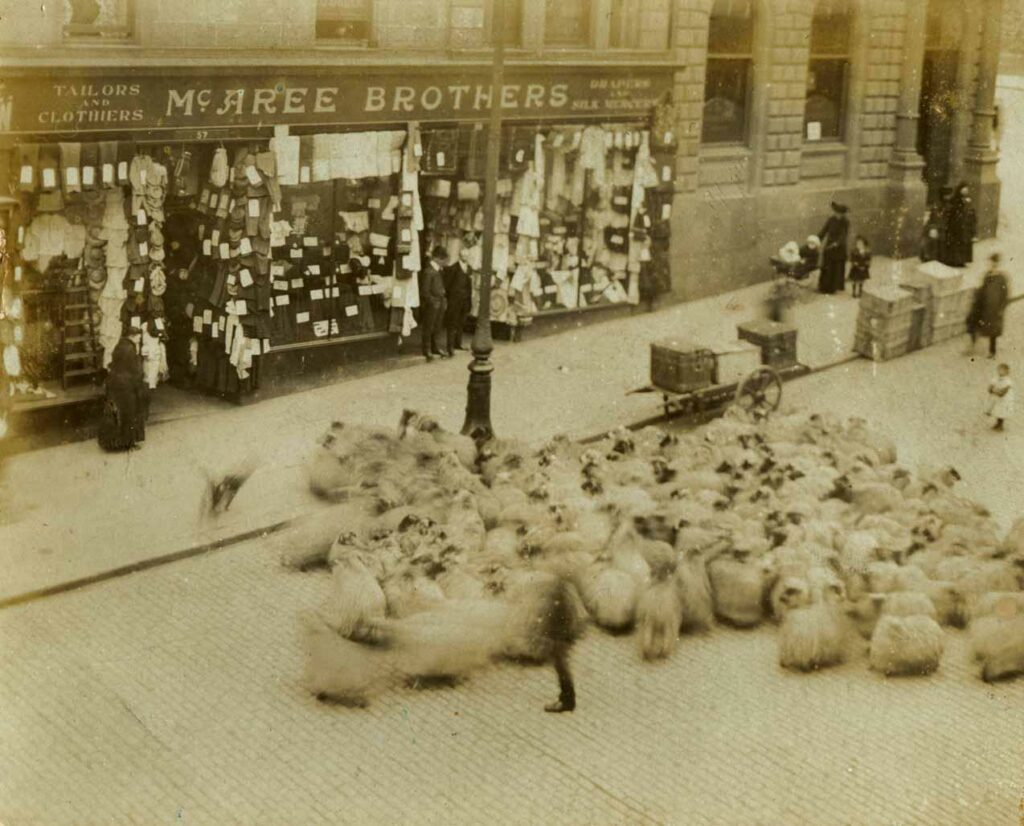 McAree Brothers, established in 1878, are described by current fans familiar with their shop in King Street as “knitting heaven in Stirling” on account of their yarn stock and knowledge of the world of knitting. As can be seen from this photograph of c1900, they have always had a close relationship with wool. The flock of sheep are on their way to the market in Wallace Street, and on market days, sheep were as common a sight in King Street as cars are today. On one occasion, a sheep broke loose and had to ousted from McAree’s front window display.
Working with the Danish Cultural Institute, McAree’s have sponsored the creation of a large woollen piece called Knitworks, now on show in the Stirling Smith until 29 August. It is made of 15 x15 centimetre squares, some of which are by knitting designers from Scandinavia and Scotland, and others by visitors to the Nordic Knitathon Workshop at the Edinburgh International Fashion Festival in the National Museum of Scotland. The Smith is the first venue for its Scottish tour; admission and parking are free.