

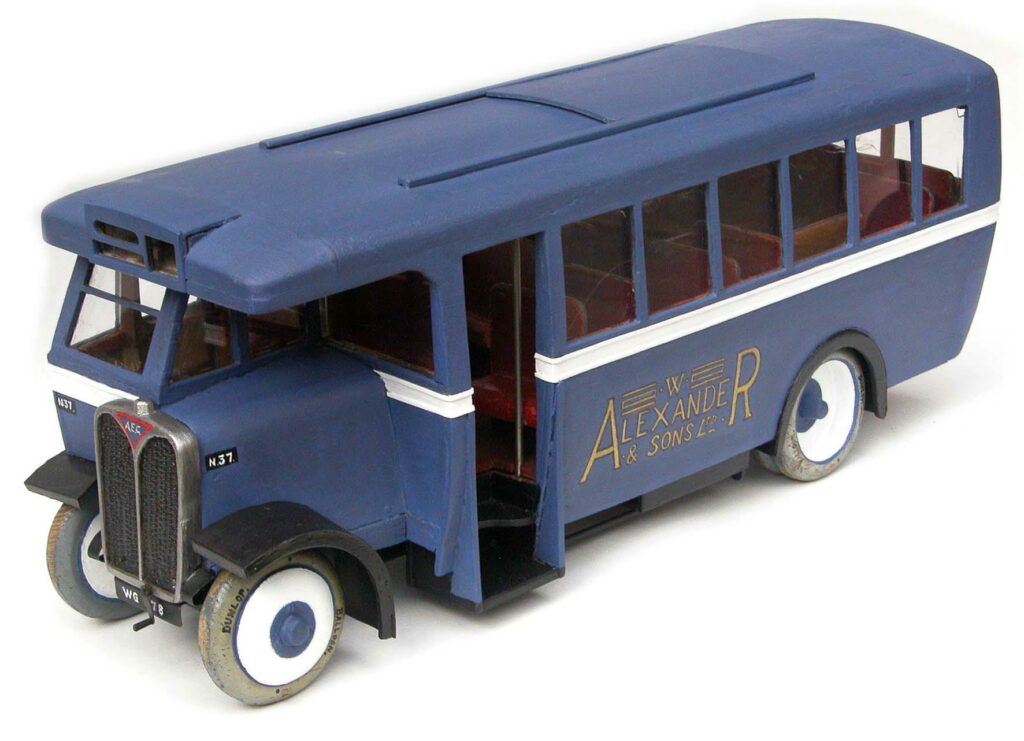
 Most of us have forgotten that Stirling was at one time a centre for the coach building industry, with the main coach works sited where Marks & Spencer now is, in Murray Place. The Raploch coach building works of W. Alexander and Son was set up in Drip Road in 1931, and single decker buses were built there. Although the company is now based in Falkirk, it had strong Stirling associations. The Bluebird branding of the luxury coaches was developed by Stirling artist Sandford Morley (1910 – 1958)
This Raploch-built bus of the period 1931-1935 is a service bus, and recent purchase for the Smith’s collections. It required extensive restoration, and both purchase and restoration money came from the Friends of the Smith. Transport history is not something which can be dealt with comfortably in the present confines of the Smith, but fortunately, this bus is a toy measuring 25 by 7 inches. Most of the bus details are faithfully reproduced, and at one time it even had lights inside. It is typical of the kind of pre-war toys which skilled workmen made for their children. The bus has a Falkirk registration number, and the only thing missing is the headlights.
When the coach works outgrew the Drip Road site, they were moved to Camelon in 1958.
During the summer, this very detailed painting of the Battle of Bannockburn by Andrew Hillhouse is on display in the Stirling Smith Art Gallery’s Bannockburn exhibition. In it, the artist has attempted to include all of the action of the second day of the battle, 24 June 1314.
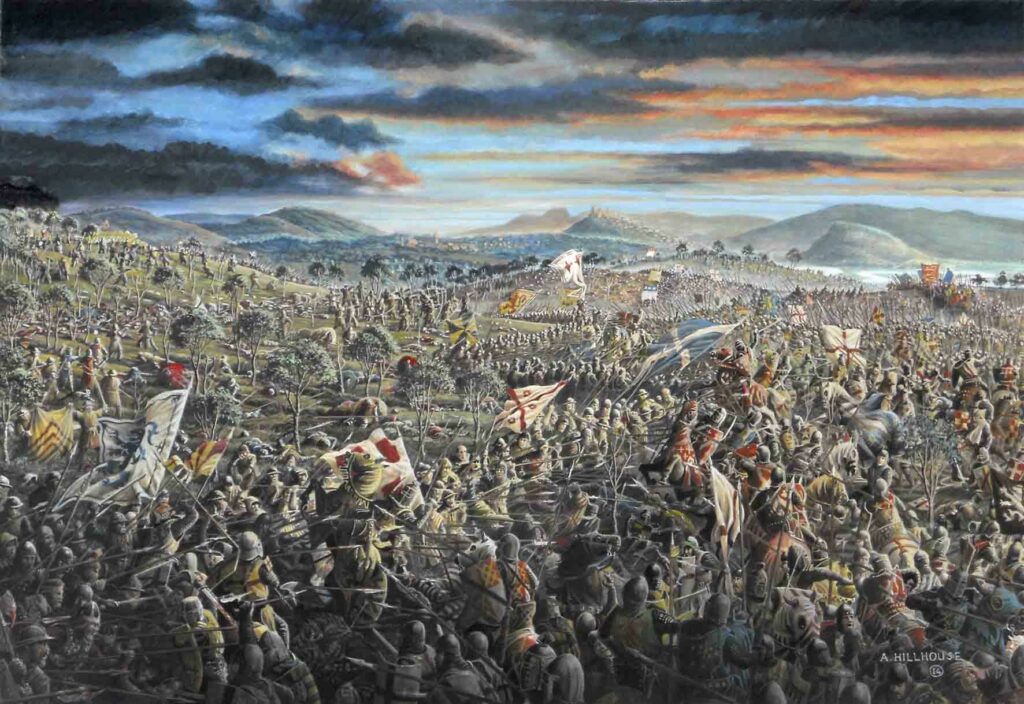 The information is taken from contemporary sources, and the artist has depicted the whole known sequence, from the Scots kneeling in prayer before the battle on the far left, to King Edward fleeing the field on the far right. The painting requires close personal study as it has a key, showing 46 different points of interest, including episodes in the battle, the landscape, and the heraldry of both the Scottish and English knights.
There are many ways of understanding the past, and we need to use all of them. Yesterday and on Monday, 700 years to the day and hour, Stirling’s bairns re-enacted many of these episodes, scripted by David Smith, Education Officer at the Smith, and guided by Stirling Council’s Archaeologists Murray Cook and Fiona Watson. On Sunday, the March of the Gillies took place in defence of Gillies Hill, preceded by the annual Bannockburn Rally organised from Glasgow on Saturday. With Bannockburn Live still to come, there are many opportunities to get involved. The Smith’s Bannockburn exhibition runs until October.
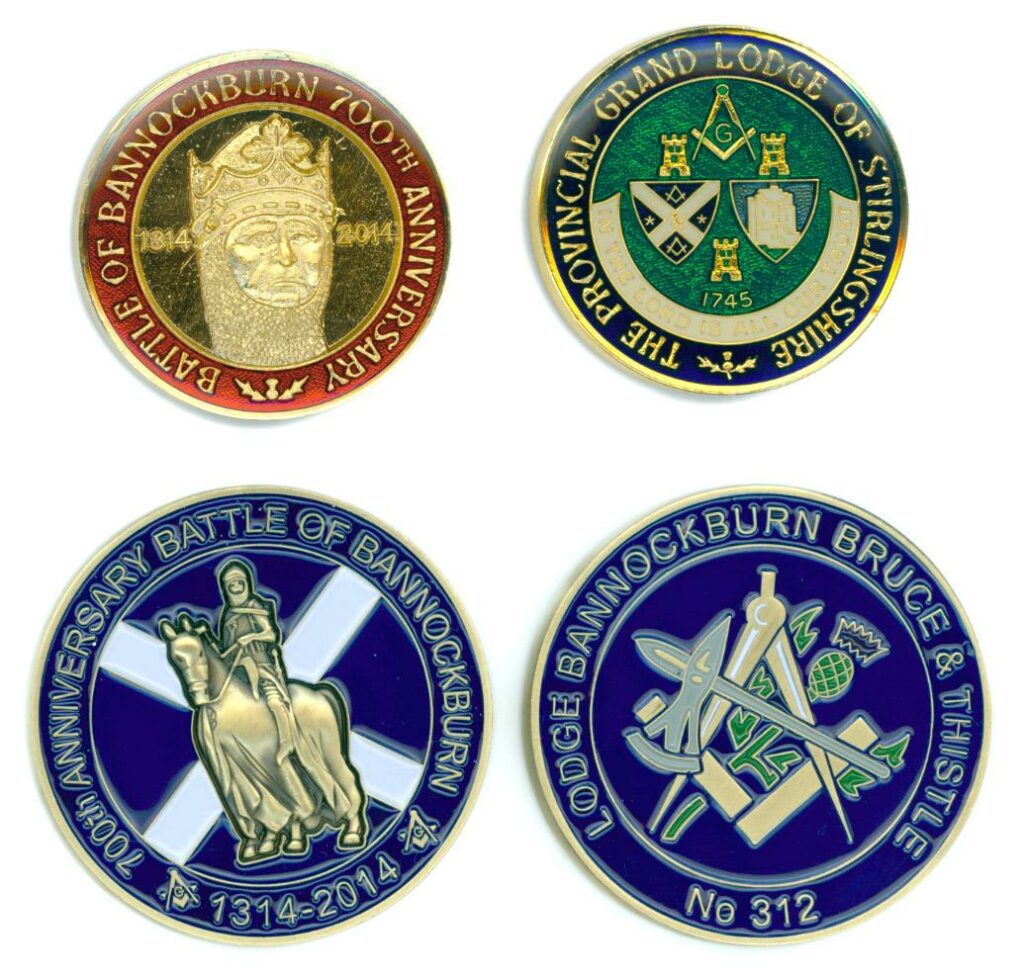
There will be many commemorations for Bannockburn 700 throughout the world, wherever Scots meet. Bannockburn near Geelong in Victoria, Australia also has its own battle re-enactment scheduled for 22 June. Here in Stirling the Masonic societies in the Provincial Grand Lodge of Stirlingshire have had a commemorative dinner for over 200 of their members. Two medals have been struck, both featuring the statue of King Robert the Bruce by the sculptor Pilkington Jackson, unveiled 50 years ago by Her Majesty the Queen. One is issued by the Provincial Grand Lodge, the other by Lodge Bannockburn Bruce and Thistle, and examples of both are in the Bannockburn exhibition at the Smith.
The survival of what little remains of the battlefield is largely down to the Masonic community. It was the Loyal Dixon Lodge of Oddfellows of Dumbarton, with the help of the Stirling Oddfellows, who erected the 120 foot high flag pole in 1870. Before that, visitors had great difficulty in finding the Bore Stone where Robert the Bruce was said to have placed his standard.
The supporting plinth of the Bruce statue, like the flag pole beside it, was dedicated with full Masonic honours and over a thousand masons present at the ceremony in 1964. Both the flag pole and the statue have been restored recently, and should be good for another 200 years, denoting the site of Bannockburn.
The Norman McLaren Archive
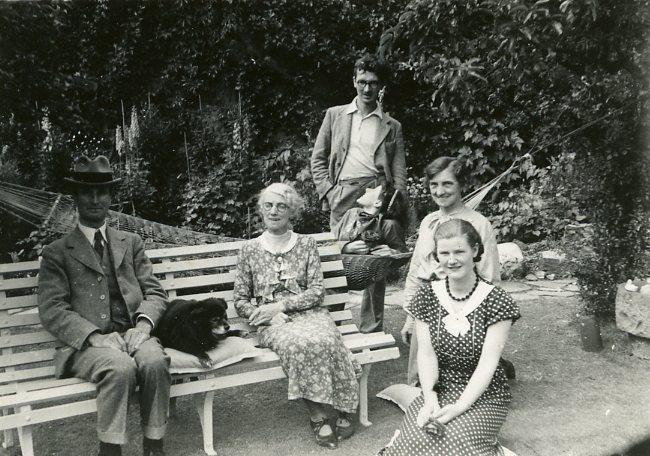
The photograph, from the University of Stirling Archives, shows a sunny day in the back garden of 21 Albert Place, Stirling. Left to right are William McLaren, his sister Jessie, his son film maker Norman McLaren, and Norman’s friends Helen Biggar and Biddy Russell.
This is one of 80 photographs in the exhibition A Dream of Stirling, which has now less than two weeks left to run at the Stirling Smith Art Gallery and Museum. Many of the photographs show the house and gardens of 21 Albert Place in the years between the Wars, and give a special insight into the social history of the Kings Park area. William McLaren was a successful interior decorator and picture frame maker who assisted with the fine art exhibitions in the Smith. His son was a genius who changed the world with his film making. The photographs show the whole social history of the family; Norman as a young child with his nanny, tea and croquet on the lawn; picking apples and sunbathing in the garden; parties mocking Hitler, the family digging their Anderson shelter on the outbreak of World War 2. There is also a treasured family film.
At 12.30pm on 19 June, archivist Karl Magee will be giving a talk on Grierson and McLaren, Tales from the Archives, in the Stirling Smith. Admission and parking are free, and this is a rare opportunity to learn more about the film treasures of the University of Stirling Archives.
The invasion of 11 May 1938 had nothing to do with Europe. Apparently the invaders, who arrived in a canoe at Stirling Harbour, came from Montreal. They were Native American Braves, led by Chief Pokobawbees, who arrived to relieve the Stirling people of their spare cash – all in aid of Stirling Royal Infirmary.
The annual Charities Week in Stirling was always a colourful high profile event, and was reported nationwide. In 1938 the invading Braves were welcomed by John J. Munro of the Stirling Observer, chairman of the charity committee, and then went by covered wagon to the Municipal Buildings where they had tea with Provost McAllister. The rest of the day was spent collecting around the town.
Until the introduction of the National Health Service in 1948, hospitals relied on charity collections and private endowments for beds and wards. A ‘bawbee’ was the old Scots word for the half penny which disappeared after the Union of 1707. During Charities Week, the Stirling people knew that their donations were necessary, and the bawbees for the Infirmary were collected by many shops in the town, as well as on the streets.
The Declaration of Arbroath, sent by the barons and nobles of Scotland to the Pope on 6 April 1320, was a document which underlined the freedom won at Bannockburn and shaped political thought in Scotland and elsewhere thereafter.
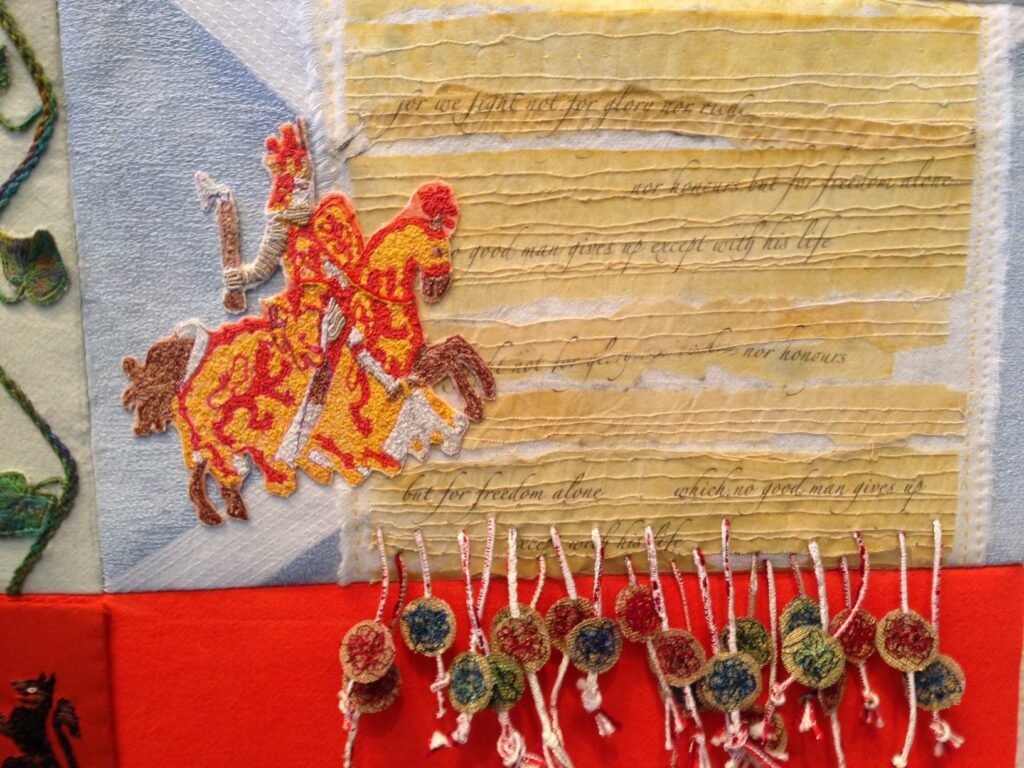
This version was stitched as part of the Smith’s 2014 banner by Stirling embroiderer Kirstine Higgins.
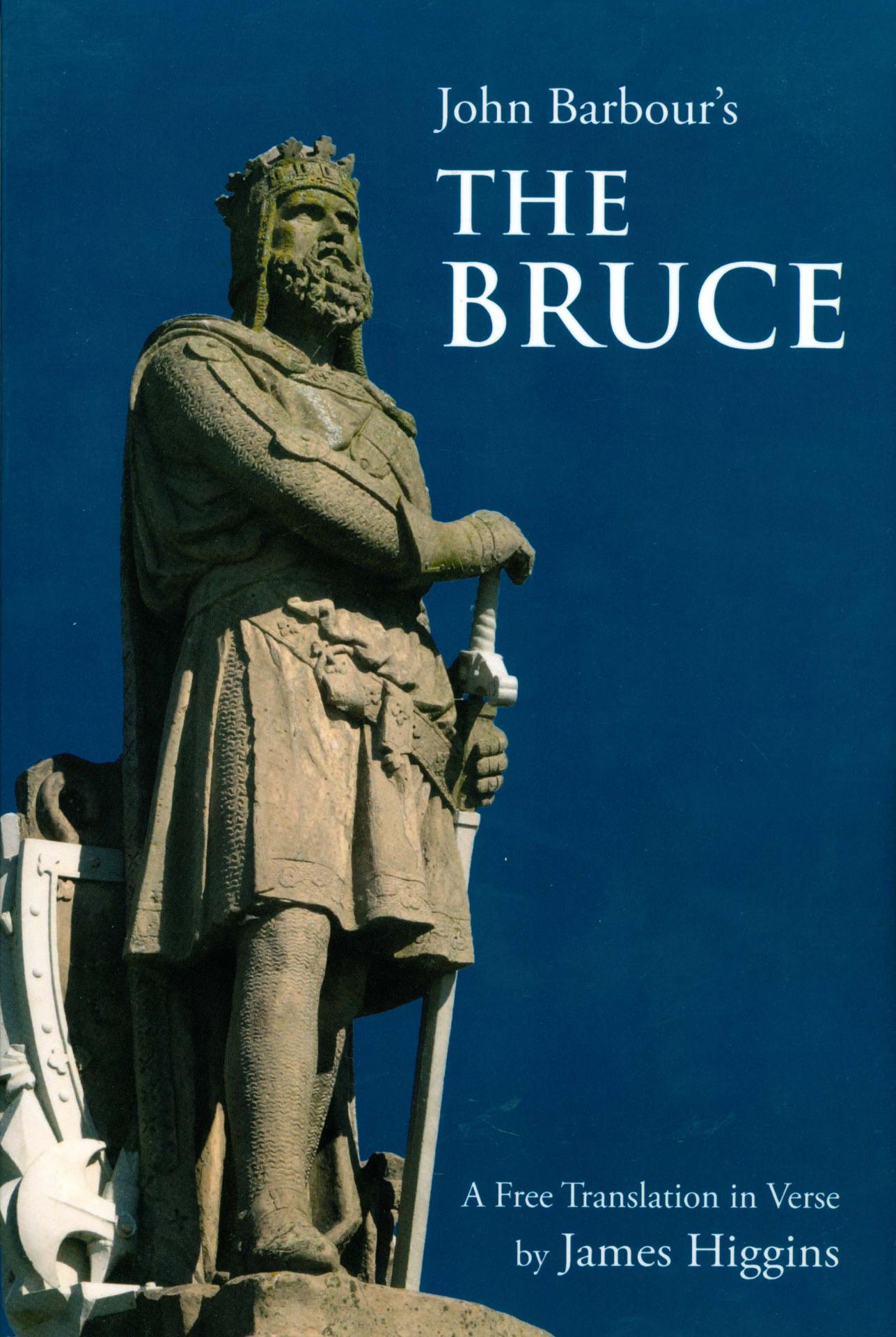
On 15 May Kirstine’s husband, James Higgins, will be speaking on the epic work by poet John Barbour, The Bruce, which he has translated from Scots into contemporary English, “just for fun”. Barbour wrote his epic work in the 1370s, sixty years after Bannockburn, for Robert the Bruce’s grandson. It is composed in verse, in 20 books, and this new free translation in verse runs to over 400 pages. The work can now be read and easily understood in this special Stirling edition.
John Barbour’s Bruce is a main source for understanding the life and times of Robert the Bruce, and the talk by James Higgins at 12 noon on 15 May in the Smith will give a good introduction to this important work of Scottish literature and history. It will also be a celebration of the contribution of one Stirling family to Bannockburn 700.
The Bannockburn 700 exhibition at the Stirling Smith looks at how Bannockburn has been remembered and memorialised over the past 700 years. The royal victor, King Robert the Bruce, has also been portrayed by artists and sculptors in so many different ways.
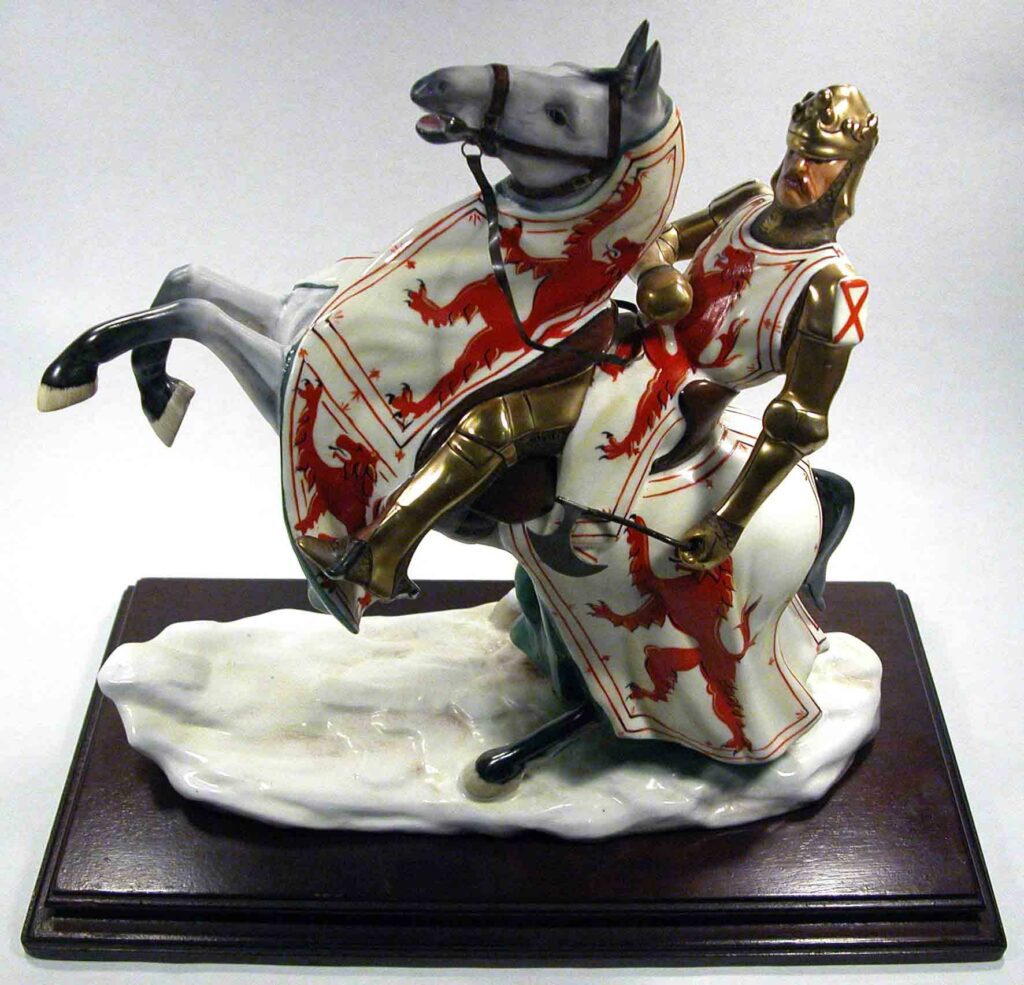
Shown here is a figurine in porcelain by Michael Sutty, made in the 1960s and purchased for the Smith collections through the Stirling Common Good Fund.
Robert the Bruce has been used for marketing purposes over the years, chiefly by whisky and shortbread companies, using his name and profile to sell their products. Chivas Regal commissioned many artistic images of Bruce and the Scottish army in different media – miniature painting, stained glass, engraved glass and manuscript illumination – for use in sophisticated magazine advertising.
One of the strangest promotions was that produced by the English pharmaceutical company, Lomotil, for their constipation medicine in the 1970s showing Bruce in a cave “try, try and trying” again.
Visit our Bannockburn Blog
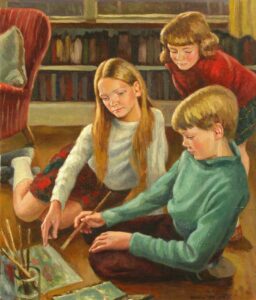 James Robert Wallace Orr (1907-1992) was a well-known Scottish artist who trained at the Glasgow School of Art, 1929-33.
Apart from war service with the RAF, he earned his living as an artist, working in Glasgow, Kirkcudbright, Helensburgh and Prestwick. He spent the last ten years of his life at Moorgait, Kippen.
‘The Young Artists’ is from this period of his life. For many years it hung in Gargunnock Primary School, and it is a recent gift to the Stirling Smith collections. Can any Observer reader identify who the young artists are, and what they are doing now?
Although the Stirling Smith has a good collection of local portraits, they are of older people. Not many commissioned portraits of children have come into the collection, and this painting is a welcome addition.
J. R.W. Orr was also a skilled engraver. His work is represented in the City of London, the Guildhall Gallery, City Hall, Aylesbury, the Hunterian, Glasgow and the University of Stirling, as well as in the Smith.
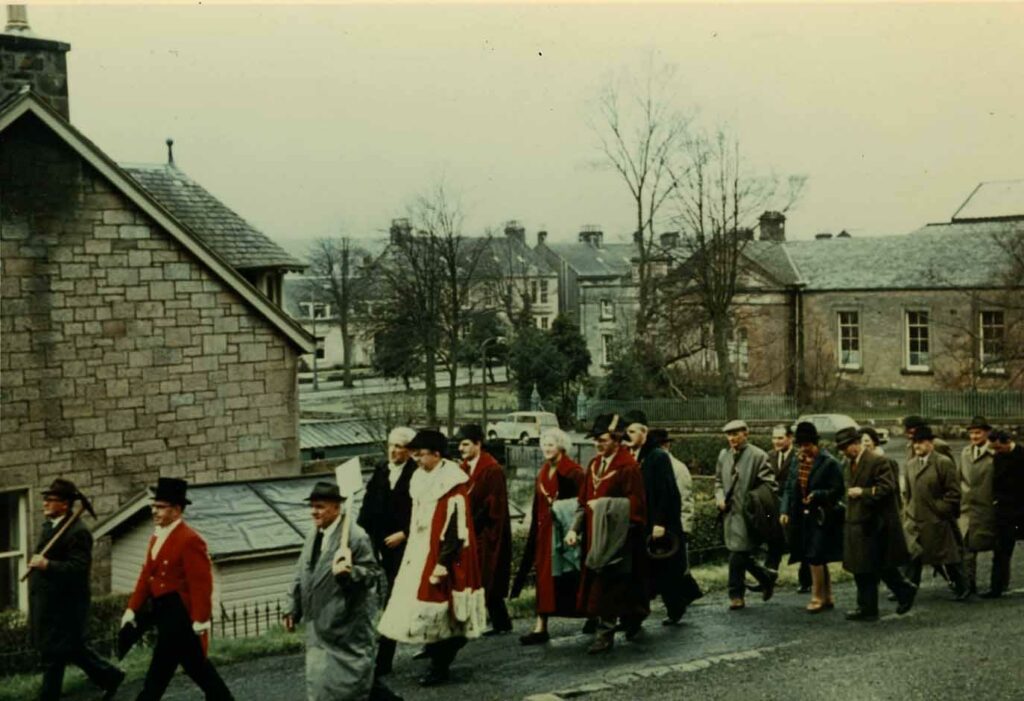
From the beginning of recorded time, the Provost and officials of Scottish burghs have walked the burgh boundary once a year, checking that the march stones are in place and that, there are no illegal encroachments on burgh land. In the border towns, and Linlithgow and Edinburgh, the marches are checked by people on horseback in the annual common ridings. This photograph shows a Stirling Walk, headed by the Provost in his Robes of Office in the 1960s. In the period 1950-2000, walks were relatively rare.
In 1737 there was a complaint that too much money was being spent on the annual dinner for the magistrates and Dean of Guild after the march, but this was over-ruled. The march stones were supplied by those who became burgesses, and in 1723, all of the stones were numbered, so that a count could be kept.
The municipal party in this photograph is walking along the lower Back Walk, now known as Greenwood Avenue. This area from the path to the Town Wall, has been professionally cleaned and cleared by volunteer Roman Solochenko, who comes from Russia. He has made a magnificent gift to Stirling, and the area is again a beauty spot for all to enjoy.
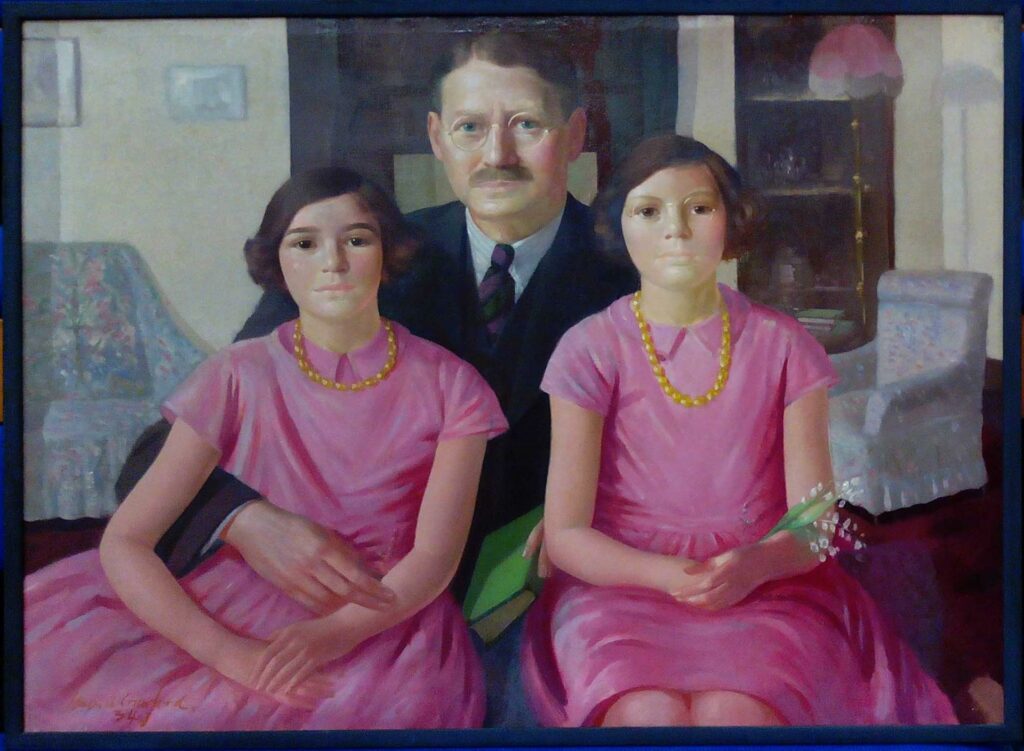
This charming family portrait is one of seven works bequeathed to the Stirling Smith by Mrs Mary Saunders (1924-2012). It is by the eminent Glasgow artist, Hugh Adam Crawford (1892-1982) and was painted in 1934 in the family house in Kingsborough Gardens, in Glasgow’s west end.
The family is that of William and Winifred Service. William Service was an engineer, and a director of the Parozone Company (now Jeyes). He is painted in the drawing room with his daughters Mary (aged 10, later Mrs Saunders) and Joan (aged 8). When in adult life, marriage brought Jean to Stirlingshire, her sister Mary followed, taking a house in King’s Park, next door to the Smith.
When the Smith reached its centenary in 1974, it was in such poor physical condition that demolition seemed the best option. There was an additional proposal to make the area a car park for a funicular railway serving Stirling Castle. At a crucial point, Mary Service came forward with a significant capital sum, which restored the Ballengeich Room, showing how good a fully – restored Smith building could be. This was opened in 1977, and the Smith has never looked back.
Throughout her life, Mary Service (Mrs Saunders) helped the Smith, and it is fitting that her portrait is now part of the Smith’s collections.