

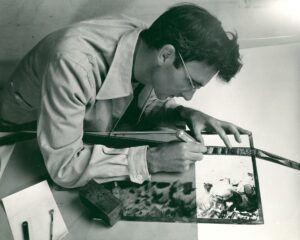
 Norman McLaren, the award-winning animated filmmaker, was born at 21 Albert Place, Stirling, opposite the Stirling Smith on 11 April 1914. Using material from the University of Stirling’s extensive Norman McLaren Archive along with items loaned from the McLaren family ‘A Dream of Stirling’ is the exhibition which looks at the influence of his Scottish upbringing.
A pupil of Stirling High School McLaren’s artistic talent was recognised at an early age. In the 1930s, while a student at the Glasgow School of Art, his work was exhibited in the Stirling Smith as part of the Stirling Fine Art Society shows. Norman’s father William was an active member of the society and the exhibition catalogues include advertisements for his decorating business in Maxwell Place.
‘A Dream of Stirling’ will include examples of Norman McLaren’s artwork from the 1920s and 1930s. Much of this material has not been publicly displayed for over 70 years and has been specially conserved, mounted and framed for the exhibition which runs at the Smith until 22 June.
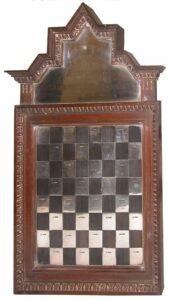 The Stirling Smith is well known as the home of the world’s oldest curling stone (1511), football (1540), early golf clubs and balls, and specialist early fishing equipment. The latest addition to the collection of sporting memorabilia is this magnificent draughts trophy in the form of a draughts board. It was competed for between 1902 and 1935 and on the last three occasions, won by J. Scott.
The board is designed to be wall mounted, like a roll of honour. However, it can also be used to play draughts. It is quite unusual to find a sporting trophy which has a practical as well as a decorative use. The white squares are hallmarked silver pieces, each inscribed with the name and year of the winner of the trophy. These were made in the Denmark Works of George Wish Ltd, Sheffield in 1904. The black squares are of lignum vitae, the hard wood of which bowling balls were often made.
The board is the generous gift of Marion Scott of Polmont.
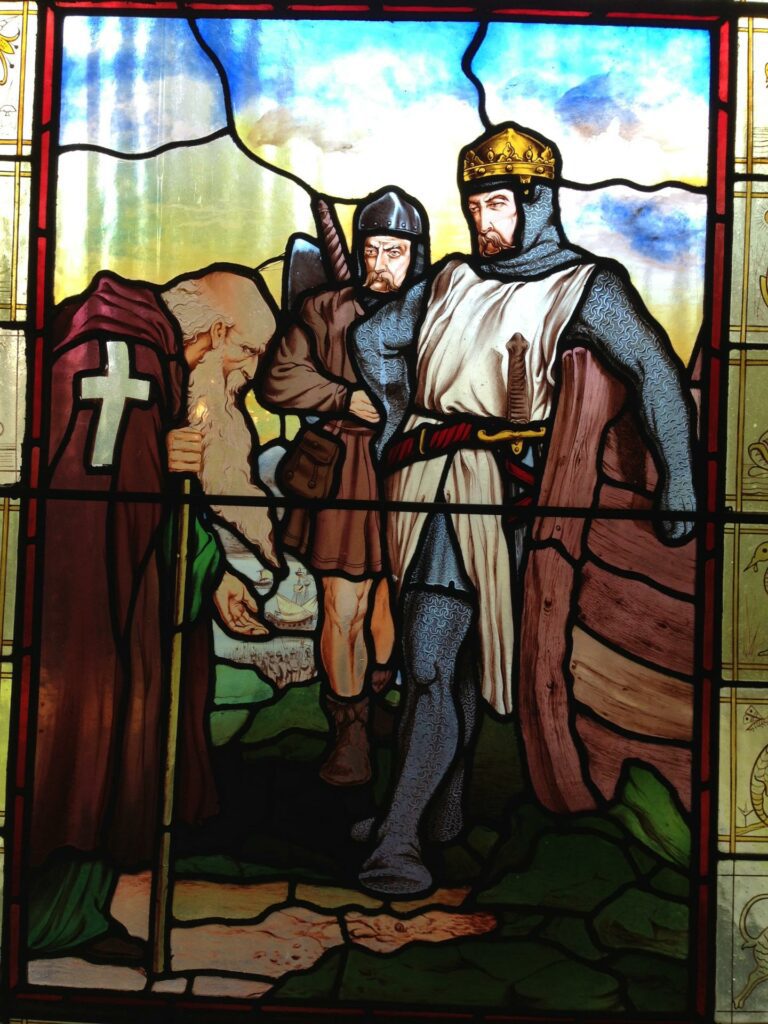
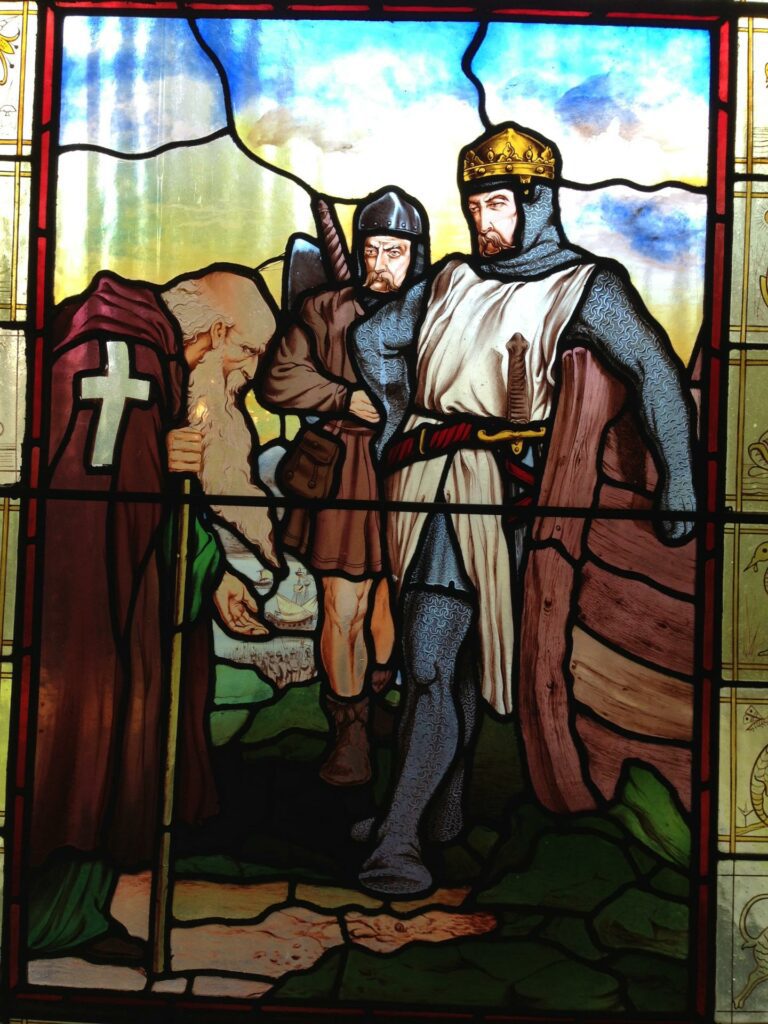 There are many interpretations of Bannockburn. Sir Walter Scott’s epic poem, The Lord of the Isles, published in 1815, is one of many literary works on the subject, and its hero, King Robert the Bruce. An episode is illustrated here in a window by Glasgow stained glass artist John Cairney in 1872. Scott’s work was popular for at least a century.
At 12 noon on Thursday 1 May 2014, Professor Robert Crawford of the University of St Andrews gave a talk on Bannockburns, the title of his new book, which deals with the literature of Bannockburn over the past 700 years. In 1314, the poet-in-residence was Robert Baston, who came north with Edward II to write about the great English victory. Captured and held prisoner by Bruce for 20 years, he wrote one of the greatest anti-war poems of the middle ages, before gaining his freedom. He wrote in Latin, and the poem was translated in 2004 by the Scottish Makar Edwin Morgan.
Robert Crawford, himself a leading Scottish poet, talked about the influence of Bannockburn on Scottish literature.
At 12 noon on Thursday 1 May, poet Robert Crawford will speak in the Stirling Smith Art Gallery and Museum on Bannockburns: Scottish Independence and Literary Imagination, 1314 – 2014, which is the subject of his latest book.
This is a rare opportunity to meet one of Scotland’s leading poets and explore the literary legacy of the Battle, which began with the great anti – war poem of the English poet Robert Baston who was captured by Robert the Bruce, and continues to this day.
Born in Lanarkshire, Robert Crawford studied and taught at Glasgow and Oxford, moving to the University of St Andrews in 1989 as Professor of the School of English. He has published six collections of poetry and over two dozen other books. A Fellow of the Royal Society of Edinburgh and of the British Academy, he has given readings and lectures at Berkeley, Oxford and Yale as well as in schools and village halls. An experienced broadcaster, he has been a judge of the National Poetry Competition, the T S Eliot Prize, and the David Cohen Prize.
Admission to the talk is free. Copies of the book, price £20, will be available on the day.
Event organised in conjunction with Waterstone’s of Stirling.
With the Ryder Cup exhibition in the Stirling Smith, we continue to explore the local story of golf. The Bridge of Allan Golf Course was laid out by the famous Old Tom Morris in 1895, on ground selected by him. Shown here is Edmund Pullar declaring the extended course open in June 1909. A nine hole course, it has had no additions since then. It has plenty of hazards, with dykes, whins and bunkers, and the greens are of a specially fine quality. Tom Morris thought that the Bridge of Allan folk might truthfully claim that they had the finest view from any golf course in the country, and that the air was pure and bracing. A golf historian describes it as ‘one of Scotland’s national treasures.’
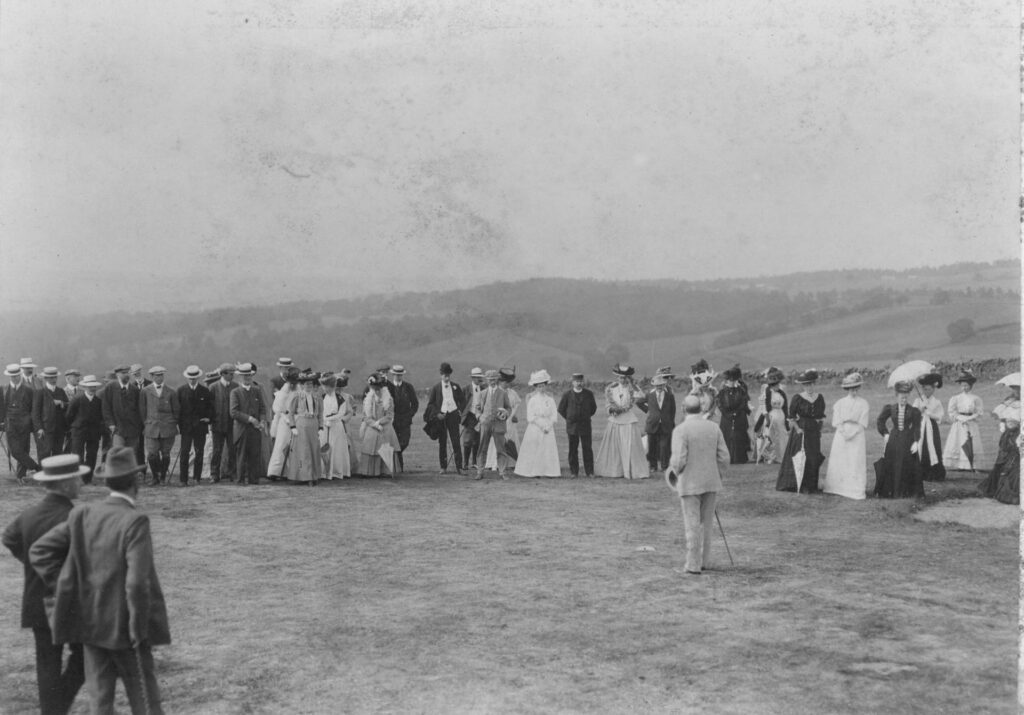
The course was promoted in the World of Golf Magazine, 1909 as ‘a charming holiday course’ which would please visitors, on account of all of the facilities, attractions and shopping opportunities in and around Bridge of Allan. Wives and partners with no interest in golf could be well entertained by all that Bridge of Allan has to offer. The same is still true, over a hundred years later.
This photograph was loaned by Evelyn Cameron. The Smith welcomes the opportunity of copying historic photographs.
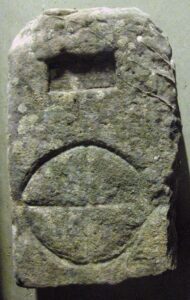 This important early Christian grave marker, discovered by farmer Mr A.M. Paterson on his land at Ballangrew Farm, Port of Menteith in 1975, is evidence of early Christian belief in the Stirling area. It dates from 400-600AD and is one of the earliest surviving Christian stones. It was acquired for the Smith collection from Mrs E.J. Paterson through Treasure Trove in 2007, and is on display for the first time.
In historical terms, it is one of the most significant finds in the district, demonstrating that Christianity was practised nearly 900 years before the monks arrived on nearby Inchmahome in the Lake of Menteith. The settlement at Ballangrew on the Flanders Moss dated to prehistoric times, and was a homestead moat made of turf. Until the 18th century, turf housing was not uncommon on the moss lands.
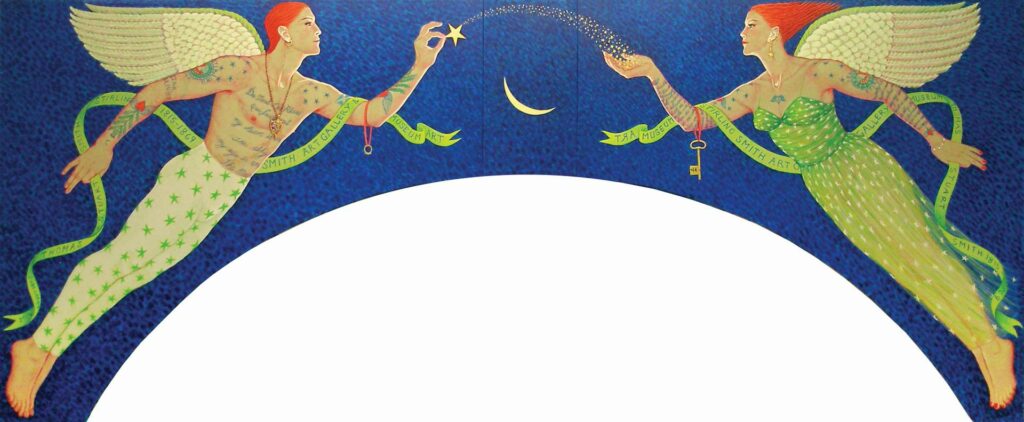
An important new work of art is installed in the Stirling Smith later this week. ‘A Heavenly Gift’ has been made by artist June Carey, who lives and works in Stirling, to celebrate the 140th birthday of the Smith in 2014. Thomas Stuart Smith, also an artist with Stirling connections, bequeathed his fortune, from which the Smith was built. June Carey’s work will decorate the arch above the doorway into the central gallery.
June Carey has spent months perfecting the size, shape and content of the mural to suit the spaces in the Smith’s archway. Paintings for the architectural spaces in public buildings in Scotland are a rarity. With this work, the artist has complemented the classical architecture, given meaning to the collection, beautified the building and thanked Thomas Stuart Smith in the only way in which a good artist can be thanked – with a beautiful work of art, which will endure.
Two angels soar in the arch, exchanging a shower of golden stardust. Both carry ribbons with the name and dates of T.S. Smith, and have tattoos of the Stirling Heads on their arms. One angel has the Guildry Ring of 1360 over his arm; the other has the key of Stirling, surrendered to Prince Charles Edward Stuart in 1746, symbolising the history of the City.
Installation costs have been met by the memorial fund of Janey Buchan (1926-2012), Smith Trustee and patron of the arts.
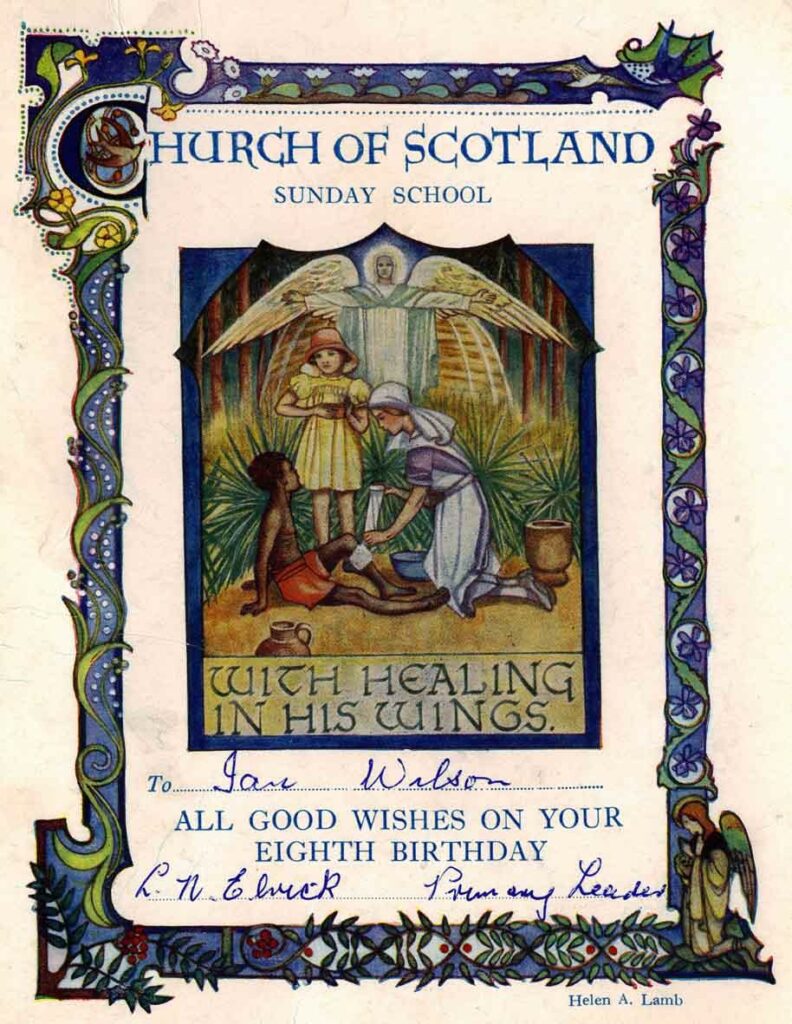 The subject today is the ‘Glasgow Girl’ artist Helen Lamb (1893-1981) whose work gave colour and meaning to church services for several generations of worshippers in the Church of Scotland. She studied at the Glasgow School of Art, and spent most of her working life in Dunblane, with a studio in Bryanstone, the house built by her father.
Helen Lamb was known internationally for her calligraphy and manuscript illuminations, and her finest original work can be seen in Dunblane Cathedral, Dunblane Museum and in the Royal Collections. In 1927, the Church of Scotland obtained the right to print copies of her cradle roll, and these, together with her certificates, birthday cards for children, Girl’s Guildry, Women’s Guild cards and other works were used in Scottish churches world wide, to the end of the last century.
Shown here is a Birthday Card for an 8 year old in Dunblane. Such works are now a rarity, so the new book on the Art of Helen Lamb by Dr. Valerie Inglis is timely. It explores her life and work in a full colour, sumptuous paperback of 142 pages, available at only £10 from the Stirling Smith and all good bookshops.
An elaborate fan, of machine cut paper lace, was the Valentine message sent by J. Malcolm Allan’s grandfather to his sweetheart in 1889. The couple married in 1890, and until it was gifted to the Smith in 2002, the Valentine fan was a family treasure. More versatile than a card, it was a fashion accessory.
Valentine messages were much more complex and discreet in the 19th century. The fan maker has used floriography, the language of the flower, to convey certain messages. The flowers on the fan include pansies, signifying ‘you occupy my thoughts’, ferns, denoting discretion, secrecy and serenity, clover, meaning ‘be mine’ and forget-me-nots, ‘true love.’ The recipient could check the messages in the popular flower books of the time. One of the verses reads ‘Some day I hope you will be mine,/ I thine,/ Together bound by that holy tie,/ That close each faithful heart to heart shall twine./ With Love that lasts to all eternity.
Valentine was an early Christian saint who was marched in Rome for performing weddings for soldiers who where forbidden to marry.
St Valentine’s Day on 14 February is traditionally the first day of spring on which the birds choose their mates. Both Geoffrey Chauncer and Stirling’s own George Buchanan refer to this in
Until 20 March, the Stirling Smith has the privilege of hosting the famous Ryder Cup Heritage exhibition. The ancient Royal Burgh and City of Stirling has golfing heritage of its own. It is recorded in the accounts of the Lord High Treasurer of Scotland that on 29 March 1506 James IV bought seven golf balls for a game while staying at Stirling Castle.
Naturally, the collections of the Stirling Smith Art Gallery and Museum reflect the importance of the game to Stirling, and featured today is ‘a Gourlay Feathery’. These balls were made of goose feathers, sewn into a leather covering, and were made by the Gourlay family from the 18th century until the gutta percha ball came into general use in the 1850s. The ball is marked with the manufacturer’s name. The number 31 refers to its weight in drams, avoirdupois (approximately 2 ounces).
In November 1839 an ancient Hindu sculpture was gifted to the St Andrews Literary and Philosophical Society by Reverend James Paterson. It arrived, packed in gutta percha, a black, rubber-like resin from the Isonandra Gutta tree. According to an article in Golf Illustrated, 1902, gutta percha was first employed in the manufacture of golf balls in April 1845.
Gifted by Miss Murrie of Snowdon Place in 1930, it is likely that the Gourlay was played on the Kings Park course in the 1860s.