

Here is a modern tribute to Forsyth’s Motor Bus Services. The company was set up by Thomas Forsyth and his wife Margaret Dickson in 1922, with a fleet of six buses. By 1925-6, he had twelve driver and conductor licenses. The service was run from Plean-Bannockburn-St Ninians-Stirling. He owned a fleet of vehicles and charabancs, and ran trips to the Trossachs, Bridge of Allan Games, and various excursions to places such as Aberdour. His wife undertook all of the applications for licenses, and probably ran the business side of the firm. Forsyth’s Motor Tours was featured in the Motor Transport Journal of 1925.
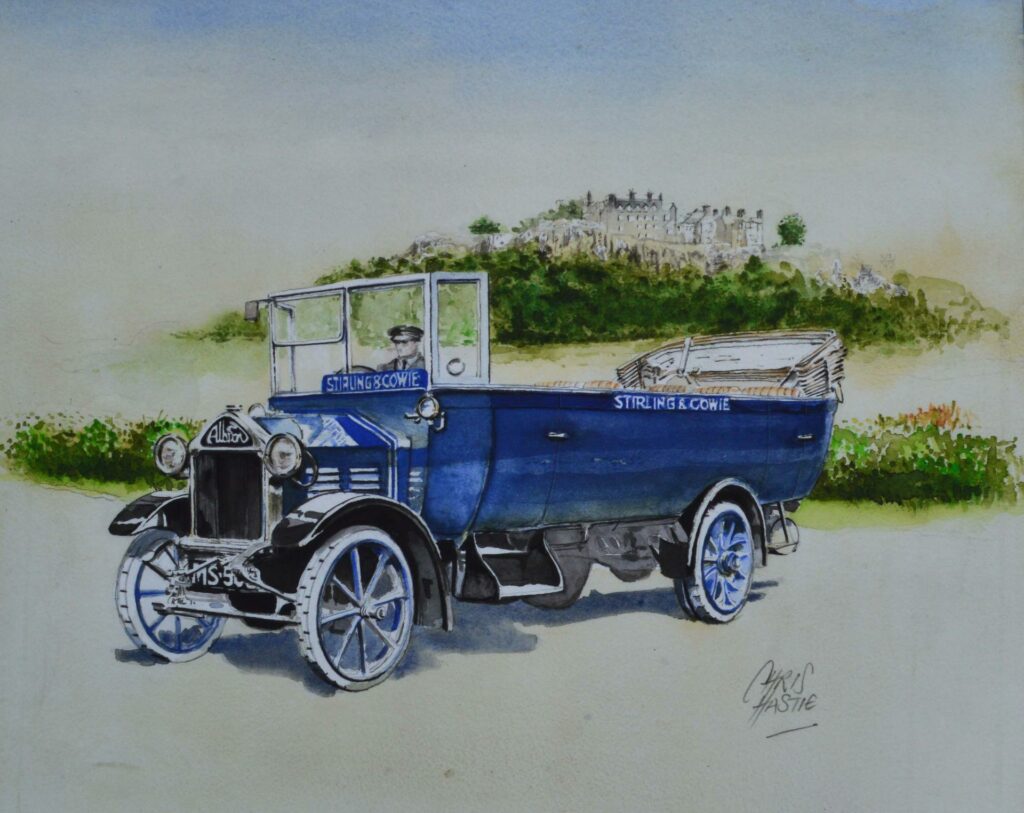
Forsyth commissioned his vehicles from Kinross’s Coach Works, Stirling and from Albion Motors, Glasgow. This splendid Albion vehicle is depicted below the Castle by Stirling – based artist Chris Hastie, who was commissioned to do the work by Forsyth family members. A giclée print of the work is a recent gift to the collections of the Stirling Smith Art Gallery and Museum. The work will also be on show at Falleninch Farm in the Forth Valley Open Studios season, 8 – 18 June, where copies of the print can be purchased.
The art work was created with the help of old photographs, a splendid way of commemorating a family business.
This object from the Stirling Smith collections marked a literal turning point in the history of Scotland. The iron boot heel was highly prized in its time, and the purchaser paid 10 guineas for it, a sum of about £6,000 in today’s prices. The label is inscribed ‘Heel of the boot in which Dr. Chalmers walked for ever out of the General Assembly to found the Free Church on the 18th May 1843 (cost £10.10s).’
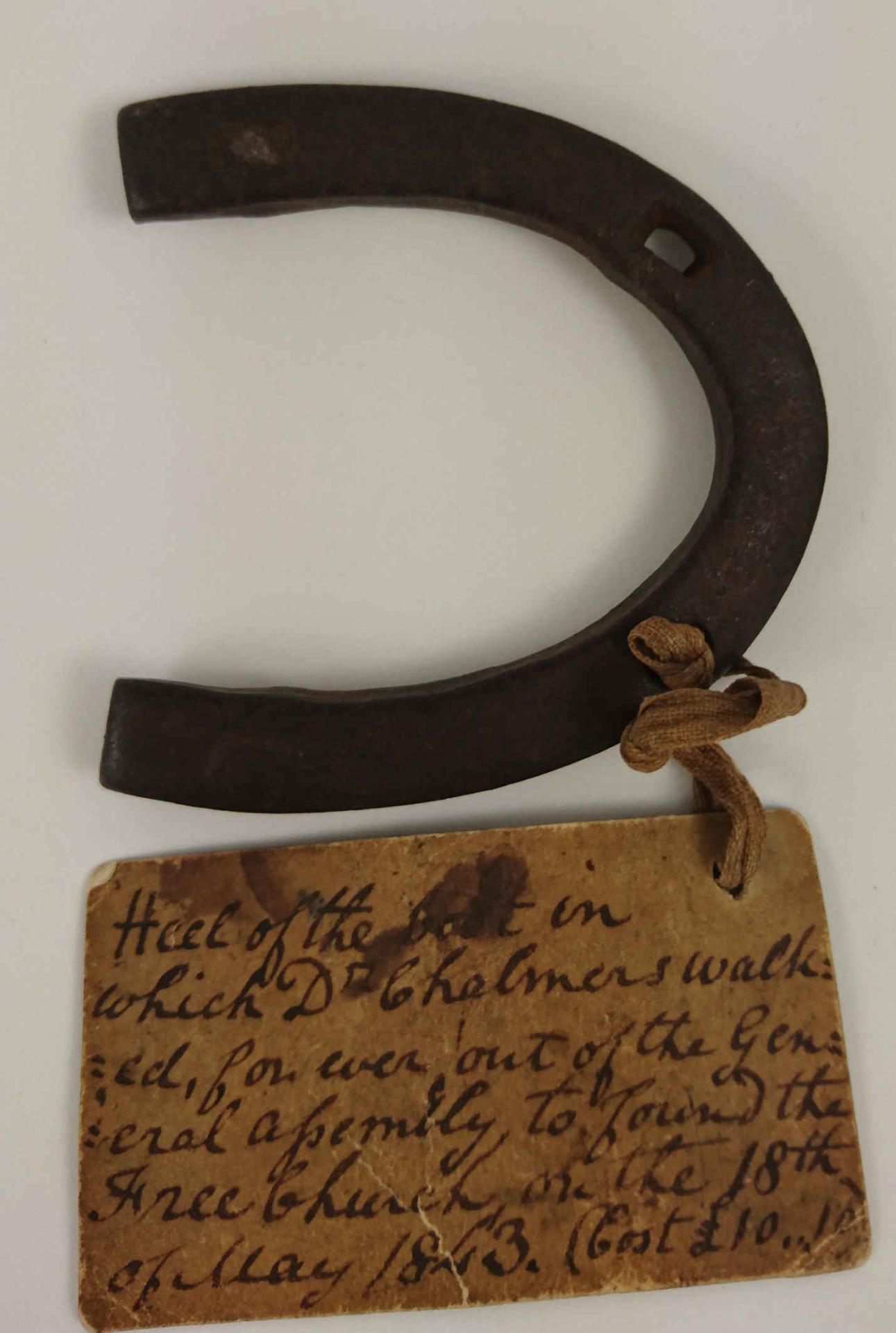
‘The Disruption’ as it was known, took place 174 years ago and was a momentous event. The issue concerned whether or not congregations could select their own minister. There were many cases in which ministers of the gospel had been intruded into parish churches against the will of the congregation. Chalmers, a great evangelical preacher, theologian, economist and academic, marched out of the General Assembly, taking 121 ministers with him. Eventually, 450 ministers – a third in total – broke away to form the Free Church of Scotland.
The Free Church of Scotland built new churches in every parish, town and village, often in the same street as the established Church of Scotland. The building programme had to be funded, and the purchase of Dr. Chalmers’ boot heel was probably part of that process.
The Stirling Smith has a small collection relating to the Free Church, Bridge of Allan. In spite of church amalgamations and closures, the Free Church of Scotland continues. The Free Church in Stirling founded in 2013, has one of the fastest growing congregations, which at present meets in the Stirling Smith Art Gallery and Museum
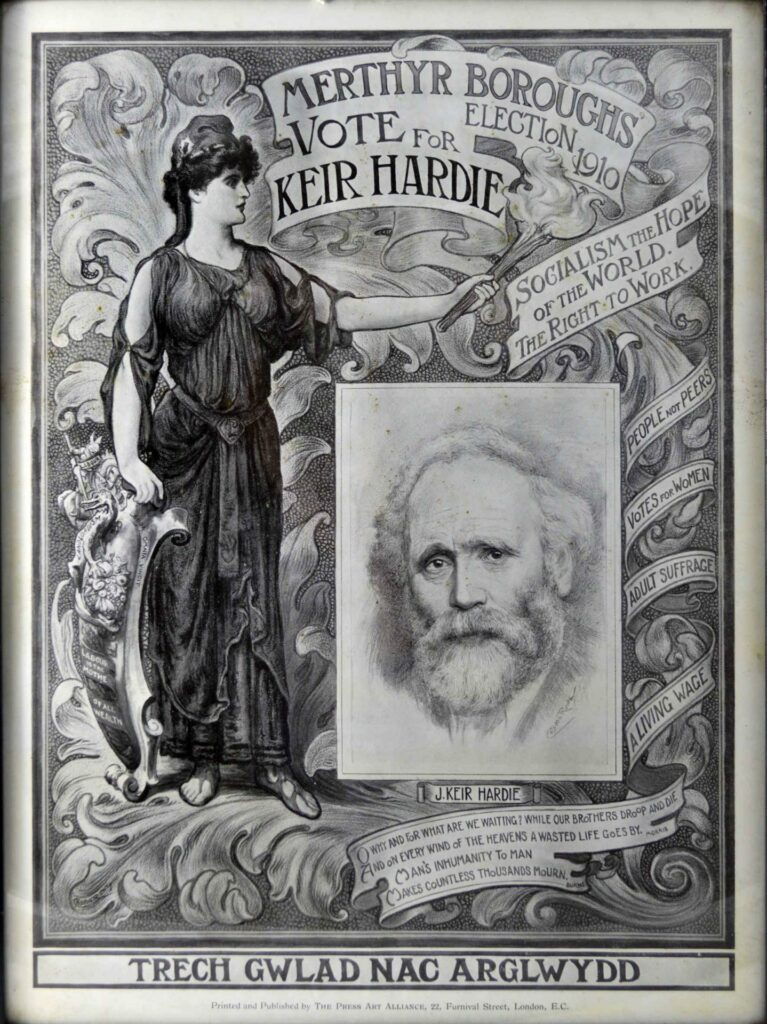
A 1910 parliamentary election poster for Merthyr in South Wales may seem to have no connection with Stirling, but it is one of the documents on display in the Graham Library in the Stirling Smith Art Gallery and Museum. The aristocrat, Robert Bontine Cunninghame Graham (1852-1936) and the miner James Keir Hardie (1856 – 1915) shared common political ideals when together, they founded the Scottish Labour Party in 1888, with Graham as president and Hardie as secretary. The new party’s manifesto included the establishment of an eight hour working day, the nationalisation of land, mines and other industries, universal suffrage and home rule for Scotland.
Graham was the first socialist MP, representing North West Lanarkshire, 1886 -1892. When he was defeated in the 1892 election, which returned Keir Hardie as MP for West Ham, he felt that part of his political mission was complete, as a working man was in parliament representing other working men for the first time.
James Keir Hardie represented Methyr Tydfil in parliament from 1900 to 1915, and thereafter, it was a safe Labour seat. The change to the Conservatives in last week’s local election was a seismic shift in a constituency where Hardie’s name and achievements are widely commemorated.
The Graham Library is the Stirling Smith is open on Thursdays, thanks to volunteer staffing by the Friends of the Smith.
This summer, the Stirling Smith hosts an exhibition on the architect John Allan (1847-1922) who created some of Stirling’s most striking and unusual buildings. His designs used red brick, steel and lead combined with carved creamy stonework to create distinctive tenements, shops and dwellings. His use of symbols and mottoes make his buildings particularly memorable. Perhaps his best known building is Wolfcraig in Port Street/ Dumbarton Road. He lived in a house of his own design at 34 Albert Place. Numerous villas in Kings Park and the Batterflats mansion, built for a member of the Drummond family, 1893 -5, on Polmaise Road show the incredible range of his design skills.
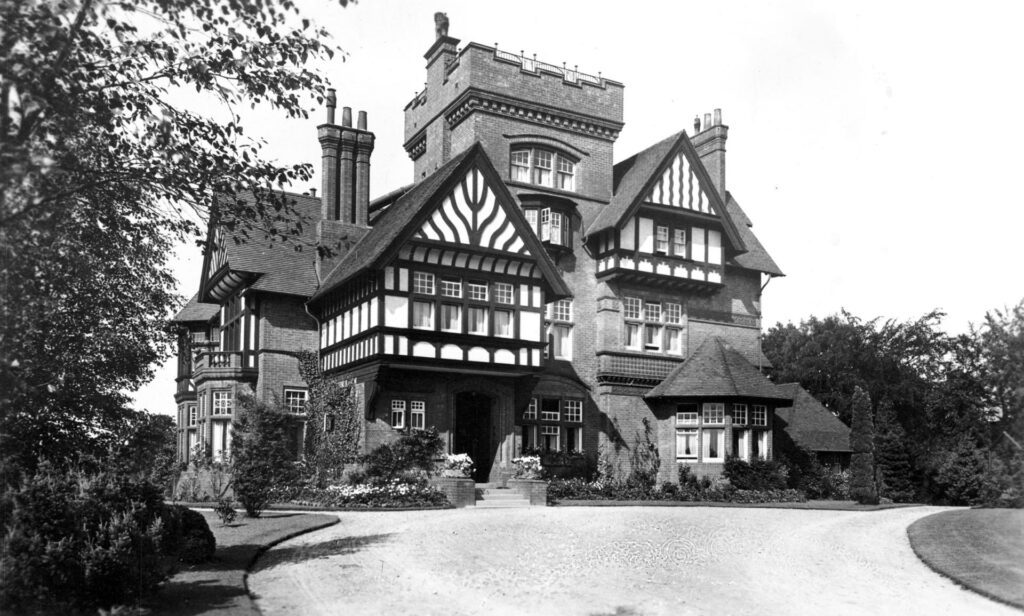
The tower and decorative cast detailing of the red Ruabon bricks below the black and white timbered upper stories of Batterflats make the building particularly distinctive. In 1929, the house was bequeathed to the Church of Scotland as a residential home. In 1954 it was sold to Stirling Council for use as an old folk’s home, accommodating 30 people. In the 1980s it was converted to private housing, and the six acre site is now covered with a housing development.
There will be a talk in the Smith by Archivist Pam McNicol at 12 noon on Wednesday 10 May on Stirling’s Dean of Guild plans, for those who would like to know more about John Allan.
No one now thinks about Stirling’s glory days as a pottery producing area, when in the 17th century, most of the earthenware for central Scotland and beyond was produced in the Throsk Pottery. The potters lived in the surrounding areas of Bandeath, Poppletrees and Cockspow, within the Barony of Cowie, and were known as pigmakers, ‘pig’ being the Scots word for pottery. The Stirling Smith has five Throsk jugs, and the National Museum has eleven, recovered from the Forth at Gargunnock, indicating a capsized boat load. Sherds of Throsk Pottery have been found throughout central Scotland, and some were uncovered in the failed Scottish colony of 1698 in Darien, Panama. With the concentration of pottery producing talent in the Stirling area, it was perhaps no accident that the first industrial pottery in Glasgow was set up by a Stirling man, William Maxwell in 1722.
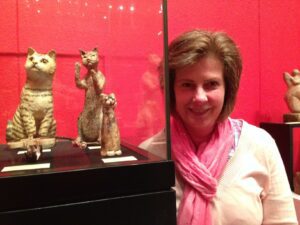
Until 28 May there is an exhibition at the Smith, showing the best of the contemporary work of the Scottish Potters Association. The SPA has only one Stirling member, Kathleen Morison, shown here with some of her work. Kathleen has worked in ceramics for four years, experimenting with alternative firing techniques, such as raku, and incorporating horsehair and feathers. She embraces the fun of imperfection and the joys of creativity, and calls her work ‘Wonky Pots’.
There are 40 potters in total exhibiting in the Smith, offering the opportunity of finding a truly unique gift, wonky or otherwise, for that special occasion.
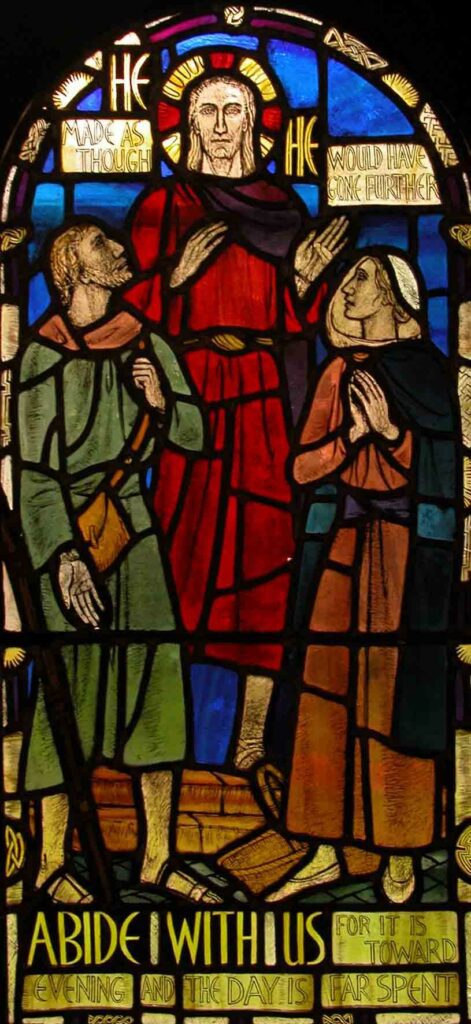 The story of the resurrection of Christ is often told through the incident mentioned in the Gospel of Luke, where two pilgrims, on the way to Emmaus on the evening after the tomb of Jesus is found empty, are discussing the matter. They were met by Christ in the guise of a stranger who rebuked them for their unbelief. The pilgrims invited the stranger to eat with them when they reached Emmaus. When he broke the bread, “their eyes were opened” and they immediately recognised him as Jesus, before he vanished. The pilgrims hastened back to Jerusalem to spread the news of the resurrection.
This story has been popular with artists throughout the ages. Here, it is depicted in a 1928 studio panel by the stained glass artist Mary Isobel Wood (d. 1969) in the Stirling Smith collections.
One of the most famous paintings of the supper at Emmaus is that by Rembrandt in the Louvre in Paris. The Stirling Smith has a copy of this too, made by Thomas Stuart Smith, who bequeathed his paintings and money to establish the gallery in Stirling in 1869. Many artists perfected their skills by copying the old masters, and there are several examples of this practice in the Smith collections.
A little insight into the history of Croftamie Primary School is offered through the gift of the family of the late Ailsa Stirling (1927 – 2016), who was head teacher of the school, 1967 – 1992. She was very well known in the field of education, speaking of her experience as a teacher in a rural area at conferences in several Scandinavian countries and elsewhere.
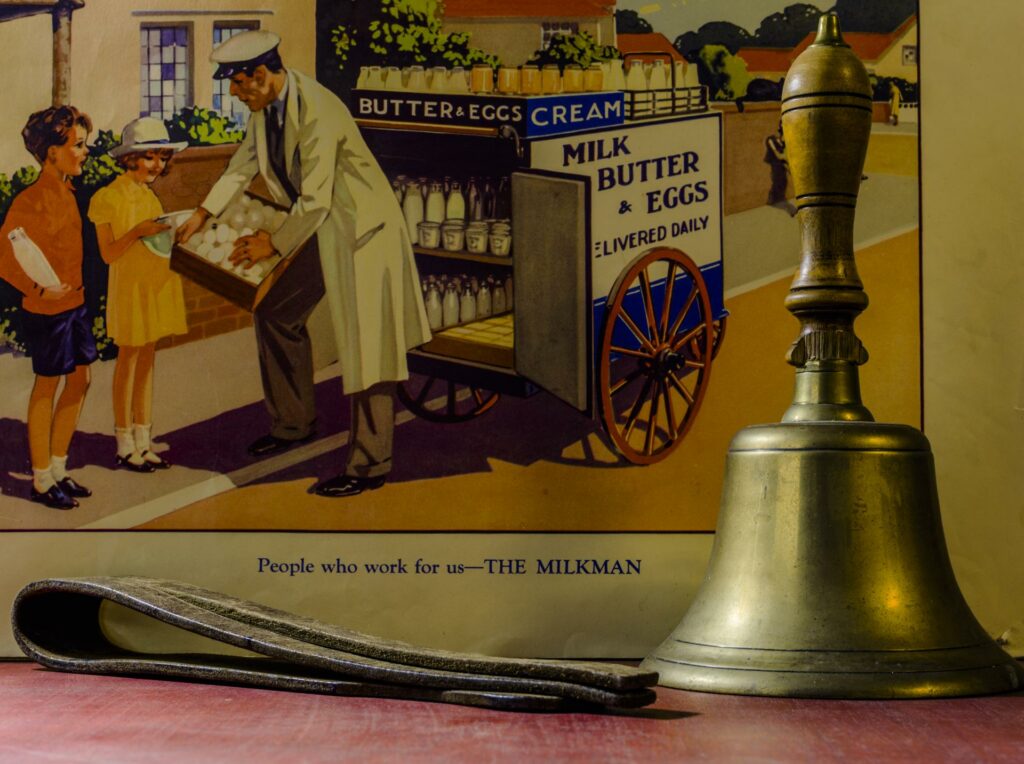
Shown here are some of the teaching aids used by Ailsa during her time as a teacher – the belt or ‘Lochgelly’ strap used to control unruly pupils, until banned by the European Court of Human Rights in 1982, the school bell, which was a simple hand bell, cracked through use and repaired with solder, and a poster from the 1930s, one of a complete set of 84, showing scenes from daily life from the local to the international. With an interest in the history of teaching, she also had a box of Cuisenaire rods, developed by the educational specialist Georges Cuisenaire and used for teaching mathematics in the 1950s as well as a good selection of hobby and crafting books.
When Croftamie Primary School closed and the remaining pupils were transferred to Drymen, Ailsa Stirling wrote a complete history of the school, 1907 – 1997, which is part of the record
NB: Photo by Forth Valley College student volunteer Alan Gardiner
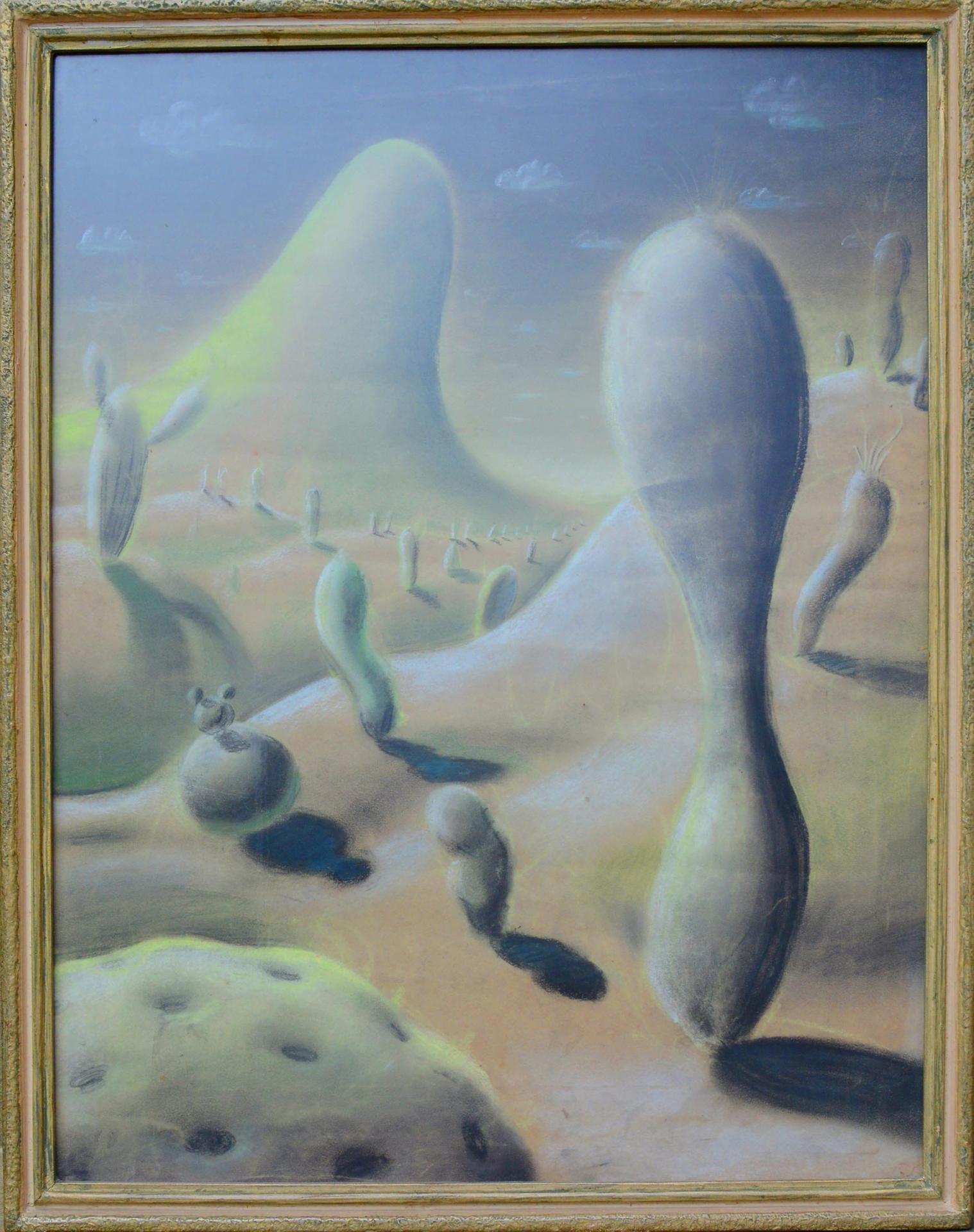 This is one of two paintings in the Stirling Smith collections by the eminent film maker Norman McLaren (1914 – 1987). McLaren was born in the house which faces the Smith and as a film maker, was internationally known through his work for the National Film Board of Canada and other agencies.
The cactus painting is one of 15 paintings and objects which caught the eye of Stirling Makar Clive Wright. Working with composers Tom David Wilson of the Royal Conservatoire, and Kostas Rekleitis, as well as the Smith’s poet in residence John Coutts, Clive Wright has written a Song Cycle for the Smith’s collections. It was be performed at the Smith on Wednesday 5 April 2017. Norman McLaren would have been delighted to hear the composition inspired by his painting, as he always believed in the power of one art form to inspire another.
Other objects celebrated in song are Thomas Stuart Smith’s Pipe of Freedom, the whale bones cast up on the Carse of Stirling by the tsunami 8000 years ago, a calthrop from the Battle of Bannockburn, the World’s Oldest Football and the wonderful carved oak chest from Cowane’s Hospital.
NB: Photo by Forth Valley College student volunteer Alan Gardiner
Yesterday was a monumental day for the Stirling Smith, when the new bronze portrait of King Robert the Bruce is unveiled by his descendant Lord Bruce. The portrait combines the research of Andrew Nelson, Professor of Anthropology of Western University, Ontario, with the work of forensic sculptor Christian Corbet, Sculptor in Residence at the Royal Canadian Navy. Together they have concluded that King Robert was never a victim of leprosy, laying to rest a pernicious 700-year old rumour. The evidence came from the close study of a cast of Bruce’s skull.
It was from the same cast that the sculptor Pilkington Jackson created his portrait of Bruce for the statue at Bannockburn, in 1960-1964. It is a little-known fact that the Bannockburn statue was made possible through funding from Canadian lawyer and philanthropist Eric L. Harvie. The bargain struck was that an identical statue of Bruce was provided for the grounds of the Alberta College of Art and Design, Calgary, Canada.
Canadian philanthropy is in the forefront again in celebrating the memory of King Robert, as the bronze is the gift of the sculptor Christian Corbet to Scotland and to Stirling, where it will star in the collections of the Stirling Smith. Corbet has helped change the course of Scottish history with this remarkable work.
Today we look back 30 years, to the time when nurses could be immediately identified by their uniform and badges. This photograph is one of a small collection gifted to the Stirling Smith, together with nursing badges. Nurse Sloan wears the green cap band of the State Enrolled Nurse and the purple and green Stirling Wolf badge of Stirling Royal Infirmary when she qualified in 1985.
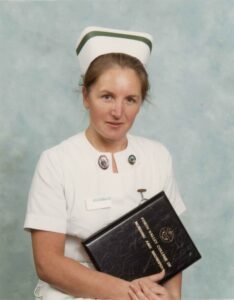
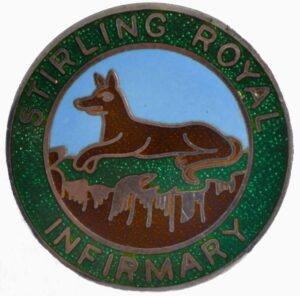
Jean Sloan joined the forces as a Royal Alexandra Nursing Student. As she did not complete her training, she later had to start from the beginning at Callander Park’s Forth Valley College. She worked in the Operating Theatre after qualifying, so rarely had the pleasure of wearing her badges at work, all of which are as new.
Nursing has changed radically in the past few decades. In the army, nurses had to stand ‘at ease’ until the consultant had done his rounds. By contrast, life in one of SRI’s gynaecology wards was so informal, that a monkey was brought in from the Safari Park in 1989 to cheer up the patients.
Nursing has always been a profession demanding strength and dedication. Nurse Sloan contributed a professional article to the Nursing Standard and was on duty when the Dunblane Tragedy struck 21 years ago.