


Further Meanderings of the Mind from Poet, Anne B Murray
In our last exhibition, Meanders, we asked people to share their memories of the lockdown with us. Local poet, Anne B Murray sent in her reminisces of the first lockdown, and now has reflected on the latest lockdown.
At Lockdown 2 [November 23rd – December 13th 2020], I started to wilt a bit. The days were becoming shorter, colder; it rained a lot. I went out walking most days but for much shorter spells of time.
Lockdown 3 [26th December 2020 to date], my spirits sink. All aspects of life seem bleak. All pastimes – jigsaws, crochet, crosswords, reading, even writing, seem utterly pointless and just as boring as doing nothing. The weather doesn’t lend itself to long walks. And anyway, I’ve lost my sense of adventure; I don’t care to try any new route. A round of Beechwood Park, stopping to say hello to Roman Maximus, the sculpted wooden bench-end; perhaps a short stretch of Kings Park or the trail along the St Ninian’s Road into town for shopping. On that last option, I stare in amazement at people buying takeaway coffees. To drink walking along the street on a cold, miserable day?
However, they were giving the local traders custom, so I joined the queue one day. First stop Cisco’s – great coffee and delicious choice of traybakes. I’m wrapped up well, have my sit-mat, and go to the Black Boy Fountain. I imagine I’m in the lounge of the Ritz Hotel in the 1930s, in Art Deco surroundings, being served by dapper waiters. Everyone else, myself included, wearing the fabulously stylish clothes, hats, shoes and jewellery of the time. Have I been watching too much Poirot on TV?
Another jaunt is a coffee and date slice from the Groundhouse at the top of King Street. From there I walk along Victoria Wood Avenue behind the Albert Hall to sit in Ailie’s Garden at the Stirling Smith Art Gallery. There I’m transported to somewhere in Africa – as a lowly assistant on a David Attenborough trip – the main event spotting (from the safety of my carved wooden bench Landrover), a crocodile rising from the mosaic pond, opening its jaws, baring its pointed teeth before settling back down again. My stillness – one has to be really still in the presence of crocodiles – encouraging the real robins, tits, goldfinch, sparrows and wagtails to come and feed close by. One can never get enough of Life on Earth.
Or am I going crazy? February 2021
How is everyone doing? Are you feeling similar to Anne? The Smith Team is busy behind the scenes but very much looking forward to the day we can open our doors again. We’re grateful that the weather has slightly improved and hope that means we’ll have more visitors to our garden again!
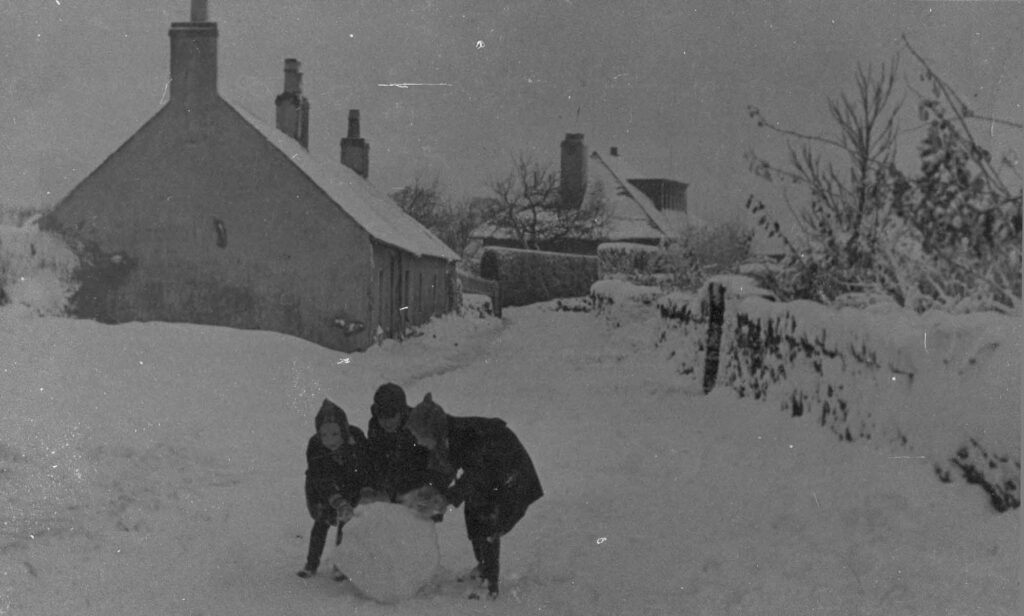
John Coutts, Poet-in-Residence at the Stirling Smith Art Gallery & Museum is collecting winter poems to share as an online poetry roundabout.
What is your favourite winter activity? What Makes winter special? What clothing, food, weather, or animals make you think of winter?
Tell us in your poem. Rhyming poems, raps, picture poems, haikus, alphabet poems, free verse, and acrostic poems are all welcome.
Send your poems along with your name, age, and school to johnjcoutts@gmail.com
Deadline for submission 14 December 2020
 The Poetry Roundabout
OCTOBER 2020
‘Season of mists and mellow fruitfulness.’
John Keats – Ode to Autumn
Edited by John Coutts, Poet in Residence
First on the Roundabout this month is a poem by Staff Nurse Dawn Martinez of Strathcarron Hospice. The Day Care Centre is closed, but it keeps in touch with its guests – including Heather and me – in many interesting ways. Recently our mailing included the following – a good example of a poem specially composed in order to share comfort and bring blessing.
Day Care
If you could come to Daycare
We would welcome you
with open arms, a cuppa and a biscuit [or two].
We want you to know, we miss you so much,
We are sending you this handmade heart
[a personal touch]
So put the kettle on and have a brew
And know that we are all thinking of you.
Colin Gregory writes: No autumn mists here in Lincolnshire yet, but I’m sure they will come before long. The hedgerows are laden with hawthorn berries, rose hips and sloes. The last few months have given us an opportunity to witness the changing of the seasons in ways we have not experienced before; it is one of the few blessings of the crisis. I did think of Keats for your October Roundabout, but instead I’ve chosen a poem about a different cycle: the ebb and flow of tides – of the sea and of humanity – and the constancy of love.
Dover Beach by Matthew Arnold
The sea is calm tonight.
The tide is full, the moon lies fair
Upon the straits; on the French coast the light
Gleams and is gone; the cliffs of England stand,
Glimmering and vast, out in the tranquil bay.
Come to the window, sweet is the night-air!
Only, from the long line of spray
Where the sea meets the moon-blanched land,
Listen! you hear the grating roar
Of pebbles which the waves draw back, and fling,
At their return, up the high strand,
Begin, and cease, and then again begin,
With tremulous cadence slow, and bring
The eternal note of sadness in.
Sophocles long ago
Heard it on the Ægean, and it brought
Into his mind the turbid ebb and flow
Of human misery; we
Find also in the sound a thought,
Hearing it by this distant northern sea.
The Sea of Faith
Was once, too, at the full, and round earth’s shore
Lay like the folds of a bright girdle furled.
But now I only hear
Its melancholy, long, withdrawing roar,
Retreating, to the breath
Of the night-wind, down the vast edges drear
And naked shingles of the world.
Ah, love, let us be true
To one another! for the world, which seems
To lie before us like a land of dreams,
So various, so beautiful, so new,
Hath really neither joy, nor love, nor light,
Nor certitude, nor peace, nor help for pain;
And we are here as on a darkling plain
Swept with confused alarms of struggle and flight,
Where ignorant armies clash by night.
Jock Stein sends a poem which takes a different view. He writes: ‘I have chosen it because it reminds us that although creation is torn, with or without Covid 19, yet God has not deserted it. And it’s nice to find a contemporary poem which curates form so skilfully.’
Every Riven Thing by Christian Wiman
God goes, belonging to every riven thing he’s made
sing his being simply by being
the thing it is:
stone and tree and sky,
man who sees and sings and wonders why
God goes. Belonging, to every riven thing he’s made,
means a storm of peace.
think of the atoms inside the stone.
think of the man who sits alone
trying to will himself into a stillness where
God goes belonging. To every riven thing he’s made
there is given one shade
shaped exactly to the thing itself:
under the tree a darker tree;
under the man the only man to see
God goes belonging to every riven thing. He’s made
the things that bring him near,
made the mind that makes him go.
A part of what man knows,
apart from what man knows,
God goes belonging to every riven thing he’s made.
©Christian Wiman. From Every Riven Thing, Farrar, Straus and Giroux, New York 2010.
And now a new poem – by Anne Clarke
Stone
I lift time’s capsule from the windowsill.
Millennia of tumbling in the great churns
of earth, air, water, fire
have shaped its rough lines to near-perfect oval.
I lay it to my cheek. Cold as the bones
of some forgotten lizard-ancestor,
it fits my palm, its weight
a constant surprise.
Helen McLaren writes: I came across this when looking for something else. Seems like politicians never change even if the topics they argue about do.
Similes for Two Political Characters Of 1819 by Percy Bysshe Shelley
As from an ancestral oak
Two empty ravens sound their clarion,
Yell by yell, and croak by croak,
When they scent the noonday smoke
Of fresh human carrion:–
As two gibbering night-birds flit
From their bowers of deadly yew
Through the night to frighten it,
When the moon is in a fit,
And the stars are none, or few:–
As a shark and dog-fish wait
Under an Atlantic isle,
For the negro-ship, whose freight
Is the theme of their debate,
Wrinkling their red gills the while:–
Are ye, two vultures sick for battle,
Two scorpions under one wet stone,
Two bloodless wolves whose dry throats rattle,
Two crows perched on the murrained cattle,
Two vipers tangled into one.
John Coutts asks; was this composed before or after the Peterloo Massacre of the same year? One source identifies the targets as ‘S-D’ (Sidmouth?) and ‘O-G’ (Castlereagh?)
Heather Carroll, Exhibitions & Events Officer at the Smith: According to Marcus Wood, author of The Poetry of Slavery: An Anglo-American Anthology, 1764-1865, Shelley wrote this after Peterloo. It was one of his two surviving poems decrying the Trans-Atlantic slave trade and Sidmouth and Castlereagh’s participation in it.
In response to our reminder
‘October 9th! Recall the date!
Beware the dreaded cry: too late!’
Jeffrey Kemp writes: Remember the date … would I forget ..? My poem suggests that is entirely possible
Memory Gain
Out
on a limbo walk.
Quickly scribble
first impressions,
date and turn the page.
The notebook later
falling open to show
a forgotten event and
question my disconnected self –
what, then, had prompted these
indecipherable words now?
Two adults,
both me, evidently
linked to the child
stranded in fragments
of memory who
who sat, bewildered
as chalk squawked
across a blackboard
to form … A … B …
… forcing him, us, me to see
how impressions could
be snared into letters,
then released to forge a link
such a recent walk that
brought a message
definitely forgettable.
I’m left no wiser but
stymied by this tying of ends
to inconclusions
giving rough allusions
of things that seemed
momentous at the time.
Maybe you had to be there.
Then again, maybe you were.
I clearly can’t remember.
Here’s a classic from the seventeenth century
‘When I consider how my light is spent’ Sonnet 19: By John Milton
When I consider how my light is spent,
Ere half my days, in this dark world and wide,
And that one Talent which is death to hide
Lodged with me useless, though my Soul more bent
To serve therewith my Maker, and present
My true account, lest he returning chide;
“Doth God exact day-labour, light denied?”
I fondly ask. But patience, to prevent
That murmur, soon replies, “God doth not need
Either man’s work or his own gifts; who best
Bear his mild yoke, they serve him best. His state
Is Kingly. Thousands at his bidding speed
And post o’er Land and Ocean without rest:
They also serve who only stand and wait
John Coutts writes: The above takes us to the next poem. I asked Anne Murray to pick a poem by Edwin Muir. She replies: ‘Of the poems you suggested, I think my favourite is Milton. I think the first four lines of the second half of the sonnet are both timeless and of our time, and I love the optimism in the final couplet. It is also such a beautifully crafted sonnet.’
Milton
Milton, his face set fair for Paradise,
And knowing that he and Paradise were lost
In separate desolation, bravely crossed
Into his second night and paid his price.
There, towards the end, he to the dark tower came
Set square at the gate, a mass of blackened stone
Crowned with vermilion streams like streamers blown
From a great funnel filled with roaring flame.
Shut in his darkness, these he could not see,
But heard the steely clamour known too well
On Saturday nights in every street in hell.
Where, past the devilish din, could Paradise be?
A footstep more, and his unblended eyes
Saw far and near the fields of Paradise.
Edwin Muir: Collected Poems. p.207
John Coutts writes: ‘I composed ‘William Booth at Mile End Waste’ many years ago. In imitation of Muir’s ‘Milton’.The ‘foundation myth’ of The Salvation Army is that the Founder and future first General, William Booth, ‘stood alone’ to preach the gospel on Mile End Waste in East London in 1865. As always, the true story is ‘more complicated than that’. But ‘foundation myths’ include grains of truth.
When William came at last to Mile End Waste
He saw the grey world sliding to and fro
Like aimless rubbish on the indifferent tide.
And then he heard the dry and evil chuckle
That once beset the Son of Man in person.
“Why waste your time? No saviour died for them.
Bundles of rags redeemed in cheapest gin.
My flock you know. Poor devils lost already.”
Damning despair, he tossed his mane and cried
“Give Lucifer a song – a gospel song.”
“Jesus, the name high over all” – at once
The Missioners were bobbing in a mob
Of drunks and drabs and precious souls in torment,
Swarmed from the lurid gas-lit hells around.
“Hurrah” cried William. As the battle brewed
He saw Christ’s blood stream in the firmament,
Flaunted before King Satan and his hosts.
Loudly he roared against the assembled fiends
That gripped each pauper by the throat, and perched
On twisted shoulders wrapped in tattered shawls.
“ ‘Angels and men before him fall’ – now, Grandma,
Tell ‘em your saved… ‘and devils fear and fly.’
Come to the tent at seven. It’s warm inside.”
Then thudding raindrops washed the crowd away,
And William, plodding through the sodden slum,
Saw Christ’s compassion streaming in the gutters,
And dirty cobbles drenched in Holy Ghost.
David Dalziel writes ‘I ve recently looked at Robert Frost’s poem and come across an article pointing out that ‘the road less travelled by is not really less travelled at all.’ This, for me, casts a new light on the poem, stressing the equality of the roads as in verse three. So what is the poet really saying to us?’
Two roads diverged…
Two roads diverged in a yellow wood,
And sorry I could not travel both
And be one traveler, long I stood
And looked down one as far as I could
To where it bent in the undergrowth;
Then took the other, as just as fair,
And having perhaps the better claim,
Because it was grassy and wanted wear;
Though as for that the passing there
Had worn them really about the same,
And both that morning equally lay
In leaves no step had trodden black.
Oh, I kept the first for another day!
Yet knowing how way leads on to way,
I doubted if I should ever come back.
I shall be telling this with a sigh
Somewhere ages and ages hence:
Two roads diverged in a wood, and I—
I took the one less travelled by,
And that has made all the difference.
ENDPIECE
In November the Roundabout will continue online but also meet live on
ZOOM!
Cry ’ No’ to doom and gloom!
Sign up for ZOOM!*
Promote the poetry boom!
[No need to hide behind a nom de plume]
Let verses bud and bloom,
For cyberspace has unrestricted room
For poems old and new, which – I assume –
Others will joyfully consume
When shared aloud online, till better times resume.
[composed with the help of The Penguin Rhyming Dictionary]
*by emailing Anne Murray on murrayanne579@gmail.com
The proposed date is Nov. 6th at 11 a.m.
Poetry Roundabout
August 2020
Edited by John Coutts, Poet in Residence
If all the pens that ever poets held
Had fed the feeling of their master’s thoughts,
And every sweetness that inspir’d their hearts,
Their minds, and muses on admired themes;
If all the heavenly quintessence they still
From their immortal flowers of poesy,
Wherein, as in a mirror, we perceive
The highest reaches of a human wit;
If these had made one poem’s period,
And all combin’d in beauty’s worthiness,
Yet should there hover in their restiless minds
One thought, one grace, one wonder, at the least,
Which into words no virtue can digest
Christopher Marlowe; from ‘Tamburlaine the Great’ [1587]
Austin Halliday On his final day at St Mary’s Primary School, Bannockburn.
Thank you, Mrs. O’Hanlon, for being the best teacher yet
You are one of the best teachers I will never forget.
You kept everyone happy and the whole school in place
With an instantly recognisable face.
Mrs. Benton you were the best P7 teacher I could ever hope for.
Every day with you was never a bore.
You gave fun and exciting work and everyone a smile,
So, thanks for making P7 worthwhile.
Thank you all the helpers for helping around the school.
You were kind and helpful and were never cruel.
You always tried to help people no matter what happened.
All the hard days over – you can now get to nappin’.
Thank you all the teachers for teaching all the things
Bouncing on the chance to teach – like a spring.
You taught all the things we will carry on for ever.
All the brain cells used, you just seem so clever.
A final thanks to all from Mrs. Strathie to Mr.Ivatt
You helped me from P1 [when I was kind of shy and quiet]
Everyone joined in and really pulled together
To make St .Mary’s Primary School the BEST school ever.
Reprinted from The Stirling Observer
Thanks Austin. John Coutts writes: When I was in in the Infants Class at Primary School- which is a long time ago, I liked most of the teachers but I was scared of Mr. Strickland, because the big boys told us he was ‘very strict’ and that we would catch it when we got in his class. I never got into his class and I think he probably wasn’t strict at all. But he sounded strict and he did look rather strict. Here is my poem about. ’A Strict Teacher’
Mr Strickland is ever so strict
He chooses the team; so I won’t be picked.
Mr. Strickland doesn’t like a din.
Mr. Strickland keeps you in.
Mr Strickland doesn’t like a noise.
That’ s why he SHOUTS at the girls and the boys.
Mr. S. has a big green door
Half way up to the second floor:
Hop, skip, jump and I go past,
Round the corner ever so fast.
Don’t look backwards – if you do
Mr. STRICT will be after you.
Don’t be daft! Of course I know.
Half his class have told me so.
Everybody says that Strickland’s strict.
So don’t you dare to CONTRADICT!
JS Munro writes: In 1994-5 (another life!) my wife and I spent a year teaching at a Chinese university in Chengdu, and on revisiting our Chinese files recently, I found a poem I’d written at the time after a visit to a local post office. I give part of it here, together with some of my present day reflections on the experience, which I have to say remains very vivid with me still.
Chengdu Poem
Chengdu, Sichuan province, 1994
At the Jinjiang post office I wanted
to buy three airmail letters.
The woman behind the counter was reading.
‘Duibuqi’, I said: excuse me.
She looked up, immediately identifying
the foreigner, the outsider.
Carefully I trotted out my prepared sentence,
my tongue stumbling a little on the unfamiliar sounds,
and wondering all the time if the tones were right:
‘Wo xiang yao san zhang hangkong xin.’
With mouth and eyes she smiled
as you would to a child,
and said something I couldn’t catch.
But I thought I heard
the word ‘Zhongwen’: Chinese language.
It may even have been a compliment;
at the very least, it seemed to be meant as an encouragement.
Then, to my inexpressible delight
she pushed over the counter
the three airmail envelopes I’d asked for,
and I came back out into the street
immeasurably enriched.
And now (Scotland 2020)
I ask myself if this is what it is to be loved:
a sense of Other as a vast unexplored hinterland
which Self can only glimpse from afar,
and yet from that distance, a smile
and a hand stretched out to give?
Helen McLaren writes: This follows on from last month’s offering about Gaelic songs and old languages.
The Eagle by Matthew Sweeney
My father is writing in Irish.
The English language, with all its facts
will not do. It is too modern.
It is good for plane-crashes, for unemployment,
but not for the unexplained return
of the eagle to Donegal.
He describes the settled pair
in their eyrie on the not-so-high mountain.
He uses an archaic Irish
to describe what used to be, what is again,
though hunters are reluctant
to agree on what will be.
He’s coined a new word
for vigilantes who keep a camera watch
on the foothills. He joins them
when he’s not writing, and when he is.
He writes about giant eggs,
about a whole new strain.
He brings in folklore
and folk-prophecy. He brings in the date
when the last golden eagle
was glimpsed there. The research is new
and dodgy, but the praise
is as old as the eagle.
Janet Richardson writes:I found a poem worth sharing in book titled “The Swallow, The Owl & The Sandpiper” compiled by Claire Maitland for The Sandpiper Trust which includes a poem sent by Her Majesty, The Queen, to The Sandpiper Trust, 18th September 2008.
The Gate of the Year by Minnie Louise Haskins
I said to the man who stood at the gate of the year
‘Give me a light that I may tread safely into the unknown.’
And he replied,
‘Go into the darkness and put your hand into the hand of God.
That shall be to you better than light and safer than a known way!”
This poem was quoted in full by King George VI in his Christmas broadcast in 1939. J.C.
Anne Clarke writes: I’ve always loved this poem, John Agard’s ‘Listen Mr Oxford Don’, which makes what is essentially a political point with great humour. I thought it might raise a smile and at the same time be appropriate in connection with Black Lives Matter.
Listen Mr Oxford Don
John Agard
Me not no Oxford don
me a simple immigrant
from Clapham Common
I didn’t graduate
I immigrate
But listen Mr Oxford don
I’m a man on de run
and a man on de run
is a dangerous one
I ent have no gun
I ent have no knife
but mugging de Queen’s English
is the story of my life
I don’t need no axe
to split/ up yu syntax
I don’t need no hammer
to mash/ up yu grammar
I warning you Mr. Oxford don
I’m a wanted man
and a wanted man
is a dangerous one
Dem accuse me of assault
on de Oxford dictionary/
imagine a concise peaceful man like me/
dem want me to serve time
for inciting rhyme to riot
but I tekking it quiet
down here in Clapham Common
I’m not violent man Mr. Oxford don
I only armed wit mih human breath
but human breath
is a dangerous weapon
So mek dem send one big word after me
I ent serving no jail sentence
I slashing suffix in self-defence
I bashing future wit present tense
and if necessary
I making de Queen’s English accessory/ to my offence
Jock Stein writes: I have continued to write poems on books from the Old Testament megillot or scrolls. Here is one which matches one of our contemporary concerns.
Black and Beautiful
‘I am black and beautiful,
O daughters of Jerusalem…’ [Song of Songs 1:5]
A colour to dance upon prejudice,
stamp on a passport to pride,
clasp in the strong, safe muscles of conviction
that the human brush
is painting some respect
on the world’s white canvas.
Colin Gregory writes: I wanted to choose something by a Scottish poet. I usually visit Scotland in May (as well as August) and was sad to miss my trip this year. I thought of George Mackay Brown, whom I first got to know through settings by Peter Maxwell Davies. I have chosen his poem The Poet (used on the London Underground as one of the Poems on the Underground). He speaks of the poet putting on a mask and “moving among the folk”, which seems apt for our times.
The Poet George Mackay Brown
Therefore he no more troubled the pool of silence
But put on mask and cloak,
Strung a guitar
and moved among the folk.
Dancing they cried,
‘Ah, how our sober islands
Are gay again, since this blind lyrical tramp
Invaded the Fair!’
Under the last dead lamp
When all the dancers and masks had gone inside
His cold stare
Returned to its true task, interrogation of silence.
Jeffrey Kemp writes: The Federation of Writers webpage mentions your wish for unleashing “the power of positive poetical thinking”: I am submitting a poem titled “Blandness Is Better Shared.”
Can’t say fairer …
Blandness Is Better Shared
With Spotify,
I discover obscure musicians
less interesting than many
I dismissed decades ago.
I’d stop growing
a virtual library if
my earlier high standards
hadn’t fallen
but critical faculties fade
as age makes
hearing anything
a victory of sorts.
Teenage hopes
of gaining instrumental mastery
by osmosis (listening,
giggling, lying on the floor)
dissipated long before
the internet gave
direct debit access to music
ranging from mediocre to poor.
Now in my dotage,
I know the danger
of equating achievement
with laziness
but nonetheless buy off
my better judgement
for a tenner
each month,
thus compelling me
to find the
truly dreadful,
intriguingly innovative.
With such denial,
disharmony
becomes
harmonious.
Sue Sexton writes: I have been looking after our daughter’s cat and it made me think of this poem which is I think not well known. All cat lovers will understand why it’s a weepy!
The Lost Cat by EV Rieu
She took a last and simple meal when there were none to see her steal –
A jug of cream upon the shelf, a fish prepared for dinner;
And now she walks a distant street with delicately sandalled feet,
And no one gives her much to eat or weeps to see her thinner.
O my beloved come again, come back in joy, come back in pain,
To end our searching with a mew, or with a purr our grieving;
And you shall have for lunch or tea whatever fish swim in the sea
And all the cream that’s meant for me – and not a word of thieving!
David Dalziel writes: I’ve just been editing and putting together some of Albert Orsborn’s work and I do like pages 123 and 124 of ‘The House of My Pilgrimage’ which contain the following.
There’s a light in mine eyes,
Just for you;
Never it shines in the throng.
Not even mine intimate
Friends get a glimpse of it.
Yet, when I look in your eyes,
Watch, and that light will arise.
There’s a touch of my hand,
Just for you;
One that comes through from the heart,
When it comes home to me,
That you belong to me;
That you are mine to possess,
Mine to defend and caress.
There’s a tone in my voice,
Just for you;
Tones are the music of speech¬
When the whole soul of me
Wakes into melody,
Deep, like a far-sounding bell,
Love sounds the note! Can you tell?
There’s a surge of my heart,
Just for you.
Oh, what a wild thing is this!
Insistent, desperate,
Something to regulate!
Yea, it were best for our bliss,
Life were not always like this!
Might this have been a love letter to his wife, or is it someone else’s work?
[Albert Orsborn, poet and songwriter, was General of The Salvation Army from 1946-1954. ‘The House of my Pilgrimage’‘ is his autobiography]
Epilogue
Christopher Marlowe gives high praise to poetry
‘Wherein, as in a mirror, we perceive
The highest reaches of a human wit.’
Now let’s hear the opposite view – and there’s no need to take it personally.
Attributed to Kings George II and George I
‘I hate all boets and bainters’
Also recorded as
‘I hate painting and poetry too.’
An epigram by Ponce Denis Ecouchard Lebrun [ 1729 – 1809 ]
‘On vient de me voler!‘
Que je plains ton malheur!
Tous me vers manuscrits!
‘Que je plains le voleur.’
‘I’ve just been robbed. I’ve lost the lot.’
‘Dear friend I share your grief.’
‘’They’ve taken all my poems, not
Yet published!’
‘Wretched thief.’
trs. J.C.
Poetry Roundabout
July 2020
Edited by John Coutts, Poet in Residence
‘The lunatic, the lover and the poet
Are of imagination all compact…
The poet’s eye, in fine frenzy rolling,
Doth glance from heaven to earth, from earth to heaven,
And as imagination bodies forth
The forms of things unknown, the poet’s pen
Turns them to shapes and gives to airy nothing
A local habitation and a name.’
Yet another varied collection of insights, information, inspiration and entertainment! A big ‘thank you’ to all our contributors!
Tony Crowther writes: I love birds and Scotland. To imagine a better future … is simple, relaxing and resonates and inspires me.
On an Eagle’s Wing
Carried away
on a golden eagle’s wing
Soaring over isles, lochs and bens,
my spirit sings
From imagination hope springs
At a time of statue-toppling, Ian McNeish recommends
Ozymandias of Egypt by P.B.Shelley
I met a traveller from an antique land
who said: Two vast and trunkless legs of stone
stand in the desert. Near them on the sand
half sunk, a shatter’d visage lies, whose frown
and wrinkled lip and sneer of cold command
tell that its sculptor well those passions read
which yet survive, stamped on these lifeless things,
the hand that mock’d them and the heart that fed:
And on the pedestal these words appear:
“My name is Ozymandias, king of kings:
Look on my works, ye Mighty, and despair!”
Nothing beside remains. Round the decay
of that colossal wreck, boundless and bare,
the lone and level sands stretch far away.
Agnes Fanning recommends ‘Lord Ullin’s Daughter’ by Thomas Campbell,
and adds: ‘There’s also a lovely version of the poem put to music, read by Jude Law’
A Chieftain to the Highlands bound,
Cries, ‘Boatman, do not tarry;
And I’ll give thee a silver pound
To row us o’er the ferry.’
‘Now who be ye would cross Lochgyle,
This dark and stormy water?’
‘Oh! I’m the chief of Ulva’s isle,
And this Lord Ullin’s daughter.
‘And fast before her father’s men
Three days we’ve fled together,
For should he find us in the glen,
My blood would stain the heather.
‘His horsemen hard behind us ride;
Should they our steps discover,
Then who will cheer my bonny bride
When they have slain her lover?’
Outspoke the hardy Highland wight:
‘I’ll go, my chief – I’m ready:
It is not for your silver bright,
But for your winsome lady.
By this the storm grew loud apace,
The water-wraith was shrieking;
And in the scowl of heaven each face
Grew dark as they were speaking.
But still, as wilder blew the wind,
And as the night grew drearer,
Adown the glen rode armed men-
Their trampling sounded nearer.
‘Oh! Haste thee, haste!’ the lady cries,
‘Though tempests round us gather;
I’ll meet the raging of the skies,
But not an angry father.’
The boat has left a stormy land,
A stormy sea before her-
When oh! Too strong for human hand,
The tempest gathered o’er her.
And still they rowed amidst the roar
Of waters fast prevailing;
Lord Ullin reach’d that fatal shore-
His wrath was chang’d to wailing.
For sore dismay’d, through storm and shade,
His child he did discover;
One lovely hand she stretch’d for aid,
And one was round her lover.
‘Come back! Come back!’ he cried in grief,
‘Across this stormy water;
And I’ll forgive your Highland chief,
My daughter!- oh, my daughter!’
‘Twas vain: the loud waves lash’d the shore,
Return or aid preventing;
The waters wild went o’er his child,
And he was left lamenting.
John Coutts adds: Ulva was sadly depopulated by the Clearances. The island has recently been the subject of a Community buyout.
Helen McLaren writes
One of the advantages of lockdown has been the opportunity to revisit books I haven’t picked up for years. I bought my copy of Iain Crichton Smith’s ‘Selected Poems’ at a reading he did at the St Magnus Festival in Orkney. This was, and still is, one of my favourites.
Gaelic Songs
by Iain Crichton Smith
I listen to these songs
from a city studio.
They belong to a different country,
to a barer sky,
to a district of heather and stone.
They belong to the sailors
who kept their course
through nostalgia and moonlight.
They belong to the maidens
who carried the milk in pails
home in the twilight.
They belong to the barking of dogs,
to the midnight of stars,
to the sea’s terrible force,
exile past the equator.
They belong to the sparse grass,
to the wrinkled faces,
to the houses sunk in the valleys,
to the mirrors
brought home from the fishing.
Now they are made of crystal
taking just a moment
between two programmes
elbowing them fiercely
between two darknesses.
John Coutts writes: I’ve been visiting our local park – standing below the Wallace monument. On one occasion I was too preoccupied to notice anything, until….This poem attempts to convey one of those ‘beyond words’ experiences.
To a birch tree
During the coronavirus lockdown
You stood still. I passed you by
Unaware of grass or sky.
Pestering thoughts beset my brain
[Same obsessions, same old pain]
Grumbles buzzing in my head….
Then – but how? – you stopped me dead.
No, not dead – but wide aware,
Free to catch my breath and stare.
Breezes stirred; your branches quivered.
Greenest leaves awoke and shivered,
Shielding tapered trunk and silvery bark…
Time also held its breath and granted me
Sight of perfection in a mortal tree.
[Just one of several in our little park]
Becalmed in joy I stood, but then
Time began to stir again.
Why not stand and watch forever?
Hovering commonsense said ‘Never.
‘Off you go: return to duty.
Share your glimpse of hidden beauty.’
Briefly blessed, I made my way
Through the park to everyday;
But not so weary as before,
Locked in self-concern no more.
Jock Stein writes: I have been writing a book called ‘From Ruth to Lamentations’, and have got as far as the book of Job. The attached is one of the poems about that book. It deals with the three cycles of speeches made by Job’s three supposed friends, ending in lockdown for Job.
Cycling (Job 4 – 26)
Lockdown takes me round the block
of Job, for exercise;
I ride and think, I think and ride,
my thoughts go round and round.
1
How wise the words of Eliphaz,
how sharp the crit of Bildad;
clear the answer Zophar gives
to Job, down on the ground.
A vision comes to Eliphaz,
a poem to his friend,
elenchus to the third, Zophar,
to keep Job on the ground.
2
‘You’re just a windbag, Job my friend,
God punishes the wicked.
Pay attention to the wise,
we speak from hallowed ground.
This virus that has knocked you down
is what all sin deserves;
it eats the skin, it shrivels up
the roots beneath the ground.’
3
‘God is on high, beyond the clouds,
so make your prayer to him;
agree with God, and be at peace,
he’ll raise you off the ground.
It’s up to you, Job, take our word:
repent, and turn to God.
If not, you maggot of a man,
you’ll stay down, and be ground.’
. . . . . . . . . . .
Locked down in the book of Job,
his friends have turned the key,
and left him pleading innocence
all through three cruel rounds.
From Clive Wright: Here is … a very small offering. It was written (alas, inevitably) when I was on a cruise – and is ideally delivered in a corny Devon accent!
To catch sharks and great whales on his mission
‘Twas Ezekiel Jones’s ambition.
When he caught but a sprat
– Alas, that was that.
He is planning a new expedition.
John Coutts adds two ‘post-modern’ limericks.
There was a young bard of Japan
Who wrote verses that no one could scan.
When they told him ‘twas so,
He replied ‘Yes, I know,’
I always try to get as many words into the last line as I possibly can.
There was an old man of Tralee
Who was horribly stung by a wasp.
When they said, ‘Did it hurt?’
He replied, ‘ Not at all!
It can do it again if it likes.’
If this great world of joy and pain…’ by William Wordsworth, Poems of Sentiment and Reflection
Colin Gregory writes: This poem has special significance because I used it as part of a pageant I directed for the Millennium. The drama group I belong to started off by presenting large scale outdoor pageants, the first in 1910. For the Millennium we decided to revive one. It will be the 20th anniversary of the final performance on Wednesday (8th July). The original had a huge cast; we managed 100, with 60 children, which was quite an undertaking. I chose the Wordsworth poem to be sung at the end (I composed the tune): it seemed to me to encompass our need to treat one another and the earth better.
‘If this great world of joy and pain
Revolve in one sure track;
If freedom, set, will rise again,
And virtue, flown, come back;
Woe to the purblind crew who fill
The heart with each day’s care;
Nor gain, from past or future, skill
To bear, and to forbear!’
On the edge of extinction
Today 7,000 languages are spoken. Fully half are expected to die out before the year 2100, continuing a centuries-long trend.
‘Dahwdezeldiin’ koht’aene kenaege’,
ukesdezt’aet.
Yaane’ koht’aene yaen’,
nekenaege’ nadahdelna.
Koht’aene kenaege’ k’os nadestaan.’
(I am beginning to write in our language,
but it is difficult.
Only the elders speak our words,
and they are forgetting.
There are not many words anyhow.
They are scattered like clouds.)
John Elvis Smelcer, writing in Ahtna language, Alaska.
Poems from the Edge of Extinction: An Anthology of Poetry in Endangered Languages, edited by Chris McCabe, is published by Chambers.
‘Share[s] folklore, songs and a richness of world views with a vivacity that heightens their collective call to protect the planet’s linguistic, and cultural, ecosystem.’ Financial Times
And Gaelic is included as one of the endangered languages! J.C
James Coutts is learning Polish – he has translated Ośla łączka, [‘The donkey’s meadow’] by Tadeusz Dąbrowski
Ośla łączka
When I write this poem, it gets smaller
When I approach the mountains they get smaller and disappear behind the flat and quiet hills
When I read the mountains I am speechless at the view.
The best poems finish in the middle.
‘The donkey’s meadow: a popular name for a very easy ski slope, with a very small slope and short length, intended for children and beginner skiers.’
Tadeusz Dąbrowski (born 1979) is a Polish poet, essayist, and critic. He is also the editor of the literary bimonthly Topos and the art director of the European Poet of Freedom Festival.’ [from Wikipedia]
Anne Murray writes: Many of the poems of R.S. Thomas I find helpful and reassuring in times of doubt and distress. This poem is no exception, as far as the sentiment of it goes. It is also a beautifully crafted piece – the layout, line endings and stanza breaks are all just perfect. I hope others will like it too
Moorland
It is beautiful and still;
the air rarefied
as the interior of a cathedral
expecting a presence. It is where, also,
the harrier occurs,
materialising from nothing, snow-
soft, but with claws of fire,
quartering the bare earth
for the prey that escapes it;
hovering over the incipient
scream, here a moment, then
not here, like my belief in God.
And to conclude [almost]
Roger Clarke writes The Greek poet Callimachus famously declared: Mega biblion mega kakon – ‘Big book, big bane’. The Russian poet Pushkin, too, favoured brevity. He wrote:
CONCISION
In wordiness I’m glad to own myself deficient;
in weighty lexicons no benefit I see.
To bring true happiness – dear comrades, trust in me –
all words may be too few, but one may be sufficient.
(translated by Roger Clarke)
A final thought from JC –
‘…And as imagination bodies forth
The forms of things unknown, the poet’s pen
Turns them to shapes and gives to airy nothing
A local habitation and a name.’
Do poets always deal in ‘airy nothing’, or do they sometimes help us to glimpse ultimate reality?
If you would like to contribute to the next PoetryRoundabout, send your chosen poem – your own work or a favourite to johnjcoutts@gmail.com by Friday August 7th.
Poetry Roundabout
June 2020
Leaving Lockdown (?) Edition
Edited by John Coutts, Poet in Residence
‘…Fair Quiet, have I found thee here,
And Innocence, thy sister dear!
Mistaken long, I sought you then
In busy companies of men;
Your sacred plants, if here below,
Only among the plants will grow.
Society is all but rude,
To this delicious solitude.’
From ‘The Garden’, by Andrew Marvell (1621-1678)
We have a really good mix of poems this time, including translations from the classics and up-to-date responses to the current lockdown. A big ‘thank-you’ to all our contributors.
My Mind to me a Kingdom Is
Sir Edward Dyer
No one claimed the prize – coffee-and cake – for identifying our headline quotation in the May edition. It is the work of Sir Edward Dyer. (1543-1697) Not many of his poems have survived, though he has been credited with the authorship of Shakespeare. Here is the entire poem – you can hear it, set to music by William Byrd, and sung by Emma Kirkby here.
My mind to me a kingdom is;
Such perfect joy therein I find
That it excels all other bliss
That world affords or grows by kind.
Though much I want which most men have,
Yet still my mind forbids to crave.
No princely pomp, no wealthy store,
No force to win the victory,
No wily wit to salve a sore,
No shape to feed each gazing eye;
To none of these I yield as thrall.
For why my mind doth serve for all.
I see how plenty suffers oft,
How hasty climbers soon do fall;
I see that those that are aloft
Mishap doth threaten most of all;
They get with toil, they keep with fear.
Such cares my mind could never bear.
Content I live, this is my stay;
I seek no more than may suffice;
I press to bear no haughty sway;
Look what I lack my mind supplies;
Lo, thus I triumph like a king,
Content with that my mind doth bring.
Some have too much, yet still do crave;
I little have, and seek no more.
They are but poor, though much they have,
And I am rich with little store.
They poor, I rich; they beg, I give;
They lack, I leave; they pine, I live.
I laugh not at another’s loss;
I grudge not at another’s gain;
No worldly waves my mind can toss;
My state at one doth still remain.
I fear no foe, nor fawning friend;
I loathe not life, nor dread my end.
Some weigh their pleasure by their lust,
Their wisdom by their rage of will,
Their treasure is their only trust;
And cloaked craft their store of skill.
But all the pleasure that I find
Is to maintain a quiet mind.
My wealth is health and perfect ease;
My conscience clear my chief defense;
I neither seek by bribes to please,
Nor by deceit to breed offense.
Thus do I live, thus will I die.
Would all did so as well as I!
Margaret Hay writes from New Zealand, ‘Thanks for May Roundabout’.
I missed the June 5 cut-off date
But send warm thanks at any rate
For May’s respite from lockdown gloom
And no requirement to Zoom.
Our toon has the seed shop you describe,
And Solovyov’s pure joy to imbibe,
‘The strong sun of love shines for aye’.
A quickening thought on a winter’s day.
Much thanks to all at Roundabout.
New Zealand calling — over and out.
Lockdown is Ending
By Eugene Lubbock
[Eugene’s school in London is reopening, but not for him]
Lockdown is ending,
The R number’s falling,
Yet I still feel
That life is a bore.
The days are all blending
The schoolwork’s unending
My mood is appalling
The internet’s stalling
Getting up in the morning
Is terribly boring.
When Isolation Ends
Roger Clarke writes
Between 1824 and 1826 the Russian poet Pushkin lived in isolation under house arrest (political rather than medical quarantine) on his family’s remote country estate. Like many of us he greatly missed the company of friends. When eventually one attractive young ladyfriend managed to visit him he celebrated the break from isolation with the following
[To Anna Kern]
I well recall a wondrous meeting,
the moment we came face to face –
you, like a vision all too fleeting,
pure spirit of exquisite grace.
Later, in torpor and depression,
in uproar, fuss, fatuity,
I’d catch that voice’s soft expression,
dream of those features dear to me.
Time passed. The storms of fierce repression
dispersed those dreams of yesteryear,
drove from my mind your soft expression,
your heavenly features I’d held dear.
In exile’s dismal isolation
my days dragged by in misery –
no goddesses, no inspiration,
no tears, no life, no love for me!
Now night has passed, despair’s retreating:
once more we’re meeting face to face –
you, like a vision still too fleeting,
pure spirit of exquisite grace!
My heart now throbs in exaltation,
exhilarated to attain
its goddess and its inspiration
its tears, its life, its love again.
A.S. Pushkin (1825) Translated from the Russian by Roger Clarke from Alexander Pushkin: Love Poems, Alma Classics (2016)
Agnes Fanning writes,
I’ve chosen this poem by Florbela Espanca because currently, and always, the world could do with more love. Florbela Espanca (1894-1930), was a Portuguese poet known for her feminist writing.
Amar!
Eu quero amar, amar perdidamente!
Amar só por amar: Aqui… além…
Mais Este e Aquele, o Outro e toda a gente…
Amar! Amar! E não amar ninguém!……
TO LOVE!
(Translation by Austen Hyde)
I want to love – love madly!
Love just to love – here… there… and beyond…
Him over there, and him right there, and everybody…
Love! Love! And not love anyone!….
Thanks, Agnes. I hadn’t heard of her, but now I’ve learnt a lot about her from the internet. I enjoyed listening to the entire poem here -JC
In Memory of Tessa Ransford
Founder of the Scottish Poetry Library
John Coutts writes: Poets and Poetry lovers owe Tessa a huge debt.
‘Farewell too little and too lately known.’ [John Dryden]
‘To mercy, pity peace and love
All pray in their distress’ [William Blake]
Farewell, too little and too lately known.
We met at Scottish PEN
[The group that fights
For persecuted writers Human Rights]
And there and then
You roped me in to run the Peace Committee:
A post I graced with dribs and drabs of Pity,
Mercy, Peace and Love for several years.
Tessa, forgive the flippant tone
Which only grief excuses.
Defensive irony with good intent
Beats bogus tears.
For you have raised a double monument,
Building a high-tech Temple of the Muses –
A shrine of sacred speech in silent stone,
Where hidden hoards of poems clamour to be heard,
Lurking in print, alive in spoken word.
Old William Blake was bold to say
That each of us, in dire distress
Can find surprising strength to pray
‘To mercy, pity, peace and love’. I doubt
If this true of ‘all of us’- or me;
But, sure as hell, it was of you,
Who lived the life of love that sets us free,
Spiced with a flavour that was yours alone.
You blessed me, Tessa. Yes – and still you bless.
Goodbye – so late, yet well and truly known.
Your Dad did What? Sophie Hannah
Catriona Duncan writes The poem is from Leaving and Leaving You (Carcanet Press 1999) by author Sophie Hannah. To read the entire piece (it’s worth it! J.C.) visit the author’s website.
Where have they been if they have been away.
Or what they’ve done at home, if they have not –
You make them write about the holiday.
One writes My Dad did, What? Your dad did what? ….
John Coutts writes: Here’s another tale of misunderstanding in the classroom. Jack was a quiet lad, adrift and too often unnoticed, in a class of teenage tearaways.
He cannae read!
I catch a glimpse of teenage Jack.
He sits bewildered at the back.
He does exactly what he’s told.
Wears the school tie, in red and gold
I’ll start again. More haste, less speed.
But he cannae read.
He cannae read!
I write it up. He takes it down.
His fist is clenched. He wears a frown.
His pencil breaks: I lend him mine.
The work is done. The book looks fine.
But, sir, he says – those eyes do plead!
‘Ah cannae read!
He cannae read!
It’s true. The words don’t mean a thing.
I’m glad you told me. Why not…sing….
Or draw…or act…record a tape?
The bell says ‘Stop!’ The boys escape.
And if at first you don’t succeed….
But… he cannae read.
Sappho
One girl to another
Roger Clarke writes
Despite her fame, few of Sappho’s poems survive, and few of these are complete. This is one of these few. What is striking about the poem, despite its age and the obscurity of its Aeolic dialect, is its simplicity and directness: once the language itself is mastered, the feelings of the poet come through with an immediacy that is unimpeded by any barriers of time or culture. The poem also teases with the ambiguity of its triangular situation: of the couple the poet watches is it the man or the woman that attract her more powerfully? Is she jealous of her, or him?
I have translated the poem into a metre that exactly replicates the original: unrhymed stanzas in the Sapphic metre, with the brief fourth lines of each stanza giving a sense of the breathlessness and faintness experienced by the poet.
Quite divine! Yes, that’s how he seems to me – that
man I mean, the one that sits facing you there,
leaning forward, listening to your delightful
voice as you’re speaking
and to that bright laughter of yours; it’s really
set the heartbeat pounding within my breast; for
when I glimpse you, or when I hear you calling,
I am left helpless:
frozen stiff and mute is my tongue, but subtly
underneath my skin there’s a fire now raging;
I can see no more with my eyes; a humming
deafens my eardrums;
streams of sweat pour down me; and all my body
trembles uncontrollably, and I go more
pale than dry grass. Dead, very nearly dead – yes
that’s how I feel now…
Anne Murray writes
My two poems for this month’s Roundabout. are from a lovely book called ‘The Lost Words’ which is a celebration in poetry of the 20 words that have been dropped from the Oxford English Children’s Dictionary. They are all words from Nature. The poems are all acrostics and the book is written and beautifully illustrated with children in mind, but I believe appeals to adults too. The poet is Robert MacFarlane and the illustrator Jackie Morris.
Ivy
I am ivy, a real high-flier.
Via bark and stone I scale tree and spire.
You call me ground-cover; I say sky-wire.
Kingfisher
Kingfisher: the colour-giver, fire-bringer, flame-flicker,
river’s quiver.
Ink-black bill, orange throat, and a quick blue
back-gleaming feather-stream.
Neat and still it sits on the snag of a stick, until with . . .
Gold-flare, wing-fan, whipcrack the kingfisher –
zingfisher, singfisher! –
Flashes down too fast to follow, quick and quicker
carves its hollow
In the water, slings its arrow superswift to swallow
Stickleback or shrimp or minnow.
Halcyon is its other name – also ripple-calmer,
water-nester,
Evening angler, weather-teller, rainbringer and
Rainbow bird – that sets the stream alight with burn
and glitter!
Domestique
by Kitty Fitzgerald
Helen Mclaren writes This is a poem from a pamphlet of poems for the Tour de France cycle race. I particularly like the first verse as it describes how I cycle, with one eye on what’s around me, an ear open for bird song, and always happy to stop for something interesting. During lockdown I’ve done a lot of cycling locally and have seen much of interest on my travels.
Cycling the Coquet, three geared sit-up-and-beg,
when state-of-the-art racers whizz by, heads down,
arses up. I’m an anachronism, enjoying the view,
complex blue of the sky, breath caught in my throat.
The sweep of the valley, the soaring falcons,
a kind of adulation at my victory….
The entire poem is to be found in ‘Tour de Vers’, poems for the Tour de France edited by Andy Jackson and published by Red Squirrel Press.
Lockdown
by Michaela Burns
Michaela writes: I wrote a poem and wanted it to be real on the impact that lockdown is not only having on me but, I am sure, on many others too… I hope that my poems may reach others, so that people can relate and realise that they are not alone.
They say lockdown
May have three weeks to go
Sometimes it feels like
It is going so slow
I understand the reasons
And the importance of being safe
But I don’t know if I can take it
Being tied up in this place
It feels like torture
Being stuck in my own head
Experiencing feelings
Of complete and utter dread
Running out of ways
To keep myself busy
Its grinding me down
Feels like I’m going crazy
Emotions are high
The loneliness is real
Struggling to make
Even one simple meal
I sit here and cry
Is it really to much
To long for a hug
Just a loving touch
Flacon
Jock Stein introduces an old friend.
It has sat there,
nodding acquaintance
while a library
took shape around it
– more than a little
drunk, that stopper,
like Stephen’s crown
in Hungary, bent
with the vicissitudes
of European history.
It still sits there
empty, without
the swirl of perfume
in its glassy body,
scent which might
have shared a neck
with pearls or diamonds,
eavesdropped sweetly
on the blossoming
of European history.
It will sit there
on the shelf,
a quiet creature,
lost in a world
of books and china,
knowing its shape
is out of kilter,
hoping to survive
the breaking up
of European history.
POSTSCRIPT
John Coutts writes: The last word – like the first – comes from Andrew Marvell’s ‘Garden’. He seeks peace at Nunappleton, home of the Lord General Sir Thomas Fairfax, in or after the brutal lockdown of the civil wars
… Meanwhile the mind, from pleasure less,
Withdraws into its happiness;
The mind, that ocean where each kind
Does straight its own resemblance find,
Yet it creates, transcending these,
Far other worlds, and other seas;
Annihilating all that’s made
To a green thought in a green shade.
We have had to cut some poems from this Roundabout; for the full Poetry Roundabout for June please email John at johnjcoutts@gmail.com.
Deadline for next month’s Roundabout – Monday , July 5th